
• Skip to main content
  • Skip to secondary menu
  • Skip to primary sidebar
  • Skip to secondary sidebar
  • Skip to footer

  • Opinion
  • Health IT
    • Behavioral Health
    • Care Coordination
    • EMR/EHR
    • Interoperability
    • Patient Engagement
    • Population Health Management
    • Revenue Cycle Management
    • Social Determinants of Health
  • Digital Health
    • AI
    • Blockchain
    • Precision Medicine
    • Telehealth
    • Wearables
  • Life Sciences
  • Investments
  • M&A
  • Value-based Care
    • Accountable Care (ACOs)
    • Medicare Advantage

The “Platform” Squeeze: Epic Releases Native AI Charting, Putting Venture-Backed Scribes on Notice

by Fred Pennic 02/05/2026 Leave a Comment

  • LinkedIn
  • Twitter
  • Facebook
  • Email
  • Print
The "Platform" Squeeze: Epic Releases Native AI Charting, Putting Venture-Backed Scribes on Notice

What You Should Know

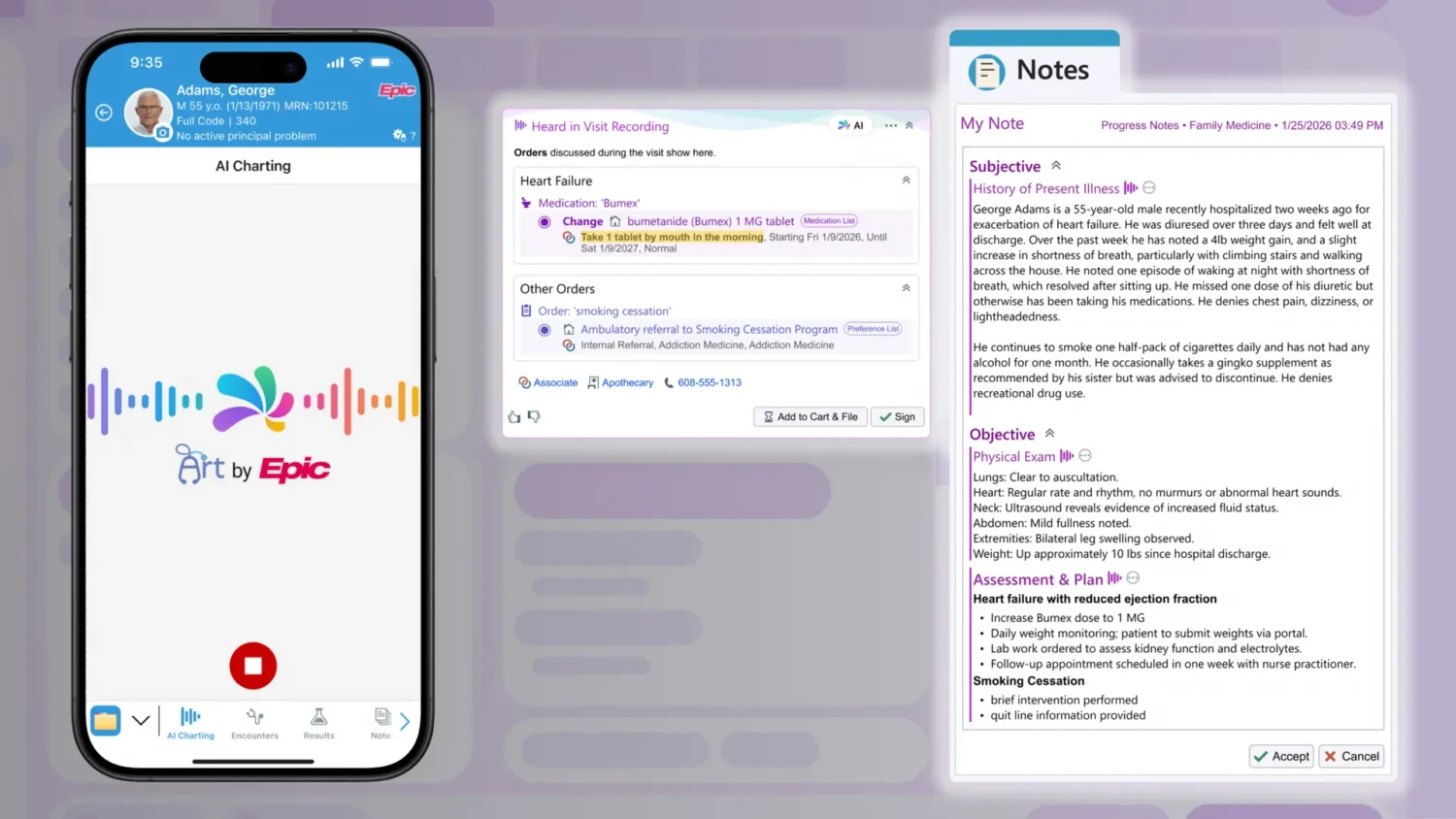
  • The Launch: Epic has officially released AI Charting, a native feature that listens to patient visits and automatically drafts notes and orders. This is part of a broader suite called Art (for clinicians), Penny (for revenue cycle), and Emmie (for patients).
  • The Integration: Unlike third-party tools that require separate logins or data bridges, Epic’s AI is “built-in.” It draws context from the entire medical record to draft notes and allows clinicians to format them via voice commands (e.g., “Make this a bulleted list”).
  • The Market Shakeout: This move creates an existential threat for standalone “point solutions” like Abridge, Ambience, and Nabla. With Epic offering a “good enough” native alternative that is likely cheaper and safer for IT teams, health systems may pause or cancel contracts with external vendors.

The “Native” Advantage

The pitch for Epic’s AI Charting is integration. Third-party scribes often exist as a “sidecar”—an app running on a phone or a separate window. They can be brilliant, but they are ultimately guests in the house.

Epic’s solution is the house. Because it is native, AI Charting draws from the patient’s entire historical record to inform the note. It allows clinicians to use voice commands to structure data instantly (“format the history of present illness as a bulleted list”) and, crucially, it queues up orders. This “listening-to-action” workflow is much harder for third-party tools to execute safely without deep, expensive integrations.

“Feedback has been very positive, and we’re iterating quickly based on what clinicians tell us works best,” said Corey Miller, Vice President of R&D at Epic.

Ambient AI Market Implications

In the tech world, to be “Sherlocked” is to have Apple release a free feature that destroys your paid app business. Epic may be doing the same to the ambient AI market.

For CIOs and Health System leaders, the focus has just shifted:

  1. Cost: Why pay for a separate ambient AI contract (often costing millions) if you already pay Epic for a similar capability?
  2. Security: Native tools eliminate the need to send patient audio to a third-party cloud, reducing the cybersecurity surface area.
  3. Simplicity: One less vendor means one less contract to manage.

This puts immense pressure on standalone players like Abridge and Ambience. To survive, they must prove that their AI is not just marginally better than Epic’s, but radically better—capable of handling complex specialties or offering workflow magic that Epic’s generalist tool cannot match.

Beyond the Scribe: Penny and Emmie

Epic’s announcement wasn’t limited to the exam room. The company is deploying a “full stack” AI strategy:

  • Penny (Operations): Automates revenue cycle tasks. Over 200 organizations are using Penny to automate coding, seeing a 20% reduction in denials.
  • Emmie (Patients): A conversational AI for MyChart that helps patients pay bills and schedule appointments, escalating to humans only when necessary.

  • LinkedIn
  • Twitter
  • Facebook
  • Email
  • Print

Tagged With: Artificial Intelligence, Epic Systems

Tap Native

Get in-depth healthcare technology analysis and commentary delivered straight to your email weekly

Reader Interactions

Primary Sidebar

Subscribe to HIT Consultant

Latest insightful articles delivered straight to your inbox weekly.

Submit a Tip or Pitch

Featured Research Report

2026 Best in KLAS Awards: The Full List of Software & Services Winners

2026 Predictions & Trends

Healthcare 2026 Forecast: Executives on AI Survival, Financial Reckoning, and the End of Point Solutions

2026 Healthcare Executive Predictions: Why the AI “Pilot Era” Is Officially Over

Most-Read

The "Platform" Squeeze: Epic Releases Native AI Charting, Putting Venture-Backed Scribes on Notice

The “Platform” Squeeze: Epic Releases Native AI Charting, Putting Venture-Backed Scribes on Notice

Analysis: Oracle Cerner’s Plans for a National EHR

Oracle May Cut 30k Jobs and Sell Cerner to Fund $156B OpenAI Deal

The $1.9B Exit: Why CommonSpirit is Insourcing Revenue Cycle and Tenet is Betting Big on Conifer AI

The $1.9B Exit: Why CommonSpirit is Insourcing Revenue Cycle and Tenet is Betting Big on Conifer AI

KLAS 2026 Rankings: Aledade and Guidehealth Named Top VBC Enablement Firms

KLAS 2026 Rankings: Aledade and Guidehealth Named Top VBC Enablement Firms

Beyond the Hype: New KLAS Data Validates the Financial and Clinical ROI of Ambient AI

Beyond the Hype: New KLAS Data Validates the Financial and Clinical ROI of Ambient AI

Anthropic Debuts ‘Claude for Healthcare’ and Opus 4.5 to Engineer the Future of Life Sciences

Anthropic Debuts ‘Claude for Healthcare’ and Opus 4.5 to Engineer the Future of Life Sciences

OpenAI Debuts ChatGPT Health: A ‘Digital Front Door’ That Connects Medical Records to Agentic AI

OpenAI Debuts ChatGPT Health: A ‘Digital Front Door’ That Connects Medical Records to Agentic AI

From Genes to Hackers: The Hidden Cybersecurity Risks in Life Sciences

From Genes to Hackers: The Hidden Cybersecurity Risks in Life Sciences

Utah Becomes First State to Approve AI System for Prescription Renewals

Utah Becomes First State to Approve AI System for Prescription Renewals

NYC Health + Hospitals to Acquire Maimonides in $2.2B Safety Net Overhaul

NYC Health + Hospitals to Acquire Maimonides in $2.2B Safety Net Overhaul

Secondary Sidebar

Footer

Company

  • About Us
  • 2026 Editorial Calendar
  • Advertise with Us
  • Reprints and Permissions
  • Op-Ed Submission Guidelines
  • Contact
  • Subscribe

Editorial Coverage

  • Opinion
  • Health IT
    • Care Coordination
    • EMR/EHR
    • Interoperability
    • Population Health Management
    • Revenue Cycle Management
  • Digital Health
    • Artificial Intelligence
    • Blockchain Tech
    • Precision Medicine
    • Telehealth
    • Wearables
  • Startups
  • Value-Based Care
    • Accountable Care
    • Medicare Advantage

Connect

Subscribe to HIT Consultant Media

Latest insightful articles delivered straight to your inbox weekly

Copyright © 2026. HIT Consultant Media. All Rights Reserved. Privacy Policy |