
• Skip to main content
  • Skip to secondary menu
  • Skip to primary sidebar
  • Skip to secondary sidebar
  • Skip to footer

  • Opinion
  • Health IT
    • Behavioral Health
    • Care Coordination
    • EMR/EHR
    • Interoperability
    • Patient Engagement
    • Population Health Management
    • Revenue Cycle Management
    • Social Determinants of Health
  • Digital Health
    • AI
    • Blockchain
    • Precision Medicine
    • Telehealth
    • Wearables
  • Life Sciences
  • Investments
  • M&A
  • Value-based Care
    • Accountable Care (ACOs)
    • Medicare Advantage

McKinsey Report: The Rise of Health Services Technology (HST) in a Decade of Strain

by Fred Pennic 01/16/2026 Leave a Comment

  • LinkedIn
  • Twitter
  • Facebook
  • Email
  • Print

What You Should Know

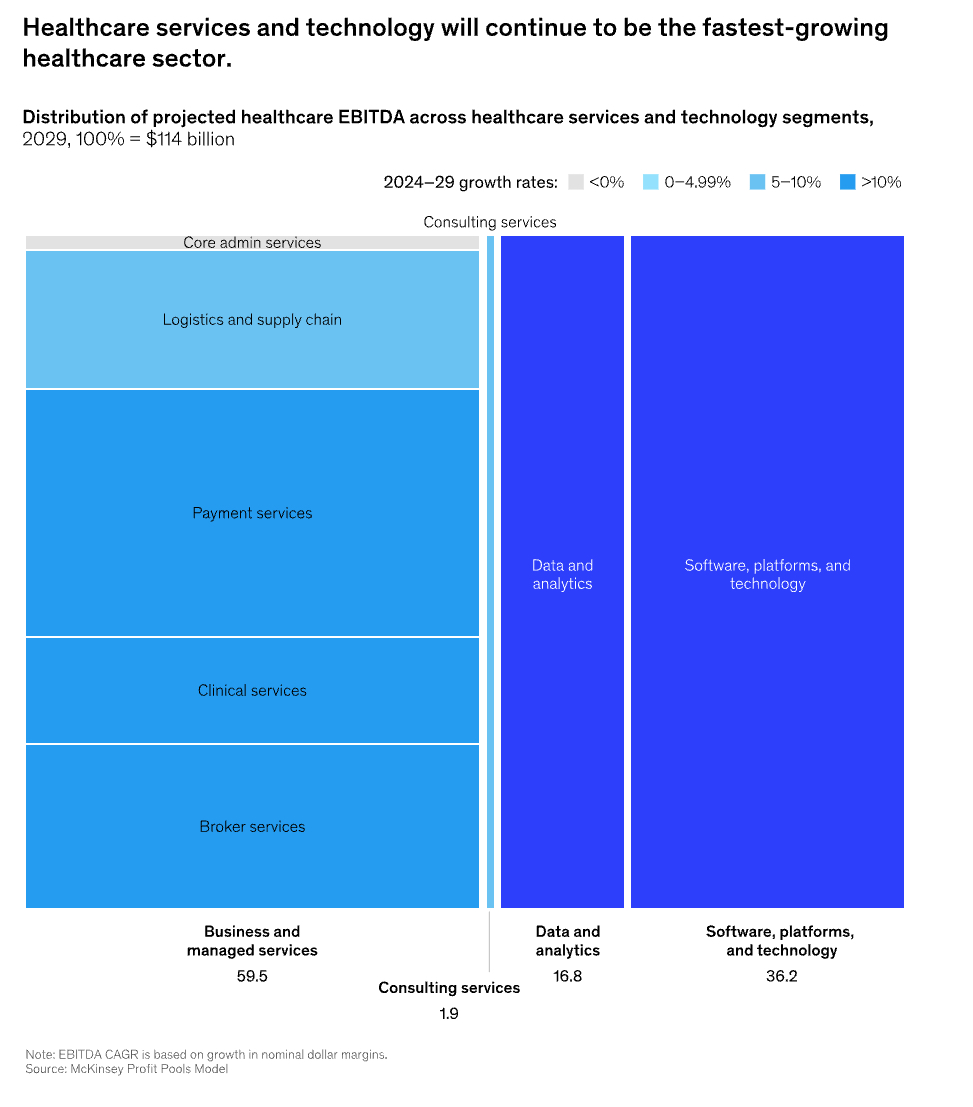
– A new McKinsey & Company report reveals that Health Services Technology (HST) has become the fastest-growing segment in U.S. healthcare, with EBITDA projected to exceed $110B by 2029.

– As traditional payers and providers face a “prolonged strain” on margins, they are decisively shifting investment toward AI-enabled automation and outsourcing to solve structural labor shortages and administrative complexity.

Uneven Recovery Period in Healthcare

The U.S. healthcare industry is entering a period of “uneven recovery,” where the traditional powerhouses—hospitals and insurers—are seeing their share of the profit pool shrink relative to the technology companies that serve them. According to McKinsey’s 2026 Healthcare Profit Pools report, industry EBITDA as a share of National Health Expenditure fell from 11.2% in 2019 to 8.9% in 2024.

While the macro outlook is somber, HST is the outlier, projected to grow at 9% annually through 2029. This isn’t just a trend; it’s a structural migration of value from labor-intensive services to software and analytics.

The Gen AI “Tipping Point”: From Pilot to Production

We have officially moved past the “vaporware” phase of Generative AI. The data shows a massive acceleration in adoption:

  • 85% of healthcare organizations are currently implementing Gen AI solutions.
  • Over 10% of U.S. physicians are already using AI-powered ambient documentation tools (e.g., medical scribing).
  • Workflow Automation: The shift is most pronounced in “workflow-heavy” areas like automated claims management and real-time data connectivity, where the ROI is immediately measurable.

Segment Breakdown: Winners and Losers through 2029

The report illustrates a decisive shift in where money is made in the ecosystem.

  • Providers: Facing a “fragile recovery” until 2027. Hospitals are battling a spike in uncompensated care risk as Medicaid disenrollment continues. The bright spot? Non-acute care (Ambulatory Surgery Centers, Home Health, and Hospice) continues to outperform traditional inpatient settings.
  • Payers: Group commercial insurance is emerging as the “critical stabilizer,” expected to account for 36% of total payer profits by 2029 as disenrolled Medicaid members move to employer-sponsored plans.
  • Pharmacy: Reshaped by the “GLP-1 Effect.” These drugs accounted for half of the 11% growth in drug spending in 2024. Total drug spend is on a path to reach $1 trillion by 2029.

The Efficiency Trap

For decades, I’ve heard that “tech will save us” from rising costs. McKinsey’s data suggests that for the first time, the pressure is high enough—and the tech (AI) is mature enough—that the shift is actually happening. However, a word of caution to the C-Suite: as you move from “labor-intensive” to “software-intensive” models, the competitive advantage lies not in owning the AI, but in the integration. The vendors who can connect fragmented data silos will win; those selling isolated “point solutions” will likely be consolidated into larger platforms.

3 Key Takeaways for Healthcare Leaders

For a CEO or CFO, this report confirms that HST is no longer a back-office expense; it is a core growth strategy. 

1. Prioritize Outsourcing: Scale efficiencies are becoming impossible to achieve in-house for mid-sized players. 

2. Double Down on ASCs and Home Health: The “site-of-care” shift is permanent and accelerating. 

3. Audit your AI Roadmap: If you aren’t among the 85% implementing Gen AI, you are already behind the competitive curve.

  • LinkedIn
  • Twitter
  • Facebook
  • Email
  • Print

Tap Native

Get in-depth healthcare technology analysis and commentary delivered straight to your email weekly

Reader Interactions

Primary Sidebar

Subscribe to HIT Consultant

Latest insightful articles delivered straight to your inbox weekly.

Submit a Tip or Pitch

2026 Predictions & Trends

Healthcare 2026 Forecast: Executives on AI Survival, Financial Reckoning, and the End of Point Solutions

2026 Healthcare Executive Predictions: Why the AI “Pilot Era” Is Officially Over

Featured Research Report

Digital Health Funding Hits $14.2B in 2025: A Year of AI Exuberance and Market Bifurcation

Most-Read

Trump Unveils 'The Great Healthcare Plan': A Global Price-Matching Pivot to Settle the Affordability Crisis

Price Reset 2026: How Trump’s ‘Great Healthcare Plan’ Slashes Drug Costs at Trumprx.gov

Anthropic Debuts ‘Claude for Healthcare’ and Opus 4.5 to Engineer the Future of Life Sciences

Anthropic Debuts ‘Claude for Healthcare’ and Opus 4.5 to Engineer the Future of Life Sciences

OpenAI Debuts ChatGPT Health: A ‘Digital Front Door’ That Connects Medical Records to Agentic AI

OpenAI Debuts ChatGPT Health: A ‘Digital Front Door’ That Connects Medical Records to Agentic AI

From Genes to Hackers: The Hidden Cybersecurity Risks in Life Sciences

From Genes to Hackers: The Hidden Cybersecurity Risks in Life Sciences

Utah Becomes First State to Approve AI System for Prescription Renewals

Utah Becomes First State to Approve AI System for Prescription Renewals

NYC Health + Hospitals to Acquire Maimonides in $2.2B Safety Net Overhaul

NYC Health + Hospitals to Acquire Maimonides in $2.2B Safety Net Overhaul

KLAS Report: Why Hospitals Are Choosing Efficiency Over 'Agentic' AI Hype in 2025

KLAS Report: Why Hospitals Are Choosing Efficiency Over ‘Agentic’ AI Hype in 2025

Advanced Primary Care 2026: Top 6 Investments for Health Systems According to Harvard Medical School

Advanced Primary Care 2026: Top 6 Investments for Health Systems According to Harvard Medical School

AI Nutrition Labels: The Key to Provider Adoption and Patient Trust?

AI Nutrition Labels: The Key to Provider Adoption and Patient Trust?

Kristen Hartsell, VP of Clinical Services, RedSail Technologies

The Pharmacy Closures Crisis: How Independent Pharmacies Are Fixing Pharmacy Deserts

Secondary Sidebar

Footer

Company

  • About Us
  • 2026 Editorial Calendar
  • Advertise with Us
  • Reprints and Permissions
  • Op-Ed Submission Guidelines
  • Contact
  • Subscribe

Editorial Coverage

  • Opinion
  • Health IT
    • Care Coordination
    • EMR/EHR
    • Interoperability
    • Population Health Management
    • Revenue Cycle Management
  • Digital Health
    • Artificial Intelligence
    • Blockchain Tech
    • Precision Medicine
    • Telehealth
    • Wearables
  • Startups
  • Value-Based Care
    • Accountable Care
    • Medicare Advantage

Connect

Subscribe to HIT Consultant Media

Latest insightful articles delivered straight to your inbox weekly

Copyright © 2026. HIT Consultant Media. All Rights Reserved. Privacy Policy |