
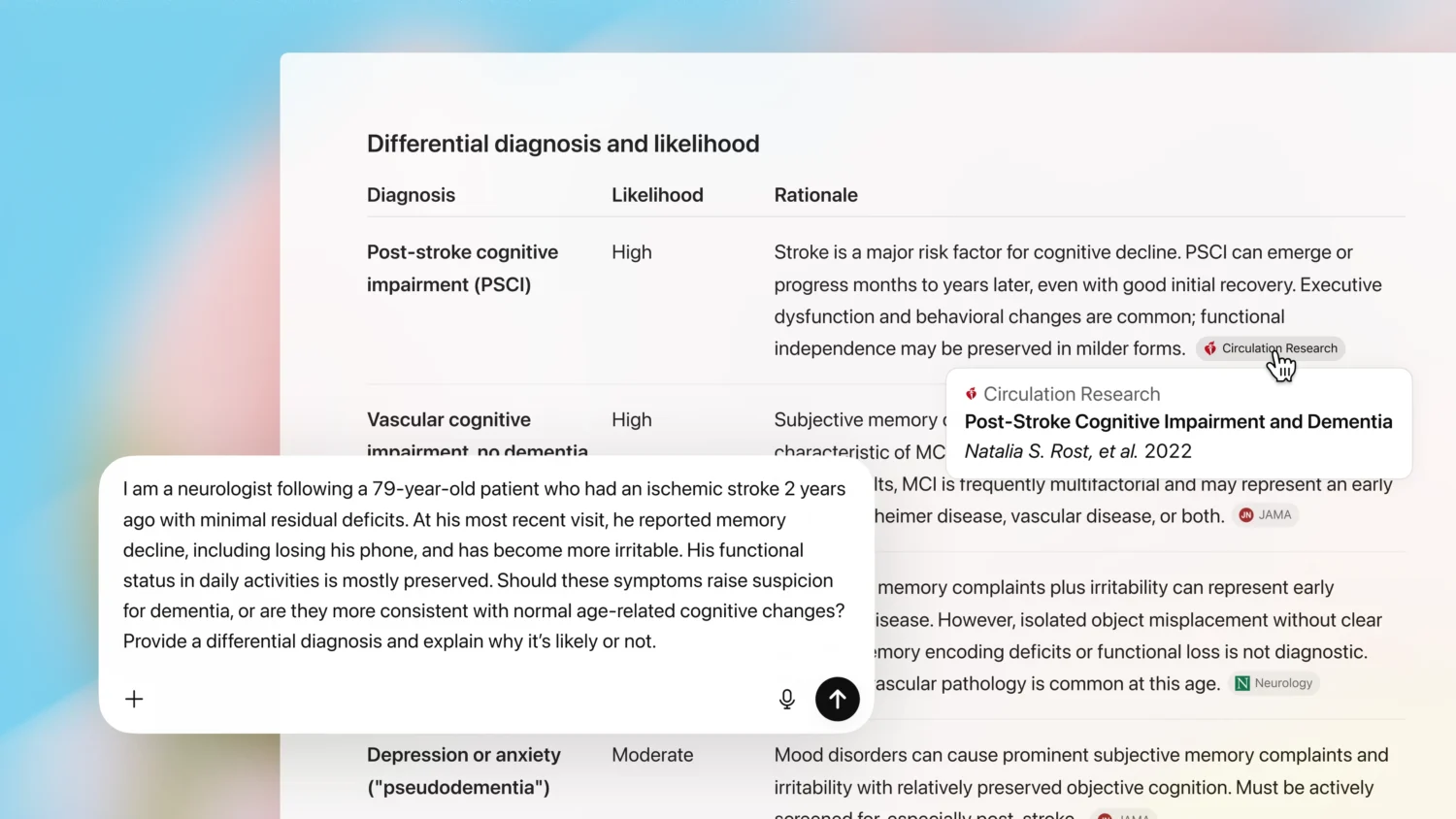
What You Should Know
– OpenAI has officially entered the medical market with OpenAI for Healthcare, a suite of products led by ChatGPT for Healthcare and the GPT-5.2-powered API.
– Already rolling out to eight leading institutions—including Stanford Medicine, HCA Healthcare, and UCSF—the platform provides a secure, HIPAA-compliant workspace for clinical reasoning, evidence retrieval with transparent citations, and the automation of administrative tasks like prior authorizations and discharge summaries.
The Intelligence Core: GPT-5.2 and HealthBench Performance
The defining feature of this launch is the introduction of GPT-5.2 models, which were developed through two years of research with a global network of 260 licensed physicians. Unlike general-purpose models, GPT-5.2 was “red-teamed” by physicians to ensure trustworthy information retrieval and safe clinical reasoning.
Benchmark Breakthroughs:
- HealthBench Consensus: GPT-5.2 (Thinking) consistently outperforms prior generations and competitors like Claude Opus 4.5 and Gemini 3 Pro on challenging healthcare professional workflows.
- GDPval: The model surpasses human baselines across every medical role measured, moving beyond factual recall to assess uncertainty handling and communication quality.
- Diagnostic Accuracy: A live study with Penda Health demonstrated that an OpenAI-powered clinical copilot reduced both diagnostic and treatment errors in routine primary care.
ChatGPT for Healthcare: A Secure Clinical Workspace
For organizations that have been hesitant to adopt AI due to regulatory constraints, OpenAI now offers an enterprise-grade foundation with built-in HIPAA support.
- Evidence Retrieval: Grounded in millions of peer-reviewed studies and clinical guidelines, ChatGPT now provides transparent citations—including titles and publication dates—to support clinician source-checking.
- Institutional Alignment: The platform integrates with tools like Microsoft SharePoint, allowing it to incorporate an institution’s specific care pathways and policies into its responses.
- Automated Templates: Teams can use shared templates to automate “re-writing” tasks, such as drafting patient instructions, referral letters, and discharge summaries.
- Governance & Control: Organizations maintain total data control via SAML SSO and a signed Business Associate Agreement (BAA), ensuring patient data is never used to train OpenAI’s models.
Real-World Impact: From Boston to Baylor
The announcement is bolstered by an impressive roster of early adopters. AdventHealth, Baylor Scott & White, and Cedars-Sinai are among the systems already rolling out the tools.
“Our early work with a custom OpenAI-powered solution allowed us to move quickly… and establish strong governance foundations,” said John Brownstein, Chief Innovation Officer at Boston Children’s Hospital.
These partners are using the tools to:
- Automate Documentation: Drafting discharge summaries and patient letters.
- Support Prior Authorization: Generating clinical justifications for insurance claims.
- Personalize Patient Education: Translating complex medical jargon into readable instructions for patients.
