
• Skip to main content
  • Skip to secondary menu
  • Skip to primary sidebar
  • Skip to secondary sidebar
  • Skip to footer

  • Opinion
  • Health IT
    • Behavioral Health
    • Care Coordination
    • EMR/EHR
    • Interoperability
    • Patient Engagement
    • Population Health Management
    • Revenue Cycle Management
    • Social Determinants of Health
  • Digital Health
    • AI
    • Blockchain
    • Precision Medicine
    • Telehealth
    • Wearables
  • Life Sciences
  • Investments
  • M&A
  • Value-based Care
    • Accountable Care (ACOs)
    • Medicare Advantage

Who Made Your Medicine? How to Use ProPublica’s Rx Inspector to Audit Your Generics

by Fred Pennic 01/06/2026 Leave a Comment

  • LinkedIn
  • Twitter
  • Facebook
  • Email
  • Print
Who Made Your Medicine? How to Use ProPublica’s Rx Inspector to Audit Your Generics

What You Should Know

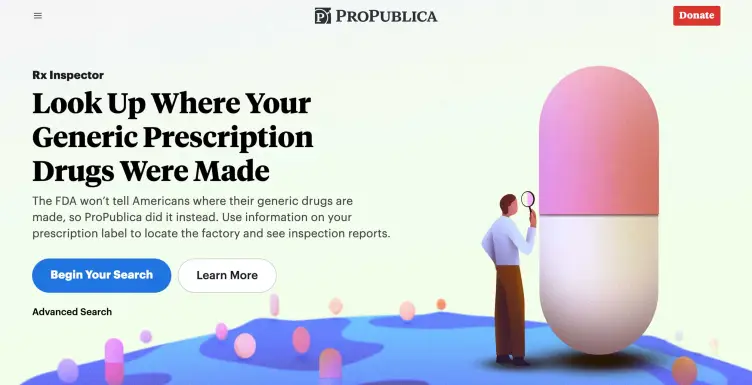
– ProPublica has released Rx Inspector, a first-of-its-kind database that allows Americans to identify the exact facility where their generic prescriptions were manufactured.

– By connecting disparate FDA databases and suing for factory location data, ProPublica has mapped more than 80% of generic products to their originating plants, revealing safety violations that the FDA has historically kept hidden from consumers.


The Shadow World of Generic Manufacturing

Generic drugs now account for 90% of all prescriptions dispensed in the U.S., yet their origins remain a “black box” for consumers and clinicians alike. Labels on pill bottles typically list only the distributor or repackager, masking the fact that the underlying medication may have been produced in facilities with documented issues such as mold, filthy equipment, or insect infestations.

To build Rx Inspector, journalists connected disparate databases and sued the FDA in federal court to obtain factory location lists that the agency previously deemed “confidential commercial information”.

Operational Mechanics: How to Audit Your Prescription

The tool acts as a “digital auditor” for the patient’s medicine cabinet. Users navigate the system using:

  • The “Front Door”: Users enter the drug name and the company listed on the pill bottle (repackager/distributor).
  • Advanced Identification: To ensure a precise match, users can filter by pill color, shape, imprints, or the National Drug Code (NDC).
  • The Outcome: The app displays the facility address, other drugs produced there, and available FDA inspection reports.

The ‘Risk Tier’ Framework: Decoding FDA Compliance

Rx Inspector translates technical FDA compliance designations into actionable insights for patients and providers:

  1. Import Alert: Highest Risk. The facility is banned from shipping to the U.S. due to severe standard violations, though “exemptions” are sometimes granted to prevent shortages.
  2. Warning Letter: Disciplinary action highlighting significant federal violations; requires a formal company response.
  3. Unacceptable Compliance: “Official Action Indicated” (OAI). Serious issues found; the FDA typically pauses new drug approvals from this facility.
  4. Voluntary Action (VAI): Most Common. Issues were found, but the FDA determined the facility could correct them voluntarily.
  5. Inspector Issues (483): Specific deficiencies documented via a Form 483; these may not appear in official summary dashboards.
  6. Acceptable State (NAI): No Action Indicated.” The best possible outcome; no compliance action taken.

Do not confuse “transparency” with “crisis.” While Rx Inspector highlights troubling inspection reports, doctors and pharmacists strongly advise patients not to stop taking medications. Instead, use this data to engage your provider in a discussion about alternative manufacturers or pharmacies if a facility has a pattern of “Official Action Indicated” reports.

The “Rx Roulette” Methodology

The database is built on a complex architecture that connects the Structured Product Labeling database, the National Drug Code (NDC) Directory, and years of Form 483 documents obtained via Freedom of Information Act (FOIA) requests. While the data is a “first step” and may have gaps due to corporate acquisitions, it represents the most comprehensive public audit of the generic drug supply chain to date.

The Bottom Line: 

We have officially moved beyond the era of “trust the label.” For 2026, the mandate is clear: Verify the source.

  • LinkedIn
  • Twitter
  • Facebook
  • Email
  • Print

Tagged With: Public Health

Tap Native

Get in-depth healthcare technology analysis and commentary delivered straight to your email weekly

Reader Interactions

Primary Sidebar

Subscribe to HIT Consultant

Latest insightful articles delivered straight to your inbox weekly.

Submit a Tip or Pitch

Featured Research Report

2026 Best in KLAS Awards: The Full List of Software & Services Winners

Most-Read

The "Platform" Squeeze: Epic Releases Native AI Charting, Putting Venture-Backed Scribes on Notice

The “Platform” Squeeze: Epic Releases Native AI Charting, Putting Venture-Backed Scribes on Notice

Analysis: Oracle Cerner’s Plans for a National EHR

Oracle May Cut 30k Jobs and Sell Cerner to Fund $156B OpenAI Deal

The $1.9B Exit: Why CommonSpirit is Insourcing Revenue Cycle and Tenet is Betting Big on Conifer AI

The $1.9B Exit: Why CommonSpirit is Insourcing Revenue Cycle and Tenet is Betting Big on Conifer AI

KLAS 2026 Rankings: Aledade and Guidehealth Named Top VBC Enablement Firms

KLAS 2026 Rankings: Aledade and Guidehealth Named Top VBC Enablement Firms

Beyond the Hype: New KLAS Data Validates the Financial and Clinical ROI of Ambient AI

Beyond the Hype: New KLAS Data Validates the Financial and Clinical ROI of Ambient AI

Anthropic Debuts ‘Claude for Healthcare’ and Opus 4.5 to Engineer the Future of Life Sciences

Anthropic Debuts ‘Claude for Healthcare’ and Opus 4.5 to Engineer the Future of Life Sciences

OpenAI Debuts ChatGPT Health: A ‘Digital Front Door’ That Connects Medical Records to Agentic AI

OpenAI Debuts ChatGPT Health: A ‘Digital Front Door’ That Connects Medical Records to Agentic AI

From Genes to Hackers: The Hidden Cybersecurity Risks in Life Sciences

From Genes to Hackers: The Hidden Cybersecurity Risks in Life Sciences

Utah Becomes First State to Approve AI System for Prescription Renewals

Utah Becomes First State to Approve AI System for Prescription Renewals

NYC Health + Hospitals to Acquire Maimonides in $2.2B Safety Net Overhaul

NYC Health + Hospitals to Acquire Maimonides in $2.2B Safety Net Overhaul

Secondary Sidebar

Footer

Company

  • About Us
  • 2026 Editorial Calendar
  • Advertise with Us
  • Reprints and Permissions
  • Op-Ed Submission Guidelines
  • Contact
  • Subscribe

Editorial Coverage

  • Opinion
  • Health IT
    • Care Coordination
    • EMR/EHR
    • Interoperability
    • Population Health Management
    • Revenue Cycle Management
  • Digital Health
    • Artificial Intelligence
    • Blockchain Tech
    • Precision Medicine
    • Telehealth
    • Wearables
  • Startups
  • Value-Based Care
    • Accountable Care
    • Medicare Advantage

Connect

Subscribe to HIT Consultant Media

Latest insightful articles delivered straight to your inbox weekly

Copyright © 2026. HIT Consultant Media. All Rights Reserved. Privacy Policy |