
• Skip to main content
  • Skip to secondary menu
  • Skip to primary sidebar
  • Skip to secondary sidebar
  • Skip to footer

  • Opinion
  • Health IT
    • Behavioral Health
    • Care Coordination
    • EMR/EHR
    • Interoperability
    • Patient Engagement
    • Population Health Management
    • Revenue Cycle Management
    • Social Determinants of Health
  • Digital Health
    • AI
    • Blockchain
    • Precision Medicine
    • Telehealth
    • Wearables
  • Life Sciences
  • Investments
  • M&A
  • Value-based Care
    • Accountable Care (ACOs)
    • Medicare Advantage

The New “Pass/Fail” Test: Why Sovereignty, Not Features, Will Decide Global Health IT Contracts in 2026

by Fred Pennic 12/31/2025 Leave a Comment

  • LinkedIn
  • Twitter
  • Facebook
  • Email
  • Print

What You Should Know: 

– A new 2026 report from Black Book Market Research reveals a decisive shift in global healthcare procurement: digital sovereignty has replaced functionality as the primary “gatekeeper” for international contracts. 

– Roughly 80% of international health buyers now treat data residency and jurisdictional control as pass/fail criteria, often disqualifying vendors before a product demo even occurs. This shift is being accelerated by AI, as ministries demand to know exactly where inference runs and where model telemetry is stored.

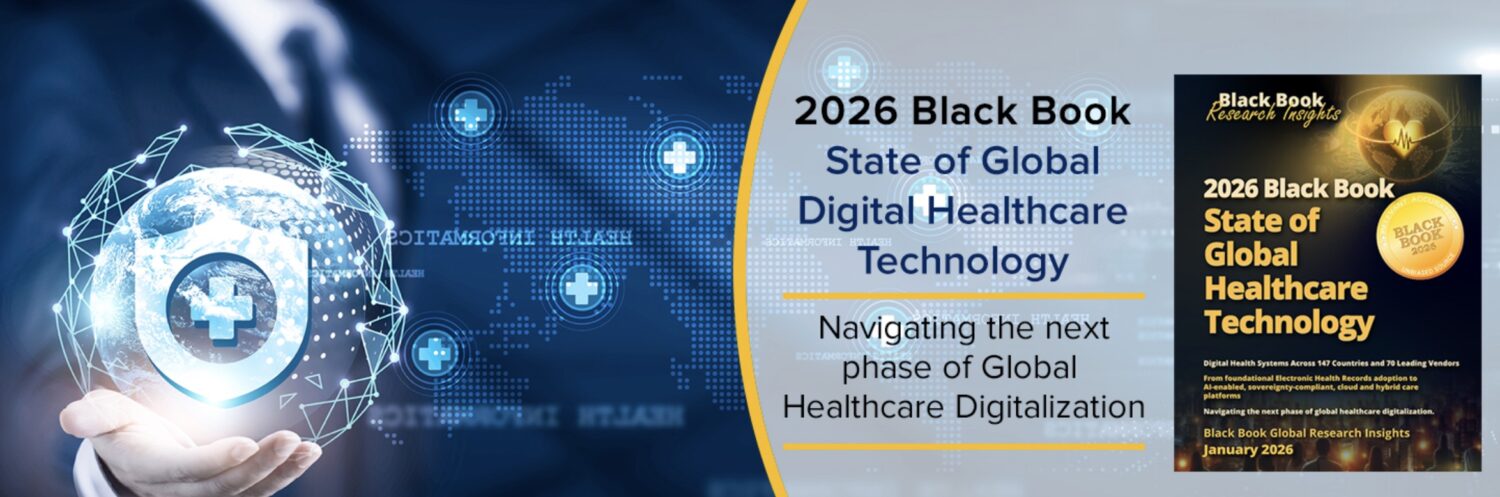
Black Book Releases 2026 Global Digital HIT Report

For decades, the global healthcare IT market ran on a simple equation: the vendor with the best features and the most robust platform usually won the deal. In 2026, that equation has broken.

According to the 2026 State of Global Digital Healthcare Information Technology (HIT) Report released by Black Book Market Research, the primary determinant for winning public-sector contracts outside the U.S. is no longer what your platform can do—it is where your data legally resides.

The report identifies “digital sovereignty” as the new, non-negotiable “eligibility gate” for vendors competing in Europe, the Gulf States, and Southeast Asia. Vendors who cannot prove immunity from foreign legal compulsion are being screened out before their feature lists are even reviewed.

Defining Sovereignty in 2026 Procurement

Digital sovereignty is now defined by five “Hard Pillars” that vendors must meet to clear eligibility:

  • Data Residency & Processing: Core patient records and AI inference must run within national borders or sovereign-approved environments.
  • Legal Jurisdiction: Clear authority for local courts to govern subpoenas, access, and audit rights, explicitly excluding foreign legal “long-arm” reach.
  • AI Dataflow Governance: Strict controls on whether clinical prompts/outputs are retained for model training or fine-tuning by the parent vendor.
  • Operational Continuity: Local legal entities or partners must be responsible for uptime and incident response to ensure national security.
  • Cross-Border Limits: Defined and logged rules for what telemetry or logs are allowed to leave the country.

Regional Tightening: Where the Gate is Fastest

Black Book identifies specific regions where sovereignty-first procurement is actively reshaping vendor shortlists:

– Europe: Cross-border initiatives and GDPR enforcement—€5.88B in fines by early 2025 has driven zero-tolerance for hosting accountability.

– Gulf States: National Vision programs (KSA, UAE) mandating in-region hosting and bilingual operational readiness.

– China: “Domestic favor” mandates and localization laws have effectively narrowed pathways for foreign enterprise EHRs.

– Southeast Asia: Clarifying residency requirements is finally enabling cloud adoption—but only for vendors with local data centers.

The “Innovation Trap”: Why AI is the Accelerant

The report warns that “innovation” is now evaluated after eligibility. Vendors often lead with impressive generative AI capabilities, but procurement teams are flagging these as “Sovereignty Risks” due to:

  1. Model Telemetry: Inadvertent data leakage through logs sent back to US-based headquarters.
  2. Training Rights: “Blanket consent” for using data to improve models is a non-starter for sovereign health systems.
  3. Black-Box Inference: If the AI processing happens in a “Global Cluster,” it fails the residency test.

Implication for Investors

Jurisdictional compliance is no longer a contract clause; it is a core product capability. Vendors with “sovereign-native” architectures (e.g., modular, edge-ready, or federated learning models) will see a massive valuation premium over legacy “Global Cloud” providers in 2026.

  • LinkedIn
  • Twitter
  • Facebook
  • Email
  • Print

Tap Native

Get in-depth healthcare technology analysis and commentary delivered straight to your email weekly

Reader Interactions

Primary Sidebar

Subscribe to HIT Consultant

Latest insightful articles delivered straight to your inbox weekly.

Submit a Tip or Pitch

2026 Predictions & Trends

Healthcare 2026 Forecast: Executives on AI Survival, Financial Reckoning, and the End of Point Solutions

2026 Healthcare Executive Predictions: Why the AI “Pilot Era” Is Officially Over

Most-Read

NYC Health + Hospitals to Acquire Maimonides in $2.2B Safety Net Overhaul

NYC Health + Hospitals to Acquire Maimonides in $2.2B Safety Net Overhaul

KLAS Report: Why Hospitals Are Choosing Efficiency Over 'Agentic' AI Hype in 2025

KLAS Report: Why Hospitals Are Choosing Efficiency Over ‘Agentic’ AI Hype in 2025

Advanced Primary Care 2026: Top 6 Investments for Health Systems According to Harvard Medical School

Advanced Primary Care 2026: Top 6 Investments for Health Systems According to Harvard Medical School

AI Nutrition Labels: The Key to Provider Adoption and Patient Trust?

AI Nutrition Labels: The Key to Provider Adoption and Patient Trust?

Kristen Hartsell, VP of Clinical Services, RedSail Technologies

The Pharmacy Closures Crisis: How Independent Pharmacies Are Fixing Pharmacy Deserts

HHS Launches 'OneHHS' AI Strategy to Integrate AI Across CDC, CMS, and FDA for Efficiency and Public Trust

HHS Launches ‘OneHHS’ AI Strategy to Integrate AI Across CDC, CMS, and FDA for Efficiency and Public Trust

From Overwhelmed to Optimized: How AI Agents Address Staffing Challenges and Burnout in Healthcare

From Overwhelmed to Optimized: How AI Agents Address Staffing Challenges and Burnout in Healthcare

The VBC Paradox: Why Hospitals Are Doubling Down on Value-Based Care While Revenue at Risk Lags

The VBC Paradox: Why Hospitals Are Doubling Down on Value-Based Care While Revenue at Risk Lags

Tebra Secures $250M to Challenge Legacy EHRs with AI-Powered Automation

Tebra Secures $250M to Challenge Legacy EHRs with AI-Powered Automation

AstraZeneca Selects Salesforce Agentforce Life Sciences to Deploy AI-Powered Global Customer Engagement

AstraZeneca Selects Salesforce Agentforce Life Sciences to Deploy AI-Powered Global Customer Engagement

Secondary Sidebar

Footer

Company

  • About Us
  • Advertise with Us
  • Reprints and Permissions
  • Op-Ed Submission Guidelines
  • Contact
  • Subscribe

Editorial Coverage

  • Opinion
  • Health IT
    • Care Coordination
    • EMR/EHR
    • Interoperability
    • Population Health Management
    • Revenue Cycle Management
  • Digital Health
    • Artificial Intelligence
    • Blockchain Tech
    • Precision Medicine
    • Telehealth
    • Wearables
  • Startups
  • Value-Based Care
    • Accountable Care
    • Medicare Advantage

Connect

Subscribe to HIT Consultant Media

Latest insightful articles delivered straight to your inbox weekly

Copyright © 2025. HIT Consultant Media. All Rights Reserved. Privacy Policy |