
What You Should Know:
– A new report from KLAS Research reveals that while healthcare AI adoption is surging in 2025, organizations are overwhelmingly favoring low-risk, high-efficiency tools like ambient speech and revenue cycle automation over experimental clinical applications.
– Despite significant market buzz, “agentic AI” adoption remains virtually non-existent, with only one interviewed organization currently using it. The data confirms a pragmatic shift in the industry: health systems are prioritizing measurable ROI and governance over cutting-edge innovation.
KLAS Releases 2025 Healthcare AI Update: Ambient Speech and Revenue Cycle Lead Adoption
For the last few years, the healthcare sector has been inundated with promises of AI “agents” that can autonomously diagnose patients and manage complex care plans. But according to the latest market data, the reality on the ground in 2025 is far more pragmatic—and profitable.
KLAS Research released its “Healthcare AI Update 2025” today, offering a high-level look at adoption trends across more than 1,700 healthcare organizations. The verdict? The industry has moved past the experimental phase and entered the era of “operational efficiency.”
“Healthcare organizations increasingly view AI as an essential tool for improving performance,” the report states, noting a distinct pivot toward “automating well-defined, lower-risk workflows” rather than reinventing care delivery.
The Dominance of “Boring” AI
While generative AI grabs headlines, the actual investment dollars are flowing into the unglamorous back-end of hospital operations. Organizations are prioritizing tools that alleviate staffing challenges and streamline documentation—areas where the Return on Investment (ROI) is immediate and measurable.
Top Use Cases by Category:
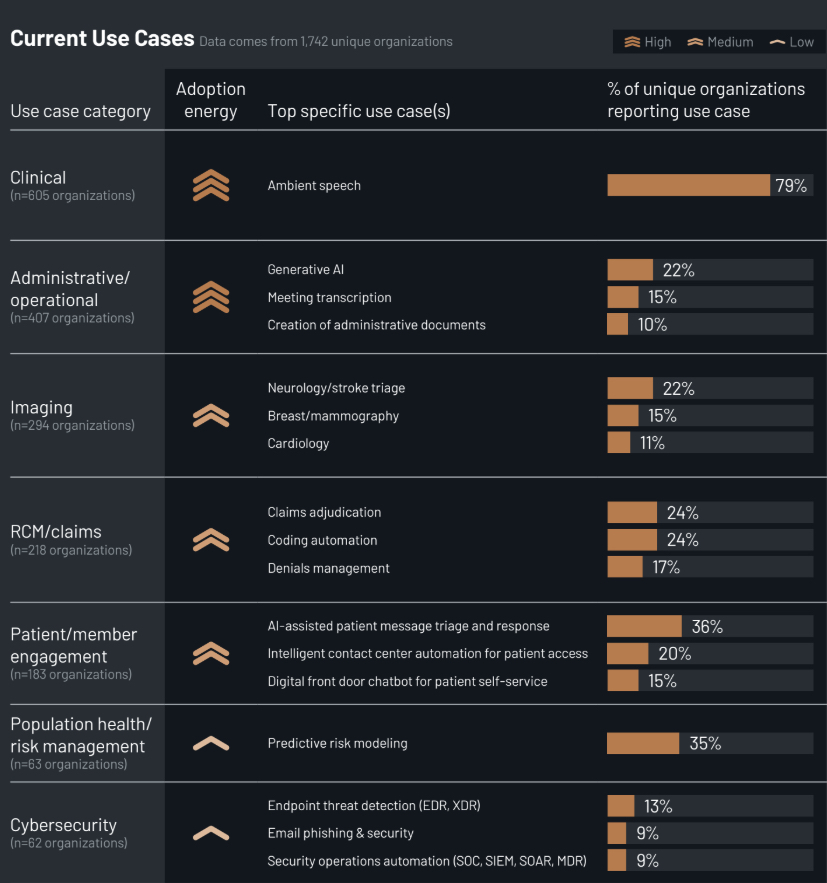
- Patient Engagement (36%): AI-assisted triage of patient messages has become the single most adopted use case, driven by the explosion of portal messages that have overwhelmed primary care physicians.
- Revenue Cycle Management (24%): Claims adjudication and coding automation are seeing heavy adoption as CFOs look to reduce denials and accelerate cash flow.
- Clinical Efficiency (22%): Ambient speech technology—which listens to patient visits and drafts notes automatically—dominates the clinical landscape, far outpacing clinical decision support tools.
“Although enthusiasm is strong, most organizations are … cautious about higher-stakes clinical applications,” the report notes.
The “Agentic AI” Reality Check
Perhaps the most striking finding in the KLAS data is the disconnect between vendor marketing and buyer reality regarding “Agentic AI”—systems capable of autonomous decision-making and action.
Despite reaching “peak hype” in the tech press, adoption is statistically negligible. Of the more than 3,000 respondents interviewed, only 17 specifically mentioned agentic AI, and only one organization is currently using it.
The barrier isn’t just technology; it’s data. “Many organizations are still working to leverage simpler AI tools and ensure the data they rely on is clean, accurate, and trustworthy,” the report explains. Without a pristine data foundation, autonomous agents present an unacceptable risk profile for health systems already navigating complex governance frameworks.
Microsoft and Epic Tighten Their Grip
The vendor landscape in 2025 tells a story of consolidation. While KLAS validated over 650 vendors in the space, the market is heavily skewed toward incumbents.
Microsoft and Epic continue to be the most frequently used and considered vendors, leveraging their existing footprint to push AI capabilities.
- Ambient Speech: Microsoft (Nuance/Dragon) leads, followed closely by Abridge and Oracle Health.
- Imaging: Niche players like Aidoc, RapidAI, and Viz.ai maintain strong footholds due to their specialized capabilities in stroke and neurology triage.
- Revenue Cycle: Solventum (formerly 3M Health Care) remains the top choice for coding automation.
The Road Ahead: Governance First, Deployment Second
As healthcare leaders look to the remainder of 2025, the focus is shifting from “what can we buy?” to “how do we control it?” The report highlights that leaders are actively “developing governance frameworks and running targeted pilots to evaluate safety, oversight, and measurable ROI”.
