
• Skip to main content
  • Skip to secondary menu
  • Skip to primary sidebar
  • Skip to secondary sidebar
  • Skip to footer

  • Opinion
  • Health IT
    • Behavioral Health
    • Care Coordination
    • EMR/EHR
    • Interoperability
    • Patient Engagement
    • Population Health Management
    • Revenue Cycle Management
    • Social Determinants of Health
  • Digital Health
    • AI
    • Blockchain
    • Precision Medicine
    • Telehealth
    • Wearables
  • Life Sciences
  • Investments
  • M&A
  • Value-based Care
    • Accountable Care (ACOs)
    • Medicare Advantage

ACA Spillovers: A Warning for Employers as Insurers Seek Up to 43% Premium Hikes

by Fred Pennic 10/03/2025 Leave a Comment

  • LinkedIn
  • Twitter
  • Facebook
  • Email
  • Print

What You Should Know: 

– The U.S. healthcare market is showing a stark divergence in cost trends between public and private sectors. While Affordable Care Act (ACA) premiums are spiking well above the industry’s decade-long trend of sub-10% increases, real-world claims data from self-funded employers show costs holding steady at under 5%, according to new data from Nomi Health. 

ACA Rate Hikes Driven by Utilization and Risk

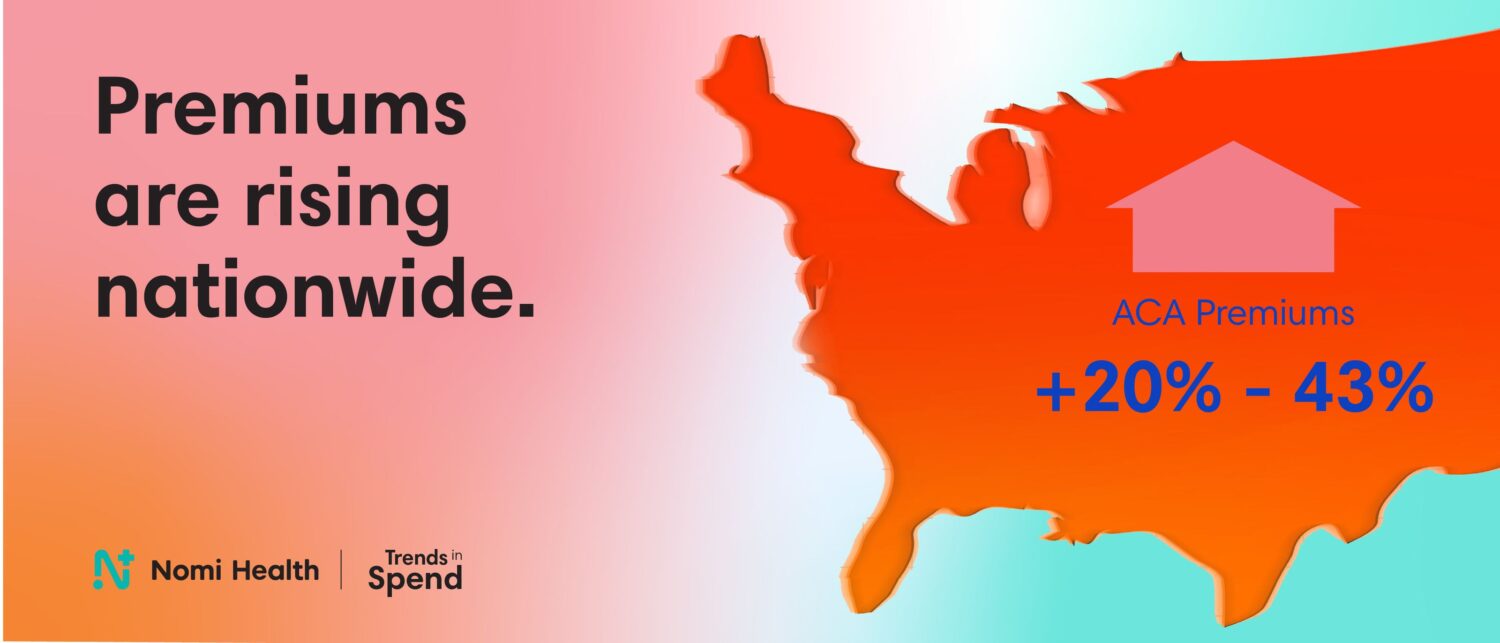
ACA insurers across the country are filing for some of the steepest premium increases in recent memory. The justification for these dramatic hikes—which include Molina Healthcare requesting a 41% increase in Florida , United seeking a 43% increase in Georgia , and increases above 18% in Michigan —is centered on rising patient utilization, worsening risk pools, and price inflation.

Examples of the requested premium increases filed by ACA carriers include:

  • Florida: Molina Healthcare requests a 41% increase for 2026.
  • Georgia: United seeks a 43% increase.
  • Texas: United seeks a  39% increase.
  • Even traditionally stable Blues plans are pushing for premium increases above 20% in multiple states.

Self-Funded Data Reveals a Stable Market

Nomi Health analyzed 12 months of real-world claims data from its nationwide self-funded employer clients, representing over 20 million lives, to see if the same trends were driving up their rates. The short answer is that they’re not.

The data from 2023–2024 shows a healthcare market that’s far more stable than the ACA premium filings suggest:

  • Medical spend rose just 1.75% per member per month.
  • Claim volume actually declined 2.17% per 1,000 members.
  • Pharmacy spend rose 8.64% per member per month, largely driven by predictable growth in categories like GLP-1s.

This stable pattern holds true even in the states facing the sharpest ACA increases:

  • Florida: 0.35% medical cost increase (while ACA carriers seek up to 41%).
  • Texas: 1.8% increase (while ACA carriers seek up to 39%).
  • Georgia: 4.08% increase (while ACA carriers seek up to 43%).

Warning: ACA Market Stress Could Spill Over

The modest and predictable growth in self-funded plan costs might seem like good news, but stability today doesn’t guarantee smooth sailing ahead. The contrast raises an urgent question of whether ACA market stress could spill over into commercial contracts and push costs higher for everyone.

Spiking ACA premiums could lead to rising uninsured populations in communities where self-funded employer members live and work. When more people lack coverage, providers often shift the costs of uncompensated care elsewhere, typically resulting in higher negotiated rates across all commercial contracts. Industry analysts estimate that each of the 179 million people with job-based coverage could see their annual costs rise by $182 to $485.

Employers who take charge of their data and dollars today are better positioned to manage their costs tomorrow. They need to stay vigilant, spot early signs of spillover (e.g., network contract disputes or hidden spread pricing), and proactively protect their plans from subsidized expenses they didn’t create.

  • LinkedIn
  • Twitter
  • Facebook
  • Email
  • Print

Tap Native

Get in-depth healthcare technology analysis and commentary delivered straight to your email weekly

Reader Interactions

Primary Sidebar

Subscribe to HIT Consultant

Latest insightful articles delivered straight to your inbox weekly.

Submit a Tip or Pitch

2026 Predictions & Trends

Healthcare 2026 Forecast: Executives on AI Survival, Financial Reckoning, and the End of Point Solutions

2026 Healthcare Executive Predictions: Why the AI “Pilot Era” Is Officially Over

Featured Research Report

Digital Health Funding Hits $14.2B in 2025: A Year of AI Exuberance and Market Bifurcation

Most-Read

Anthropic Debuts ‘Claude for Healthcare’ and Opus 4.5 to Engineer the Future of Life Sciences

Anthropic Debuts ‘Claude for Healthcare’ and Opus 4.5 to Engineer the Future of Life Sciences

OpenAI Debuts ChatGPT Health: A ‘Digital Front Door’ That Connects Medical Records to Agentic AI

OpenAI Debuts ChatGPT Health: A ‘Digital Front Door’ That Connects Medical Records to Agentic AI

From Genes to Hackers: The Hidden Cybersecurity Risks in Life Sciences

From Genes to Hackers: The Hidden Cybersecurity Risks in Life Sciences

Utah Becomes First State to Approve AI System for Prescription Renewals

Utah Becomes First State to Approve AI System for Prescription Renewals

NYC Health + Hospitals to Acquire Maimonides in $2.2B Safety Net Overhaul

NYC Health + Hospitals to Acquire Maimonides in $2.2B Safety Net Overhaul

KLAS Report: Why Hospitals Are Choosing Efficiency Over 'Agentic' AI Hype in 2025

KLAS Report: Why Hospitals Are Choosing Efficiency Over ‘Agentic’ AI Hype in 2025

Advanced Primary Care 2026: Top 6 Investments for Health Systems According to Harvard Medical School

Advanced Primary Care 2026: Top 6 Investments for Health Systems According to Harvard Medical School

AI Nutrition Labels: The Key to Provider Adoption and Patient Trust?

AI Nutrition Labels: The Key to Provider Adoption and Patient Trust?

Kristen Hartsell, VP of Clinical Services, RedSail Technologies

The Pharmacy Closures Crisis: How Independent Pharmacies Are Fixing Pharmacy Deserts

HHS Launches 'OneHHS' AI Strategy to Integrate AI Across CDC, CMS, and FDA for Efficiency and Public Trust

HHS Launches ‘OneHHS’ AI Strategy to Integrate AI Across CDC, CMS, and FDA for Efficiency and Public Trust

Secondary Sidebar

Footer

Company

  • About Us
  • 2026 Editorial Calendar
  • Advertise with Us
  • Reprints and Permissions
  • Op-Ed Submission Guidelines
  • Contact
  • Subscribe

Editorial Coverage

  • Opinion
  • Health IT
    • Care Coordination
    • EMR/EHR
    • Interoperability
    • Population Health Management
    • Revenue Cycle Management
  • Digital Health
    • Artificial Intelligence
    • Blockchain Tech
    • Precision Medicine
    • Telehealth
    • Wearables
  • Startups
  • Value-Based Care
    • Accountable Care
    • Medicare Advantage

Connect

Subscribe to HIT Consultant Media

Latest insightful articles delivered straight to your inbox weekly

Copyright © 2026. HIT Consultant Media. All Rights Reserved. Privacy Policy |