
• Skip to main content
  • Skip to secondary menu
  • Skip to primary sidebar
  • Skip to secondary sidebar
  • Skip to footer

  • Opinion
  • Health IT
    • Behavioral Health
    • Care Coordination
    • EMR/EHR
    • Interoperability
    • Patient Engagement
    • Population Health Management
    • Revenue Cycle Management
    • Social Determinants of Health
  • Digital Health
    • AI
    • Blockchain
    • Precision Medicine
    • Telehealth
    • Wearables
  • Life Sciences
  • Investments
  • M&A
  • Value-based Care
    • Accountable Care (ACOs)
    • Medicare Advantage

PHTI Report: Virtual OUD Solutions are Effective, But Don’t Substantially Reduce Costs

by Fred Pennic 09/16/2025 Leave a Comment

  • LinkedIn
  • Twitter
  • Facebook
  • Email
  • Print

What You Should Know: 

– A new evaluation from the Peterson Health Technology Institute (PHTI) has assessed the effectiveness of virtual solutions for opioid use disorder (OUD). 

– The report reveals that while these solutions are as effective as traditional, in-person care, they only provide a modest improvement in patient outcomes and do not appear to be significantly expanding access to treatment.

Modest Clinical Benefits, Unclear Economic Impact

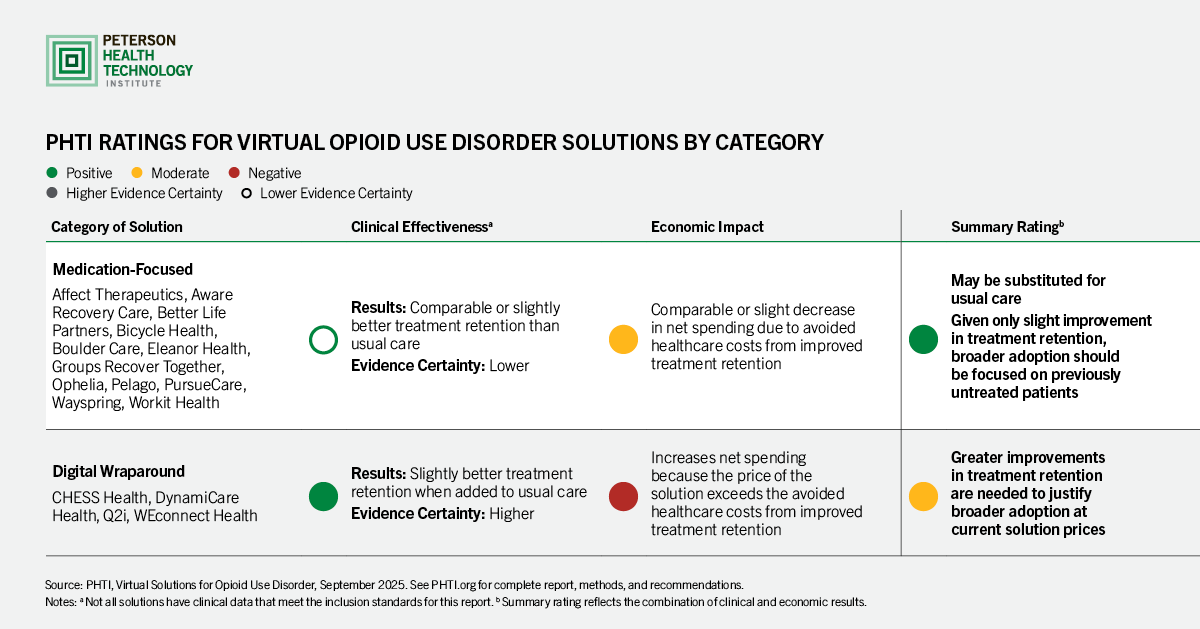
According to the PHTI evaluation, virtual OUD solutions help patients stay in treatment an average of 13 more days over six months compared to usual care. Treatment retention is considered a critical factor for clinical effectiveness, as patients who remain in care have a lower risk of fatal overdose and fewer emergency department visits and hospital admissions. While any additional time in treatment is beneficial, the report suggests that this modest improvement is not enough to substantially reduce overall healthcare spending. In fact, digital wraparound solutions, which are added to usual care, may even increase costs because the price of the solution can exceed the savings from improved treatment retention.

PHTI evaluated two main categories of virtual OUD solutions:

  • Medication-focused solutions: These solutions offer virtual prescribing, primarily for buprenorphine, with optional support services. PHTI found that these solutions can be a substitute for traditional care, with comparable or slightly lower costs for payers due to a reduction in hospitalizations and emergency room visits.
  • Digital wraparound solutions: These solutions are added to existing treatment programs and offer services such as contingency management and peer support. The evaluation found that these solutions increase net spending for purchasers because their cost is higher than the avoided healthcare costs from improved retention.

The Access Gap and Recommendations for the Future

Despite the expectation that virtual solutions would increase the number of people in medication-based OUD treatment, the assessment found no evidence that these solutions are disproportionately enrolling new patients. Currently, virtual solutions primarily reach individuals who are already in some form of treatment or would have sought in-person care.

To address this and other ongoing challenges, the PHTI report provides several recommendations:

  • Advance the evidence: More research is needed to determine which aspects of virtual OUD solutions are most effective and for which patient populations.
  • Expand access: Innovators should focus on strategies to engage and bring more untreated patients into care and keep them in treatment longer.
  • Modernize policy: Policymakers should modernize teleprescribing and licensure rules to enable these programs to expand into underserved areas. This includes finalizing proposed DEA rules for a special teleprescribing registration for controlled substances.
  • Leverage opioid settlement funds: States and localities can use opioid abatement funds to invest in virtual OUD solutions and support evidence generation.

“When it comes to opioid use disorder, any additional time in treatment helps patients avoid relapse and overdose risk. Virtual solutions perform as well as or slightly better than traditional care models, but healthcare providers and digital solutions need to continue striving for interventions that deliver more substantial improvements in retention and effectiveness,” said Caroline Pearson, executive director of PHTI. “In the meantime, the biggest impact for these solutions is to expand adoption to previously untreated patients who can benefit from proven medications and desperately need the help.”

  • LinkedIn
  • Twitter
  • Facebook
  • Email
  • Print

Tap Native

Get in-depth healthcare technology analysis and commentary delivered straight to your email weekly

Reader Interactions

Primary Sidebar

Subscribe to HIT Consultant

Latest insightful articles delivered straight to your inbox weekly.

Submit a Tip or Pitch

2026 Predictions & Trends

Healthcare 2026 Forecast: Executives on AI Survival, Financial Reckoning, and the End of Point Solutions

2026 Healthcare Executive Predictions: Why the AI “Pilot Era” Is Officially Over

Featured Research Report

Digital Health Funding Hits $14.2B in 2025: A Year of AI Exuberance and Market Bifurcation

Most-Read

Trump Unveils 'The Great Healthcare Plan': A Global Price-Matching Pivot to Settle the Affordability Crisis

Price Reset 2026: How Trump’s ‘Great Healthcare Plan’ Slashes Drug Costs at Trumprx.gov

Anthropic Debuts ‘Claude for Healthcare’ and Opus 4.5 to Engineer the Future of Life Sciences

Anthropic Debuts ‘Claude for Healthcare’ and Opus 4.5 to Engineer the Future of Life Sciences

OpenAI Debuts ChatGPT Health: A ‘Digital Front Door’ That Connects Medical Records to Agentic AI

OpenAI Debuts ChatGPT Health: A ‘Digital Front Door’ That Connects Medical Records to Agentic AI

From Genes to Hackers: The Hidden Cybersecurity Risks in Life Sciences

From Genes to Hackers: The Hidden Cybersecurity Risks in Life Sciences

Utah Becomes First State to Approve AI System for Prescription Renewals

Utah Becomes First State to Approve AI System for Prescription Renewals

NYC Health + Hospitals to Acquire Maimonides in $2.2B Safety Net Overhaul

NYC Health + Hospitals to Acquire Maimonides in $2.2B Safety Net Overhaul

KLAS Report: Why Hospitals Are Choosing Efficiency Over 'Agentic' AI Hype in 2025

KLAS Report: Why Hospitals Are Choosing Efficiency Over ‘Agentic’ AI Hype in 2025

Advanced Primary Care 2026: Top 6 Investments for Health Systems According to Harvard Medical School

Advanced Primary Care 2026: Top 6 Investments for Health Systems According to Harvard Medical School

AI Nutrition Labels: The Key to Provider Adoption and Patient Trust?

AI Nutrition Labels: The Key to Provider Adoption and Patient Trust?

Kristen Hartsell, VP of Clinical Services, RedSail Technologies

The Pharmacy Closures Crisis: How Independent Pharmacies Are Fixing Pharmacy Deserts

Secondary Sidebar

Footer

Company

  • About Us
  • 2026 Editorial Calendar
  • Advertise with Us
  • Reprints and Permissions
  • Op-Ed Submission Guidelines
  • Contact
  • Subscribe

Editorial Coverage

  • Opinion
  • Health IT
    • Care Coordination
    • EMR/EHR
    • Interoperability
    • Population Health Management
    • Revenue Cycle Management
  • Digital Health
    • Artificial Intelligence
    • Blockchain Tech
    • Precision Medicine
    • Telehealth
    • Wearables
  • Startups
  • Value-Based Care
    • Accountable Care
    • Medicare Advantage

Connect

Subscribe to HIT Consultant Media

Latest insightful articles delivered straight to your inbox weekly

Copyright © 2026. HIT Consultant Media. All Rights Reserved. Privacy Policy |