

• Skip to main content
  • Skip to secondary menu
  • Skip to primary sidebar
  • Skip to secondary sidebar
  • Skip to footer

  • Opinion
  • Health IT
    • Behavioral Health
    • Care Coordination
    • EMR/EHR
    • Interoperability
    • Patient Engagement
    • Population Health Management
    • Revenue Cycle Management
    • Social Determinants of Health
  • Digital Health
    • AI
    • Blockchain
    • Precision Medicine
    • Telehealth
    • Wearables
  • Life Sciences
  • Investments
  • M&A
  • Value-based Care
    • Accountable Care (ACOs)
    • Medicare Advantage

EHR Personalization: Improving Physician Satisfaction & Efficacy

by Syed Hamza Sohail 09/08/2023 Leave a Comment

  • LinkedIn
  • Twitter
  • Facebook
  • Email
  • Print

What You Should Know:

  • Since the Arch Collaborative’s early days, analysis of clinician feedback has identified three pillars key to EHR satisfaction: (1) strong user mastery, (2) an organization-wide sense of shared ownership, and (3) EHR technology that meets users’ unique needs (personalization).
  • This last pillar is the focus of this report. While it is important for physicians to have the flexibility to care for patients and document in a way that fits their workflow, too much freedom to change the EHR can hinder efficiency and patient safety. This report identifies the benefits of personalization as well as best practices for leveraging it

Insights into the Personalization of EHR in 2023

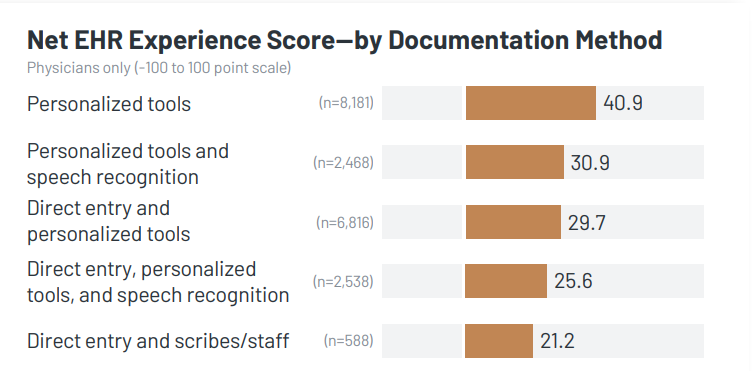
  1. Physicians Who Use Personalized Tools for Documentation Report Highest EHR Satisfaction: Although direct entry is the most common documentation approach, utilizing personalized tools is strongly associated with higher Electronic Health Record (EHR) satisfaction, as measured by the Arch Collaborative’s Net EHR Experience score (NEES). While alternative methods like dictation/transcription and speech recognition may alleviate burnout (refer to the chart on the following page), they distance users from the EHR, diminishing the potential for enhanced satisfaction. In contrast, individuals who customize the EHR display a commitment to mastering the technology rather than disengaging from it. Physicians who employ personalized tools for documentation, whether independently or in combination with other methods, exhibit an average NEES score 15.5 points higher than those who do not embrace personalized tools.
  2. Use of Multiple Documentation Methods Correlated with Higher Rates of Burnout: Except for physicians who utilize both dictation/transcription and direct entry, those who rely solely on one documentation method, regardless of its nature, generally report lower levels of burnout. Furthermore, physicians employing multiple documentation approaches are more prone to attribute their burnout to after-hours charting compared to those employing a single documentation method. As previously mentioned, physicians using dictation/transcription or speech recognition tend to experience reduced burnout but not an increase in EHR satisfaction, likely due to these methods disconnecting users from the EHR rather than promoting mastery of it.
  3. Organizations and Vendors Can Support High EHR Satisfaction through Strong Documentation Training: Organizations seeking to enhance EHR satisfaction by implementing personalized tools or any documentation approach should prioritize their documentation training programs. Irrespective of the chosen documentation method, there exists a significant gap of at least 30 points in NEES between physicians who deem their documentation training as satisfactory and those who do not. Several factors contribute to this discrepancy, with a primary one being that a substantial portion of a physician’s EHR interaction time is devoted to documentation. Enhanced training in efficient and effective documentation methods is key to physicians’ overall success with the EHR.

  • LinkedIn
  • Twitter
  • Facebook
  • Email
  • Print

Tap Native

Get in-depth healthcare technology analysis and commentary delivered straight to your email weekly

Reader Interactions

Primary Sidebar

Subscribe to HIT Consultant

Latest insightful articles delivered straight to your inbox weekly.

Submit a Tip or Pitch

2026 Predictions & Trends

Healthcare 2026 Forecast: Executives on AI Survival, Financial Reckoning, and the End of Point Solutions

2026 Healthcare Executive Predictions: Why the AI “Pilot Era” Is Officially Over

Most-Read

HHS Launches 'OneHHS' AI Strategy to Integrate AI Across CDC, CMS, and FDA for Efficiency and Public Trust

HHS Launches ‘OneHHS’ AI Strategy to Integrate AI Across CDC, CMS, and FDA for Efficiency and Public Trust

Kristen Hartsell, VP of Clinical Services, RedSail Technologies

The Pharmacy Closures Crisis: How Independent Pharmacies Are Fixing Pharmacy Deserts

From Overwhelmed to Optimized: How AI Agents Address Staffing Challenges and Burnout in Healthcare

From Overwhelmed to Optimized: How AI Agents Address Staffing Challenges and Burnout in Healthcare

The VBC Paradox: Why Hospitals Are Doubling Down on Value-Based Care While Revenue at Risk Lags

The VBC Paradox: Why Hospitals Are Doubling Down on Value-Based Care While Revenue at Risk Lags

Tebra Secures $250M to Challenge Legacy EHRs with AI-Powered Automation

Tebra Secures $250M to Challenge Legacy EHRs with AI-Powered Automation

AstraZeneca Selects Salesforce Agentforce Life Sciences to Deploy AI-Powered Global Customer Engagement

AstraZeneca Selects Salesforce Agentforce Life Sciences to Deploy AI-Powered Global Customer Engagement

Aidoc Partners with NVIDIA MONAI to Scale Open-Source Clinical AI

Aidoc Partners with NVIDIA MONAI to Scale Open-Source Clinical AI

RapidAI Secures FDA Clearance for Five New Deep Clinical AI Modules, Expanding Enterprise Imaging Platform

RapidAI and AWS Deepen Partnership to Scale Clinical AI in Healthcare

Greece and Sword Health to Build AI-Powered Healthcare Front Door

Greece and Sword Health to Build AI-Powered Healthcare Front Door

GE HealthCare Acquires Intelerad for $2.3B to Create Cloud-First, AI-Enabled Imaging Ecosystem

GE HealthCare Acquires Intelerad for $2.3B to Create Cloud-First, AI-Enabled Imaging Ecosystem

Secondary Sidebar

Footer

Company

  • About Us
  • Advertise with Us
  • Reprints and Permissions
  • Op-Ed Submission Guidelines
  • Contact
  • Subscribe

Editorial Coverage

  • Opinion
  • Health IT
    • Care Coordination
    • EMR/EHR
    • Interoperability
    • Population Health Management
    • Revenue Cycle Management
  • Digital Health
    • Artificial Intelligence
    • Blockchain Tech
    • Precision Medicine
    • Telehealth
    • Wearables
  • Startups
  • Value-Based Care
    • Accountable Care
    • Medicare Advantage

Connect

Subscribe to HIT Consultant Media

Latest insightful articles delivered straight to your inbox weekly

Copyright © 2025. HIT Consultant Media. All Rights Reserved. Privacy Policy |