
• Skip to main content
  • Skip to secondary menu
  • Skip to primary sidebar
  • Skip to secondary sidebar
  • Skip to footer

  • Opinion
  • Health IT
    • Behavioral Health
    • Care Coordination
    • EMR/EHR
    • Interoperability
    • Patient Engagement
    • Population Health Management
    • Revenue Cycle Management
    • Social Determinants of Health
  • Digital Health
    • AI
    • Blockchain
    • Precision Medicine
    • Telehealth
    • Wearables
  • Life Sciences
  • Investments
  • M&A
  • Value-based Care
    • Accountable Care (ACOs)
    • Medicare Advantage

Radial Analytics Raises $3M to Optimize Patient Care Transitions

by Jasmine Pennic 02/10/2022 Leave a Comment

  • LinkedIn
  • Twitter
  • Facebook
  • Email
  • Print
Radial Analytics Raises $3M to Optimize Patient Care Transitions

What You Should Know:

– Radial Analytics, a Concord, MA-based company optimizing patient care transitions with real-time decision-support solutions for payers and providers, today announced it has raised $3M in funding led by Initialized Capital.

– The company plans to utilize the funds to grow our team and build on our growing customer traction with Medicare Advantage plans and hospital systems in value-based care delivery contracts.


Intervene when it Matters Most

Many patients experience “crossroads moments” in their healthcare journey – windows of time where appropriate and swift action by providers and insurers is essential to optimize outcomes. Such opportunities to intervene often occur at care transitions. Founded in 2014, Radial Analytics uses artificial intelligence (AI) to enable clinical staff to make the best data-driven decisions for each patient at key “crossroads moments” in their healthcare journey. The company provides the right information to the right healthcare professionals at the right time, by providing an appropriate unobtrusive “nudge” to improve practice patterns.

Real-time decision support to discharge patients to the right post-acute care setting

Facility-based post-acute care poses many risks – including secondary infections, delirium, etc. Facilities are mixed in terms of capabilities and quality. Even experienced clinicians often lack the data they need to create robust discharge care plans.

“When Eric and I started Radial, we were inspired by the idea of using “nudge theory” to empower healthcare professionals to make better decisions. As defined by behavioral economists, “nudge theory” means using positive reinforcement and indirect suggestion to improve decision-making. At our previous startup we had seen first-hand how various types of nudges can be used to change consumer behavior. We wondered if taking a similar approach could empower healthcare professionals to optimize care decisions, simultaneously improving patient outcomes and controlling health costs,” said Thaddeus Fulford-Jones, Co-Founder and CEO at Radial Analytics.

“Rigid “decision tree” tools are common across healthcare, but the evidence suggests such tools have reached their limits. Confusingly, decision trees deliver the strongest insight where it is least helpful: the most obvious, clear-cut patient cases. By contrast, where healthcare professionals truly need decision support is in the middle zone – the murky grey area where complexity exists and clarity is lacking,” added Fulford-Jones.

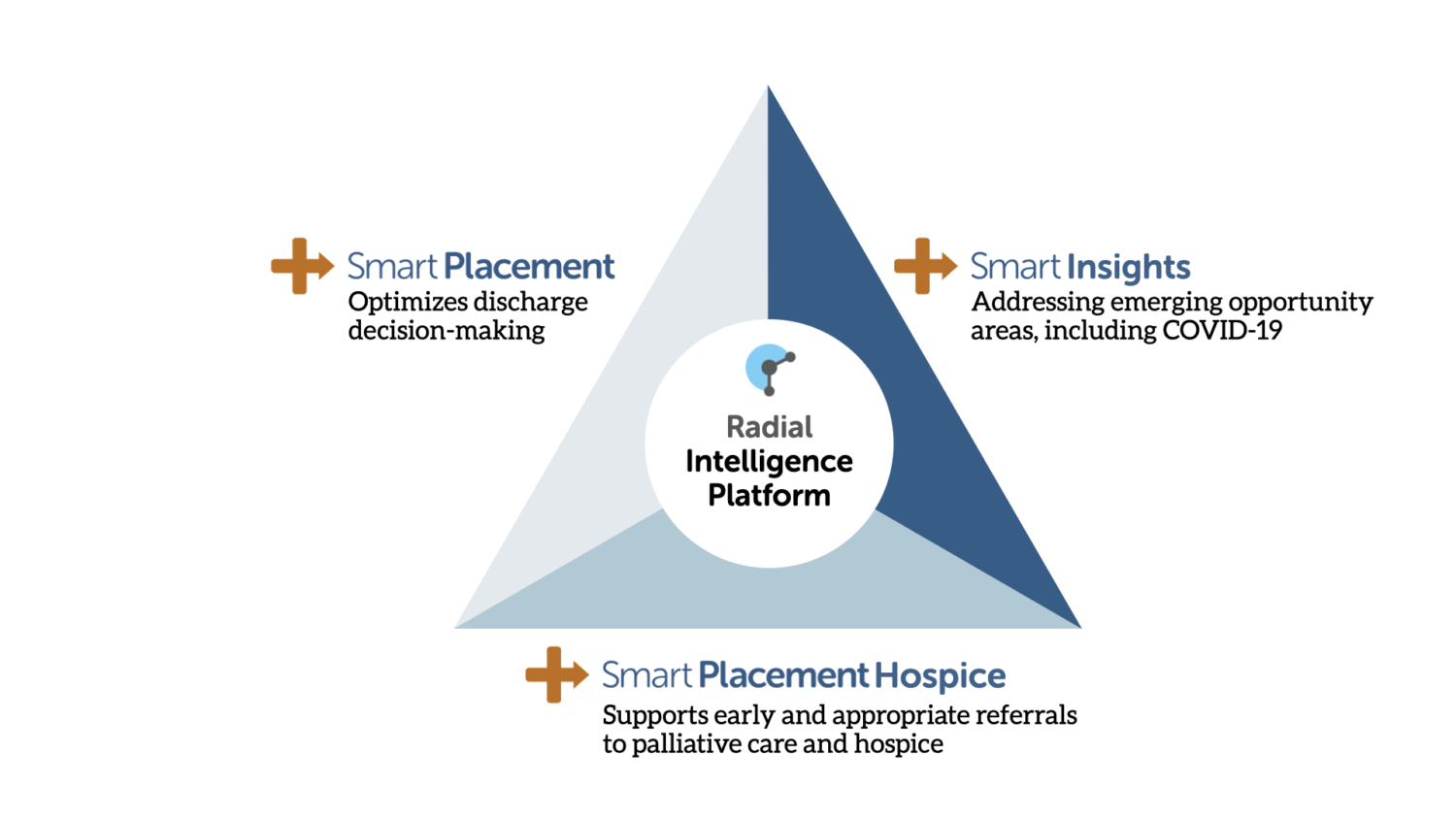
Developed in part through National Science Foundation innovation funding, Radial Analytics platform, Smart Placement transforms data into real-time patient-individualized actionable insights. The platform incorporates data from over 18 million patients, has processed more than 82 million patient encounters, and has been used daily by health insurance plans and hospitals for 3+ years. Smart Placement promotes collaboration between payer/ACO and partner hospitals leveraging machine learning and natural language processing (NLP) to identify which patients can and should safely be discharged home with services after a hospitalization.

Smart Placement has been proven to allow more elders to get discharged home from the hospital with robust home-based healthcare services. Results show lower costs, improved outcomes, and better patient satisfaction. Today, Smart Placement is deployed with payers and hospitals throughout New England, delivering real-time insights that “nudge” nurses and caregivers in the right direction, enabling higher-quality and more cost-effective decisions for the seniors they serve.

  • LinkedIn
  • Twitter
  • Facebook
  • Email
  • Print

Tagged With: Care Coordination, Patient Care

Tap Native

Get in-depth healthcare technology analysis and commentary delivered straight to your email weekly

Reader Interactions

Primary Sidebar

Subscribe to HIT Consultant

Latest insightful articles delivered straight to your inbox weekly.

Submit a Tip or Pitch

2026 Predictions & Trends

Healthcare 2026 Forecast: Executives on AI Survival, Financial Reckoning, and the End of Point Solutions

2026 Healthcare Executive Predictions: Why the AI “Pilot Era” Is Officially Over

Most-Read

KLAS Report: Why Hospitals Are Choosing Efficiency Over 'Agentic' AI Hype in 2025

KLAS Report: Why Hospitals Are Choosing Efficiency Over ‘Agentic’ AI Hype in 2025

Advanced Primary Care 2026: Top 6 Investments for Health Systems According to Harvard Medical School

Advanced Primary Care 2026: Top 6 Investments for Health Systems According to Harvard Medical School

AI Nutrition Labels: The Key to Provider Adoption and Patient Trust?

AI Nutrition Labels: The Key to Provider Adoption and Patient Trust?

Kristen Hartsell, VP of Clinical Services, RedSail Technologies

The Pharmacy Closures Crisis: How Independent Pharmacies Are Fixing Pharmacy Deserts

HHS Launches 'OneHHS' AI Strategy to Integrate AI Across CDC, CMS, and FDA for Efficiency and Public Trust

HHS Launches ‘OneHHS’ AI Strategy to Integrate AI Across CDC, CMS, and FDA for Efficiency and Public Trust

From Overwhelmed to Optimized: How AI Agents Address Staffing Challenges and Burnout in Healthcare

From Overwhelmed to Optimized: How AI Agents Address Staffing Challenges and Burnout in Healthcare

The VBC Paradox: Why Hospitals Are Doubling Down on Value-Based Care While Revenue at Risk Lags

The VBC Paradox: Why Hospitals Are Doubling Down on Value-Based Care While Revenue at Risk Lags

Tebra Secures $250M to Challenge Legacy EHRs with AI-Powered Automation

Tebra Secures $250M to Challenge Legacy EHRs with AI-Powered Automation

AstraZeneca Selects Salesforce Agentforce Life Sciences to Deploy AI-Powered Global Customer Engagement

AstraZeneca Selects Salesforce Agentforce Life Sciences to Deploy AI-Powered Global Customer Engagement

Aidoc Partners with NVIDIA MONAI to Scale Open-Source Clinical AI

Aidoc Partners with NVIDIA MONAI to Scale Open-Source Clinical AI

Secondary Sidebar

Footer

Company

  • About Us
  • Advertise with Us
  • Reprints and Permissions
  • Op-Ed Submission Guidelines
  • Contact
  • Subscribe

Editorial Coverage

  • Opinion
  • Health IT
    • Care Coordination
    • EMR/EHR
    • Interoperability
    • Population Health Management
    • Revenue Cycle Management
  • Digital Health
    • Artificial Intelligence
    • Blockchain Tech
    • Precision Medicine
    • Telehealth
    • Wearables
  • Startups
  • Value-Based Care
    • Accountable Care
    • Medicare Advantage

Connect

Subscribe to HIT Consultant Media

Latest insightful articles delivered straight to your inbox weekly

Copyright © 2025. HIT Consultant Media. All Rights Reserved. Privacy Policy |