
• Skip to main content
  • Skip to secondary menu
  • Skip to primary sidebar
  • Skip to secondary sidebar
  • Skip to footer

  • Opinion
  • Health IT
    • Behavioral Health
    • Care Coordination
    • EMR/EHR
    • Interoperability
    • Patient Engagement
    • Population Health Management
    • Revenue Cycle Management
    • Social Determinants of Health
  • Digital Health
    • AI
    • Blockchain
    • Precision Medicine
    • Telehealth
    • Wearables
  • Life Sciences
  • Investments
  • M&A
  • Value-based Care
    • Accountable Care (ACOs)
    • Medicare Advantage

How Near-Infrared Imaging Technology is Improving the Patient Experience

by HITC Staff 11/24/2021 Leave a Comment

  • LinkedIn
  • Twitter
  • Facebook
  • Email
  • Print
How Near-Infrared Imaging Technology is Improving the Patient Experience

Imaging technologies are continuously improving. In some cases, imaging advancement allows for enhanced diagnostics, such as using a CT scan to classify a tumor. However, imaging advancements are also showing promise as a way to improve patient experience at the time of the procedure. In particular, their benefits are being showcased in the blood work field to expedite the blood drawing or IV placement experience and reduce patient discomfort. 

One of the most common complaints when receiving blood work is the number of tries it takes to get the needle into the vein. Some people never experience this problem, but many know the challenge that comes with blood work all too well. With the many factors that can affect vein size, such as hydration level and genetics, inserting the needle correctly can be difficult, especially if the person drawing the blood is still relatively new in the field. Practice may make perfect, but that doesn’t mean you want to offer your arm as the practice pin cushion.

A Way to Improve Vein Visualization

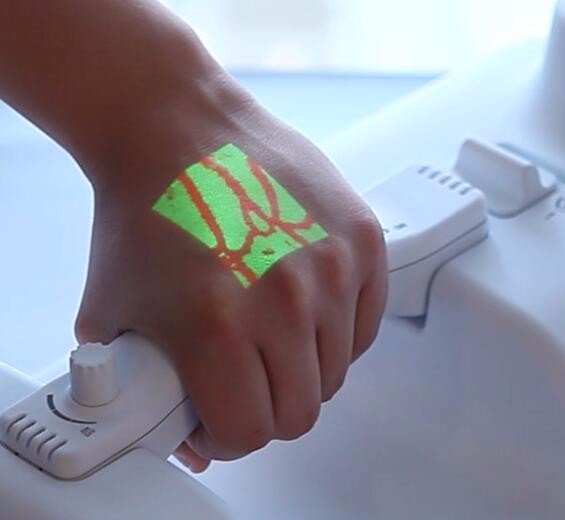
To help make the process of blood drawing smoother, vein visualizers provide a way for phlebotomists to see the veins more easily. Not only does this aid in placing the needle, but it also helps them place the needle in the best vein.

One auspicious method of vein visualization utilizes near-infrared imaging technology, which is commonly used in smartwatches to measure blood oxygen saturation. It’s painless but can provide important information.

Near-infrared imaging technology utilizes near-infrared light directed into the skin. The near-infrared light is then absorbed by the blood but reflected by the surrounding tissue. These vein finder devices can then capture, process, and digitally projected onto the skin’s surface, showing where the veins are.

Not only does this benefit those who have a hard time finding the vein, but these devices can also be immensely beneficial in an emergency when inserting an IV needs to be done quickly, and time cannot be wasted on multiple placement attempts.

Relief for a Significant Population Group

Patients who significantly benefit from vein finders are those who the medical industry terms “difficult sticks”. The usage of this name means no harm; it’s simply a fact that those who are older, overweight, agitated, or in a hurry and those with diabetes, severe burns, or IV drug use typically have veins that are harder to find and stick.

By making the needle placement process easier and faster through the usage of vein finders, the experience of these patients improves; they don’t experience as much pain, discomfort, and agitation.

In addition, many people may choose to forego regular blood work if they know, from experience, that it will not be pleasant. With early detection one of the keys to successful treatment of many diseases, this reluctance to receive blood work could result in a poorer diagnosis and more extensive treatment required in the future.

The bottom line is that some people are just more likely to be difficult sticks when drawing blood or placing IVs, but that doesn’t mean they have to suffer for this. With all the advancements in the medical field, there’s no longer a reason for patients to suffer through multiple sticking attempts when vein finders exist and can assist with the process.

  • LinkedIn
  • Twitter
  • Facebook
  • Email
  • Print

Tagged With: Patient Experience

Tap Native

Get in-depth healthcare technology analysis and commentary delivered straight to your email weekly

Reader Interactions

Primary Sidebar

Subscribe to HIT Consultant

Latest insightful articles delivered straight to your inbox weekly.

Submit a Tip or Pitch

2026 Predictions & Trends

Healthcare 2026 Forecast: Executives on AI Survival, Financial Reckoning, and the End of Point Solutions

2026 Healthcare Executive Predictions: Why the AI “Pilot Era” Is Officially Over

Most-Read

HHS Launches 'OneHHS' AI Strategy to Integrate AI Across CDC, CMS, and FDA for Efficiency and Public Trust

HHS Launches ‘OneHHS’ AI Strategy to Integrate AI Across CDC, CMS, and FDA for Efficiency and Public Trust

Kristen Hartsell, VP of Clinical Services, RedSail Technologies

The Pharmacy Closures Crisis: How Independent Pharmacies Are Fixing Pharmacy Deserts

From Overwhelmed to Optimized: How AI Agents Address Staffing Challenges and Burnout in Healthcare

From Overwhelmed to Optimized: How AI Agents Address Staffing Challenges and Burnout in Healthcare

The VBC Paradox: Why Hospitals Are Doubling Down on Value-Based Care While Revenue at Risk Lags

The VBC Paradox: Why Hospitals Are Doubling Down on Value-Based Care While Revenue at Risk Lags

Tebra Secures $250M to Challenge Legacy EHRs with AI-Powered Automation

Tebra Secures $250M to Challenge Legacy EHRs with AI-Powered Automation

AstraZeneca Selects Salesforce Agentforce Life Sciences to Deploy AI-Powered Global Customer Engagement

AstraZeneca Selects Salesforce Agentforce Life Sciences to Deploy AI-Powered Global Customer Engagement

Aidoc Partners with NVIDIA MONAI to Scale Open-Source Clinical AI

Aidoc Partners with NVIDIA MONAI to Scale Open-Source Clinical AI

RapidAI Secures FDA Clearance for Five New Deep Clinical AI Modules, Expanding Enterprise Imaging Platform

RapidAI and AWS Deepen Partnership to Scale Clinical AI in Healthcare

Greece and Sword Health to Build AI-Powered Healthcare Front Door

Greece and Sword Health to Build AI-Powered Healthcare Front Door

GE HealthCare Acquires Intelerad for $2.3B to Create Cloud-First, AI-Enabled Imaging Ecosystem

GE HealthCare Acquires Intelerad for $2.3B to Create Cloud-First, AI-Enabled Imaging Ecosystem

Secondary Sidebar

Footer

Company

  • About Us
  • Advertise with Us
  • Reprints and Permissions
  • Op-Ed Submission Guidelines
  • Contact
  • Subscribe

Editorial Coverage

  • Opinion
  • Health IT
    • Care Coordination
    • EMR/EHR
    • Interoperability
    • Population Health Management
    • Revenue Cycle Management
  • Digital Health
    • Artificial Intelligence
    • Blockchain Tech
    • Precision Medicine
    • Telehealth
    • Wearables
  • Startups
  • Value-Based Care
    • Accountable Care
    • Medicare Advantage

Connect

Subscribe to HIT Consultant Media

Latest insightful articles delivered straight to your inbox weekly

Copyright © 2025. HIT Consultant Media. All Rights Reserved. Privacy Policy |