
• Skip to main content
  • Skip to secondary menu
  • Skip to primary sidebar
  • Skip to secondary sidebar
  • Skip to footer

  • Opinion
  • Health IT
    • Behavioral Health
    • Care Coordination
    • EMR/EHR
    • Interoperability
    • Patient Engagement
    • Population Health Management
    • Revenue Cycle Management
    • Social Determinants of Health
  • Digital Health
    • AI
    • Blockchain
    • Precision Medicine
    • Telehealth
    • Wearables
  • Life Sciences
  • Investments
  • M&A
  • Value-based Care
    • Accountable Care (ACOs)
    • Medicare Advantage

Apple, Stanford Launches Heart Study App to Identify Irregular Heart Rhythms

by Jasmine Pennic 11/30/2017 Leave a Comment

  • LinkedIn
  • Twitter
  • Facebook
  • Email
  • Print

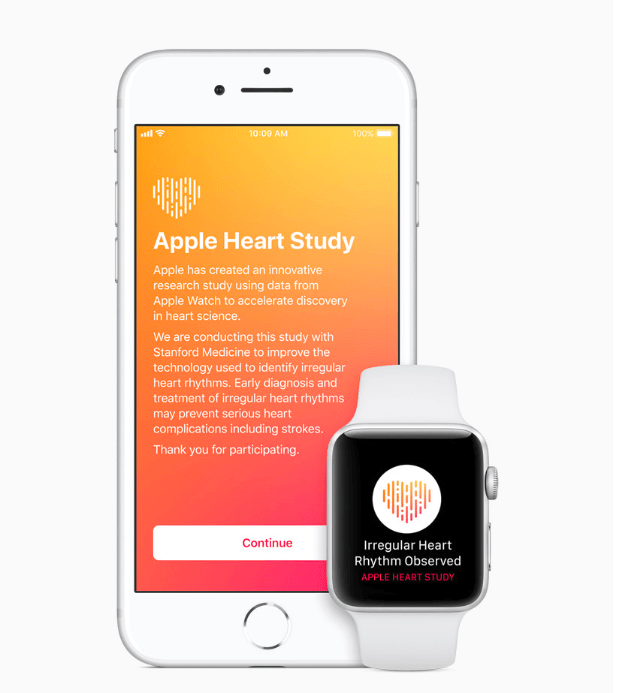
Apple Launches Heart App Study to Identify Irregular Heart Rhythms

Apple in partnership with Stanford Medicine has announced the  launch of the Apple Heart Study app, a first-of-its-kind innovative research study using Apple Watch’s heart rate sensor to collect data on irregular heart rhythms and notify users who may be experiencing atrial fibrillation (AFib). The Apple Heart Study app uses this technology to identify an irregular heart rhythm.

Atrial Fibrillation (AFib), is the most common heart arrhythmia, and a leading cause of stroke. AFib affects more than 30 million people worldwide, and one in four people over the age of 40 are at risk for developing it. Millions of people around the world are unknowingly living with AFib. Yet, two out of three strokes are preventable when AFib is detected and treated appropriately.

Apple Heart Study Overview

To calculate heart rate and rhythm, Apple Watch’s sensor uses green LED lights flashing hundreds of times per second and light-sensitive photodiodes to detect the amount of blood flowing through the wrist. The sensor’s unique optical design gathers signals from four distinct points on the wrist, and when combined with powerful software algorithms, Apple Watch isolates heart rhythms from other noise. 

As part of the study, if an irregular heart rhythm is identified, participants will receive a notification on their Apple Watch and iPhone, a free consultation with a study doctor and an electrocardiogram (ECG) patch for additional monitoring. The Apple Heart Study app is available in the US App Store to customers who are 22 years or older and have an Apple Watch Series 1 or later.

“Every week we receive incredible customer letters about how Apple Watch has affected their lives, including learning that they have AFib. These stories inspire us and we’re determined to do more to help people understand their health,” said Jeff Williams, Apple’s COO in a statement. “Working alongside the medical community, not only can we inform people of certain health conditions, we also hope to advance discoveries in heart science.”

  • LinkedIn
  • Twitter
  • Facebook
  • Email
  • Print

Tagged With: Apple CareKit, Apple Heart Study, Apple ResearchKit, Apple Watch, Atrial Fibrillation, Researchkit App

Tap Native

Get in-depth healthcare technology analysis and commentary delivered straight to your email weekly

Reader Interactions

Primary Sidebar

Subscribe to HIT Consultant

Latest insightful articles delivered straight to your inbox weekly.

Submit a Tip or Pitch

2026 Predictions & Trends

Healthcare 2026 Forecast: Executives on AI Survival, Financial Reckoning, and the End of Point Solutions

2026 Healthcare Executive Predictions: Why the AI “Pilot Era” Is Officially Over

Most-Read

HHS Launches 'OneHHS' AI Strategy to Integrate AI Across CDC, CMS, and FDA for Efficiency and Public Trust

HHS Launches ‘OneHHS’ AI Strategy to Integrate AI Across CDC, CMS, and FDA for Efficiency and Public Trust

Kristen Hartsell, VP of Clinical Services, RedSail Technologies

The Pharmacy Closures Crisis: How Independent Pharmacies Are Fixing Pharmacy Deserts

From Overwhelmed to Optimized: How AI Agents Address Staffing Challenges and Burnout in Healthcare

From Overwhelmed to Optimized: How AI Agents Address Staffing Challenges and Burnout in Healthcare

The VBC Paradox: Why Hospitals Are Doubling Down on Value-Based Care While Revenue at Risk Lags

The VBC Paradox: Why Hospitals Are Doubling Down on Value-Based Care While Revenue at Risk Lags

Tebra Secures $250M to Challenge Legacy EHRs with AI-Powered Automation

Tebra Secures $250M to Challenge Legacy EHRs with AI-Powered Automation

AstraZeneca Selects Salesforce Agentforce Life Sciences to Deploy AI-Powered Global Customer Engagement

AstraZeneca Selects Salesforce Agentforce Life Sciences to Deploy AI-Powered Global Customer Engagement

Aidoc Partners with NVIDIA MONAI to Scale Open-Source Clinical AI

Aidoc Partners with NVIDIA MONAI to Scale Open-Source Clinical AI

RapidAI Secures FDA Clearance for Five New Deep Clinical AI Modules, Expanding Enterprise Imaging Platform

RapidAI and AWS Deepen Partnership to Scale Clinical AI in Healthcare

Greece and Sword Health to Build AI-Powered Healthcare Front Door

Greece and Sword Health to Build AI-Powered Healthcare Front Door

GE HealthCare Acquires Intelerad for $2.3B to Create Cloud-First, AI-Enabled Imaging Ecosystem

GE HealthCare Acquires Intelerad for $2.3B to Create Cloud-First, AI-Enabled Imaging Ecosystem

Secondary Sidebar

Footer

Company

  • About Us
  • Advertise with Us
  • Reprints and Permissions
  • Op-Ed Submission Guidelines
  • Contact
  • Subscribe

Editorial Coverage

  • Opinion
  • Health IT
    • Care Coordination
    • EMR/EHR
    • Interoperability
    • Population Health Management
    • Revenue Cycle Management
  • Digital Health
    • Artificial Intelligence
    • Blockchain Tech
    • Precision Medicine
    • Telehealth
    • Wearables
  • Startups
  • Value-Based Care
    • Accountable Care
    • Medicare Advantage

Connect

Subscribe to HIT Consultant Media

Latest insightful articles delivered straight to your inbox weekly

Copyright © 2025. HIT Consultant Media. All Rights Reserved. Privacy Policy |