
• Skip to main content
  • Skip to secondary menu
  • Skip to primary sidebar
  • Skip to secondary sidebar
  • Skip to footer

  • Opinion
  • Health IT
    • Behavioral Health
    • Care Coordination
    • EMR/EHR
    • Interoperability
    • Patient Engagement
    • Population Health Management
    • Revenue Cycle Management
    • Social Determinants of Health
  • Digital Health
    • AI
    • Blockchain
    • Precision Medicine
    • Telehealth
    • Wearables
  • Life Sciences
  • Investments
  • M&A
  • Value-based Care
    • Accountable Care (ACOs)
    • Medicare Advantage

Quietyme Unveils Intelligent Sensor For Real-Time Noise Reduction in Hospitals

by Jasmine Pennic 04/28/2016 Leave a Comment

  • LinkedIn
  • Twitter
  • Facebook
  • Email
  • Print

Quietyme

Quietyme (pronounced “quiet time”), a intelligent sensor-focused company, today announced the launch of its automated, end-to-end solution for hospital noise reduction. The intelligent sensor technology utilizes proven continuous process improvement methods to prompt real-time modifications for an improved overall patient experience. The enhanced Quietyme solution is being rolled out to all current client hospitals and will be available for all future customers beginning the end of May 2016.

Hospital Noise Levels Impact on Patient Experience

According to a study published in the Journal of the American Medical Association, “hospital noise levels in patient rooms are markedly higher than recommended levels and associated with clinically significant sleep loss.” The study further suggests hospitals should reduce noise levels in order to ‘improve patient satisfaction and health outcomes.’

Studies like this have influenced the areas of improvement on which hospital focus. The Beryl Institute states in its State of the Patient Experience report that among U.S. hospitals, “reducing noise remains the top priority” each time they have done the survey since 2011. Although the problem is well defined and has gained attention of hospitals, a sustainable solution has been elusive. Most hospitals try a few things that seem like common-sense solutions, only to see any noise reducing gains from their efforts lost within a few weeks or months.

How It Works

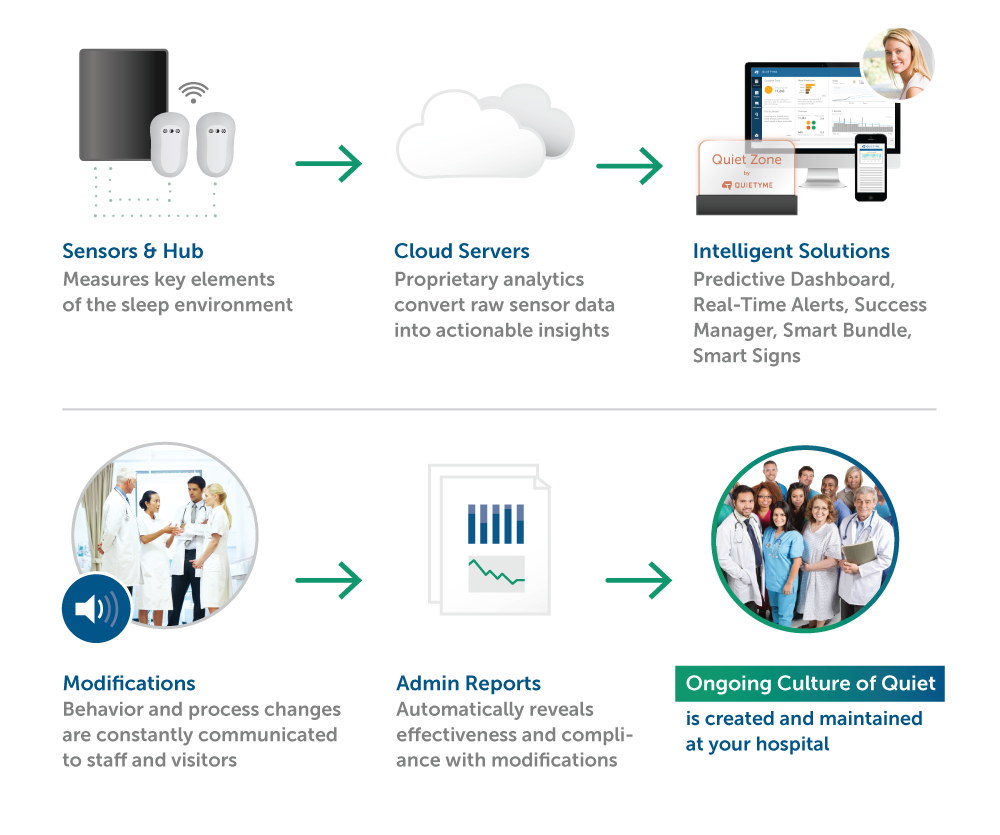
The enhanced Quietyme solution helps hospitals effortlessly reduce noise levels and maintain them long-term.  Hospitals simply plug in small decibel sensors throughout the nursing unit, and through analytics on Quietyme’s cloud server the solution is delivered via online dashboard, email attachment, real-time mobile alerts and visual smart signs placed in the environment. The easy to launch and easy to manage solution yields reduced noise, increase patient experience HCAHPS scores, and improved patient medical outcomes.

The solution includes:

– Enhanced predictive dashboard. Hospitals can make intervene before noise reaches projected levels.

– Smart Bundle. Identifies the 1 to 3 modifications specific for each nursing unit each day that will make the largest impact on noise reduction immediately

– Smart Signs. Attractive, edge-lit sign alerts staff and visitors when noise disturbances are occurring.

– Compliance & Effectiveness Reports. Automatically holds staff accountable for improvement and identifies what is having the largest impact.

Since installing at U.S. hospitals starting a little over a year ago, Quietyme has lowered noise and increased HCAHPS for client hospitals around the country including an impressive double-digit increase in HCAHPS Quiet at Night scores on a pilot nursing unit at Rochester General Hospital in Rochester, N.Y.

  • LinkedIn
  • Twitter
  • Facebook
  • Email
  • Print

Tagged With: Quietyme

Tap Native

Get in-depth healthcare technology analysis and commentary delivered straight to your email weekly

Reader Interactions

Primary Sidebar

Subscribe to HIT Consultant

Latest insightful articles delivered straight to your inbox weekly.

Submit a Tip or Pitch

2026 Predictions & Trends

Healthcare 2026 Forecast: Executives on AI Survival, Financial Reckoning, and the End of Point Solutions

2026 Healthcare Executive Predictions: Why the AI “Pilot Era” Is Officially Over

Most-Read

Utah Becomes First State to Approve AI System for Prescription Renewals

Utah Becomes First State to Approve AI System for Prescription Renewals

NYC Health + Hospitals to Acquire Maimonides in $2.2B Safety Net Overhaul

NYC Health + Hospitals to Acquire Maimonides in $2.2B Safety Net Overhaul

KLAS Report: Why Hospitals Are Choosing Efficiency Over 'Agentic' AI Hype in 2025

KLAS Report: Why Hospitals Are Choosing Efficiency Over ‘Agentic’ AI Hype in 2025

Advanced Primary Care 2026: Top 6 Investments for Health Systems According to Harvard Medical School

Advanced Primary Care 2026: Top 6 Investments for Health Systems According to Harvard Medical School

AI Nutrition Labels: The Key to Provider Adoption and Patient Trust?

AI Nutrition Labels: The Key to Provider Adoption and Patient Trust?

Kristen Hartsell, VP of Clinical Services, RedSail Technologies

The Pharmacy Closures Crisis: How Independent Pharmacies Are Fixing Pharmacy Deserts

HHS Launches 'OneHHS' AI Strategy to Integrate AI Across CDC, CMS, and FDA for Efficiency and Public Trust

HHS Launches ‘OneHHS’ AI Strategy to Integrate AI Across CDC, CMS, and FDA for Efficiency and Public Trust

From Overwhelmed to Optimized: How AI Agents Address Staffing Challenges and Burnout in Healthcare

From Overwhelmed to Optimized: How AI Agents Address Staffing Challenges and Burnout in Healthcare

The VBC Paradox: Why Hospitals Are Doubling Down on Value-Based Care While Revenue at Risk Lags

The VBC Paradox: Why Hospitals Are Doubling Down on Value-Based Care While Revenue at Risk Lags

Tebra Secures $250M to Challenge Legacy EHRs with AI-Powered Automation

Tebra Secures $250M to Challenge Legacy EHRs with AI-Powered Automation

Secondary Sidebar

Footer

Company

  • About Us
  • Advertise with Us
  • Reprints and Permissions
  • Op-Ed Submission Guidelines
  • Contact
  • Subscribe

Editorial Coverage

  • Opinion
  • Health IT
    • Care Coordination
    • EMR/EHR
    • Interoperability
    • Population Health Management
    • Revenue Cycle Management
  • Digital Health
    • Artificial Intelligence
    • Blockchain Tech
    • Precision Medicine
    • Telehealth
    • Wearables
  • Startups
  • Value-Based Care
    • Accountable Care
    • Medicare Advantage

Connect

Subscribe to HIT Consultant Media

Latest insightful articles delivered straight to your inbox weekly

Copyright © 2026. HIT Consultant Media. All Rights Reserved. Privacy Policy |