
• Skip to main content
  • Skip to secondary menu
  • Skip to primary sidebar
  • Skip to secondary sidebar
  • Skip to footer

  • Opinion
  • Health IT
    • Behavioral Health
    • Care Coordination
    • EMR/EHR
    • Interoperability
    • Patient Engagement
    • Population Health Management
    • Revenue Cycle Management
    • Social Determinants of Health
  • Digital Health
    • AI
    • Blockchain
    • Precision Medicine
    • Telehealth
    • Wearables
  • Life Sciences
  • Investments
  • M&A
  • Value-based Care
    • Accountable Care (ACOs)
    • Medicare Advantage

2016 HIMSS Value of Health IT Survey: 6 Trends to Know

by Jasmine Pennic 01/12/2016 Leave a Comment

  • LinkedIn
  • Twitter
  • Facebook
  • Email
  • Print

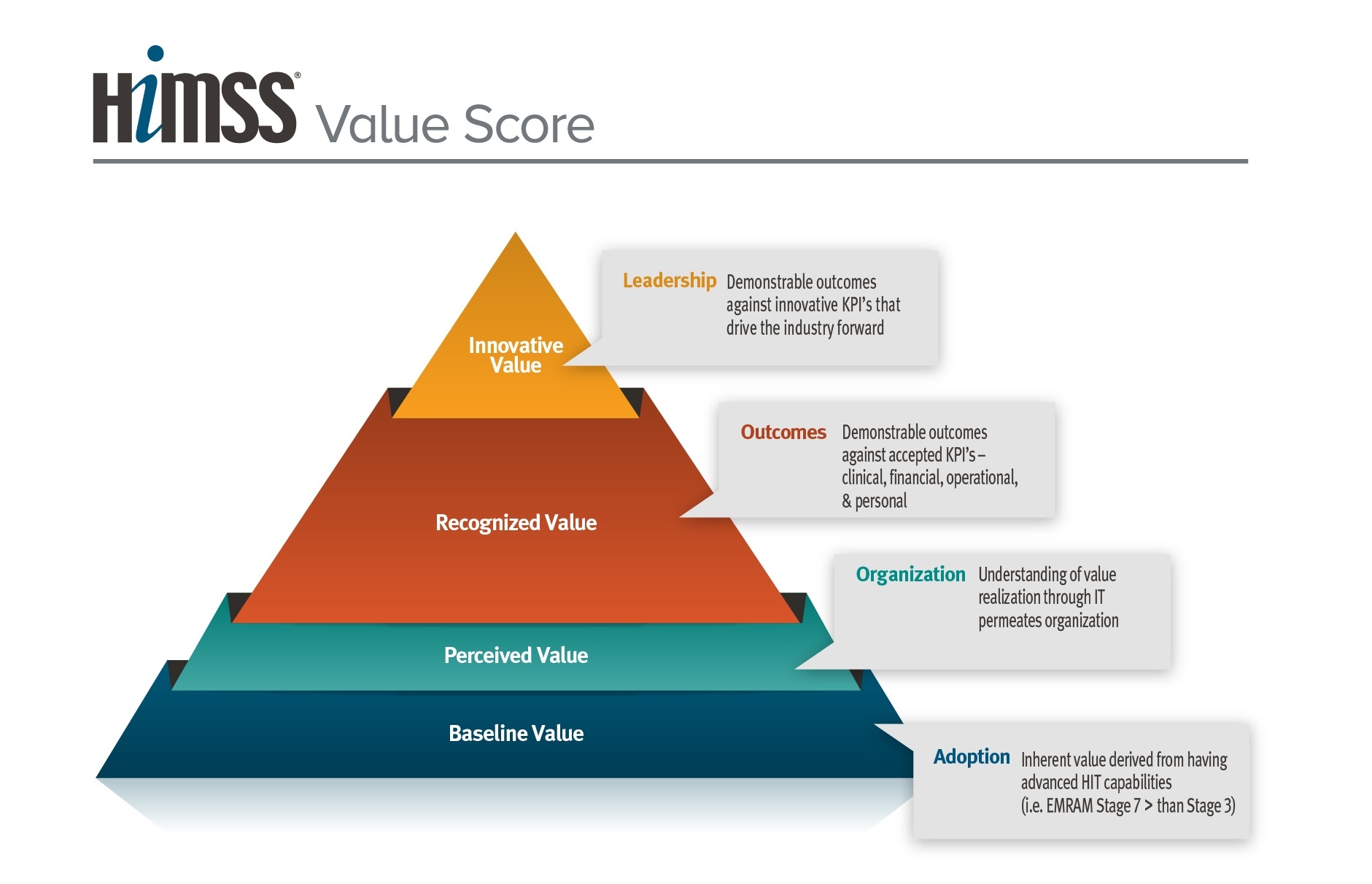
HIMSS Launches Value Score, Healthcare’s First International Quality and Value Measurement for Health IT_HIMSS Value of Health IT Survey

On Monday, HIMSS released the 2016 finding of its Value of Health IT survey that reflects the feedback from 52 senior IT leaders representing HIMSS Analytics EMRAM Stage 6 or 7 hospitals and HIMSS Davies winners, during the Summer/Fall 2015. The survey found that found that 88 percent of organizations with advanced EHR environments identified at least one positive outcome from their use of an EHR. 

Survey highlights include:

Treatment/Clinical: 83 percent indicated that their organization’s EHR implementation yielded increased efficiencies in clinical staff quality performance, with 52 percent of respondents reporting increased efficiencies in the area of clinical staff productivity.

Elimination of duplicate testing and access to patient information were the top areas in which efficiencies were noted at respondent’s organizations.  

Savings: 90 percent of IT leaders reported  that their organization had a formal measurement process in place for at least one financial metric. More than three-quarters (81 percent) reported that their organization documented a positive impact in the area of savings.

The three areas where respondents were most likely to report achieving a positive financial impact were coding accuracy, days in accounts receivable (AR) and transcription costs. 

Electronic Data/Information: Three-quarters of IT leaders  indicated their organization measured at least one of the electronic data/information metrics included in this survey. More than half (58 percent) reported that their organization had documented a positive impact in at least one of the areas included in the survey.

The area with the most positive impact as a result of their organization’s EHR implementation was the ability to share information among providers. 

Prevention and Patient Education:  69 percent of IT leaders reported that their organization has implemented a formal patient engagement strategy, only 42 percent currently have a population health strategy in place at this time.

Additionally, respondents reported beginning to see a positive impact with respect to their EHR implementation in a number of areas, including use of a patient portal (61 percent) and distribution of patient education materials (50 percent)

Satisfaction: 44 percent of respondents reported satisfaction among nurses, whereas only 29 percent of respondents reported satisfaction among physicians. 

Barrier for Deriving Value from EHR Implementation: Respondents indicated that “competing priorities” was the biggest barrier to driving value from their EHR implementation. 

Survey Background/Methodology

Limited exclusively to hospitals with highly sophisticated EHR environments (e.g. hospital having achieved Stage 6 or 7 on the HIMSS Analytics EMRAMSMmodel and HIMSS Davies winners) the survey identified and profiled patterns in Health IT value experiences leveraging the HIMSS STEPSTM model. TheHIMSS STEPSTM model, one of several components in the Health IT Value Suite, is a framework which categorizes health IT value experiences into five general areas:

– Satisfaction

– Treatment/Clinical

– Electronic Information/Data

– Patient Engagement

Population Management and Savings

While value expressions were registered in all five areas of the STEPSTM model, the findings from this study reveal that treatment/clinical benefits were most common to EHR leading healthcare organizations.

  • LinkedIn
  • Twitter
  • Facebook
  • Email
  • Print

Tagged With: himss

Tap Native

Get in-depth healthcare technology analysis and commentary delivered straight to your email weekly

Reader Interactions

Primary Sidebar

Subscribe to HIT Consultant

Latest insightful articles delivered straight to your inbox weekly.

Submit a Tip or Pitch

2026 Predictions & Trends

Healthcare 2026 Forecast: Executives on AI Survival, Financial Reckoning, and the End of Point Solutions

2026 Healthcare Executive Predictions: Why the AI “Pilot Era” Is Officially Over

Most-Read

HHS Launches 'OneHHS' AI Strategy to Integrate AI Across CDC, CMS, and FDA for Efficiency and Public Trust

HHS Launches ‘OneHHS’ AI Strategy to Integrate AI Across CDC, CMS, and FDA for Efficiency and Public Trust

Kristen Hartsell, VP of Clinical Services, RedSail Technologies

The Pharmacy Closures Crisis: How Independent Pharmacies Are Fixing Pharmacy Deserts

From Overwhelmed to Optimized: How AI Agents Address Staffing Challenges and Burnout in Healthcare

From Overwhelmed to Optimized: How AI Agents Address Staffing Challenges and Burnout in Healthcare

The VBC Paradox: Why Hospitals Are Doubling Down on Value-Based Care While Revenue at Risk Lags

The VBC Paradox: Why Hospitals Are Doubling Down on Value-Based Care While Revenue at Risk Lags

Tebra Secures $250M to Challenge Legacy EHRs with AI-Powered Automation

Tebra Secures $250M to Challenge Legacy EHRs with AI-Powered Automation

AstraZeneca Selects Salesforce Agentforce Life Sciences to Deploy AI-Powered Global Customer Engagement

AstraZeneca Selects Salesforce Agentforce Life Sciences to Deploy AI-Powered Global Customer Engagement

Aidoc Partners with NVIDIA MONAI to Scale Open-Source Clinical AI

Aidoc Partners with NVIDIA MONAI to Scale Open-Source Clinical AI

RapidAI Secures FDA Clearance for Five New Deep Clinical AI Modules, Expanding Enterprise Imaging Platform

RapidAI and AWS Deepen Partnership to Scale Clinical AI in Healthcare

Greece and Sword Health to Build AI-Powered Healthcare Front Door

Greece and Sword Health to Build AI-Powered Healthcare Front Door

GE HealthCare Acquires Intelerad for $2.3B to Create Cloud-First, AI-Enabled Imaging Ecosystem

GE HealthCare Acquires Intelerad for $2.3B to Create Cloud-First, AI-Enabled Imaging Ecosystem

Secondary Sidebar

Footer

Company

  • About Us
  • Advertise with Us
  • Reprints and Permissions
  • Op-Ed Submission Guidelines
  • Contact
  • Subscribe

Editorial Coverage

  • Opinion
  • Health IT
    • Care Coordination
    • EMR/EHR
    • Interoperability
    • Population Health Management
    • Revenue Cycle Management
  • Digital Health
    • Artificial Intelligence
    • Blockchain Tech
    • Precision Medicine
    • Telehealth
    • Wearables
  • Startups
  • Value-Based Care
    • Accountable Care
    • Medicare Advantage

Connect

Subscribe to HIT Consultant Media

Latest insightful articles delivered straight to your inbox weekly

Copyright © 2025. HIT Consultant Media. All Rights Reserved. Privacy Policy |