

• Skip to main content
  • Skip to secondary menu
  • Skip to primary sidebar
  • Skip to secondary sidebar
  • Skip to footer

  • Opinion
  • Health IT
    • Behavioral Health
    • Care Coordination
    • EMR/EHR
    • Interoperability
    • Patient Engagement
    • Population Health Management
    • Revenue Cycle Management
    • Social Determinants of Health
  • Digital Health
    • AI
    • Blockchain
    • Precision Medicine
    • Telehealth
    • Wearables
  • Life Sciences
  • Investments
  • M&A
  • Value-based Care
    • Accountable Care (ACOs)
    • Medicare Advantage

FDA Approval of Digital Health Solutions Expected to Triple by 2018

by HITC Staff 06/04/2015 Leave a Comment

  • LinkedIn
  • Twitter
  • Facebook
  • Email
  • Print

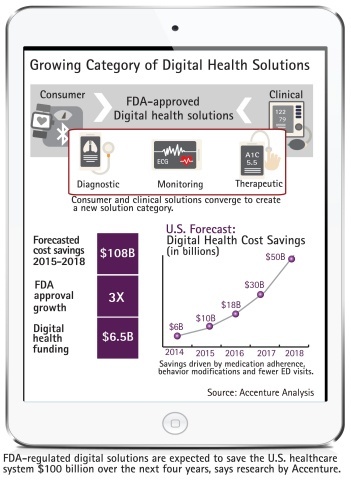
Accenture_Digital_health_chartFDA-regulated digital health solutions are expected to save the U.S. healthcare system more than $100 billion over the next four years, according to new research from Accenture. Accenture also predicts that FDA approvals of digital health solutions will triple by the end of 2018, to 100, from 33 last year. 

The Accenture study assessed the number of digital health solutions that received FDA 510(k) clearance from 2010 through 2014. The analysis focused on devices and software created for [medical] indications that are FDA-regulated but incorporate consumer-driven principles, such as mobility, user experience, industrial design and always-on connectivity.

Accenture estimates that FDA-approved digital health solutions – an internet-connected device or software created for detection or treatment of a medical indication – achieved $6 billion in cost savings in 2014, primarily driven by medication adherence, behavior modifications and fewer emergency room visits.

The company expects that figure to rise to $10 billion in 2015, $18 billion in 2016, $30 billion in 2017 and $50 billion in 2018. 

“A digital disruption is playing out in healthcare, as witnessed by the emergence of new business models and technology that will change the nature of patient interactions, alter consumer expectations and ultimately improve health outcomes,” said Rick Ratliff, managing director of digital health solutions, Accenture.

Factors Influencing FDA-Approved Digital Health Solutions

Accenture’s research found several factors, such as health IT mandates, payment reform and regulatory changes will accelerate the growth of FDA-approved digital solutions:

– Increased use of healthcare IT among physicians and patients, driven by federal Meaningful Use mandates, will continue enabling devices and solutions to integrate with patient portals and digital health records. In fact, a recent survey from Accenture found one-in-four U.S. physicians routinely use tele-monitoring devices for some aspect of chronic disease management.

– Growing demand for patients to self-manage care: Accenture estimates the number of U.S. consumers who own a wearable fitness device will double in the next five years, from 22 percent this year to 43 percent by 2020. In fact, an Accenture survey found over half (57 percent) of U.S. consumers self-track their health information online, such as medical history (cited by 37 percent of respondents), physical activity (34 percent) and symptoms (33 percent).

– Recently released regulatory guidelines for low-risk health products, establishing a line between when a wellness tool — such as a heart rate monitor — becomes a medical device, will enable more clarity on the process, expedite regulatory pathways and is expected to drive 30 percent annual growth of these solutions through 2018.

– A shift to value-based reimbursement is creating fertile ground for clinical and business strategies that incorporate [digital health] devices. Accenture estimates digital health funding will reach $6.5 billion by 2018.

  • LinkedIn
  • Twitter
  • Facebook
  • Email
  • Print

Tap Native

Get in-depth healthcare technology analysis and commentary delivered straight to your email weekly

Reader Interactions

Primary Sidebar

Subscribe to HIT Consultant

Latest insightful articles delivered straight to your inbox weekly.

Submit a Tip or Pitch

2026 Predictions & Trends

Healthcare 2026 Forecast: Executives on AI Survival, Financial Reckoning, and the End of Point Solutions

2026 Healthcare Executive Predictions: Why the AI “Pilot Era” Is Officially Over

Most-Read

KLAS Report: Why Hospitals Are Choosing Efficiency Over 'Agentic' AI Hype in 2025

KLAS Report: Why Hospitals Are Choosing Efficiency Over ‘Agentic’ AI Hype in 2025

Advanced Primary Care 2026: Top 6 Investments for Health Systems According to Harvard Medical School

Advanced Primary Care 2026: Top 6 Investments for Health Systems According to Harvard Medical School

AI Nutrition Labels: The Key to Provider Adoption and Patient Trust?

AI Nutrition Labels: The Key to Provider Adoption and Patient Trust?

Kristen Hartsell, VP of Clinical Services, RedSail Technologies

The Pharmacy Closures Crisis: How Independent Pharmacies Are Fixing Pharmacy Deserts

HHS Launches 'OneHHS' AI Strategy to Integrate AI Across CDC, CMS, and FDA for Efficiency and Public Trust

HHS Launches ‘OneHHS’ AI Strategy to Integrate AI Across CDC, CMS, and FDA for Efficiency and Public Trust

From Overwhelmed to Optimized: How AI Agents Address Staffing Challenges and Burnout in Healthcare

From Overwhelmed to Optimized: How AI Agents Address Staffing Challenges and Burnout in Healthcare

The VBC Paradox: Why Hospitals Are Doubling Down on Value-Based Care While Revenue at Risk Lags

The VBC Paradox: Why Hospitals Are Doubling Down on Value-Based Care While Revenue at Risk Lags

Tebra Secures $250M to Challenge Legacy EHRs with AI-Powered Automation

Tebra Secures $250M to Challenge Legacy EHRs with AI-Powered Automation

AstraZeneca Selects Salesforce Agentforce Life Sciences to Deploy AI-Powered Global Customer Engagement

AstraZeneca Selects Salesforce Agentforce Life Sciences to Deploy AI-Powered Global Customer Engagement

Aidoc Partners with NVIDIA MONAI to Scale Open-Source Clinical AI

Aidoc Partners with NVIDIA MONAI to Scale Open-Source Clinical AI

Secondary Sidebar

Footer

Company

  • About Us
  • Advertise with Us
  • Reprints and Permissions
  • Op-Ed Submission Guidelines
  • Contact
  • Subscribe

Editorial Coverage

  • Opinion
  • Health IT
    • Care Coordination
    • EMR/EHR
    • Interoperability
    • Population Health Management
    • Revenue Cycle Management
  • Digital Health
    • Artificial Intelligence
    • Blockchain Tech
    • Precision Medicine
    • Telehealth
    • Wearables
  • Startups
  • Value-Based Care
    • Accountable Care
    • Medicare Advantage

Connect

Subscribe to HIT Consultant Media

Latest insightful articles delivered straight to your inbox weekly

Copyright © 2025. HIT Consultant Media. All Rights Reserved. Privacy Policy |