

What You Should Know
- GE HealthCare officially announced the launch of two new artificial intelligence-assisted software capabilities for its Vscan Air handheld point-of-care ultrasound (POCUS) platform: Lung Guidance and AutoAS.
- Both algorithms are 510(k) cleared by the U.S. Food and Drug Administration (FDA) and CE marked, available immediately for purchase through Vscan Air Innovation Packages in the U.S. and select international markets.
- The dual launch directly addresses acute cardiopulmonary diagnostic ambiguity at the bedside, particularly for patients presenting with undifferentiated shortness of breath where symptoms may originate from cardiac dysfunction, pulmonary pathology, or overlapping conditions.
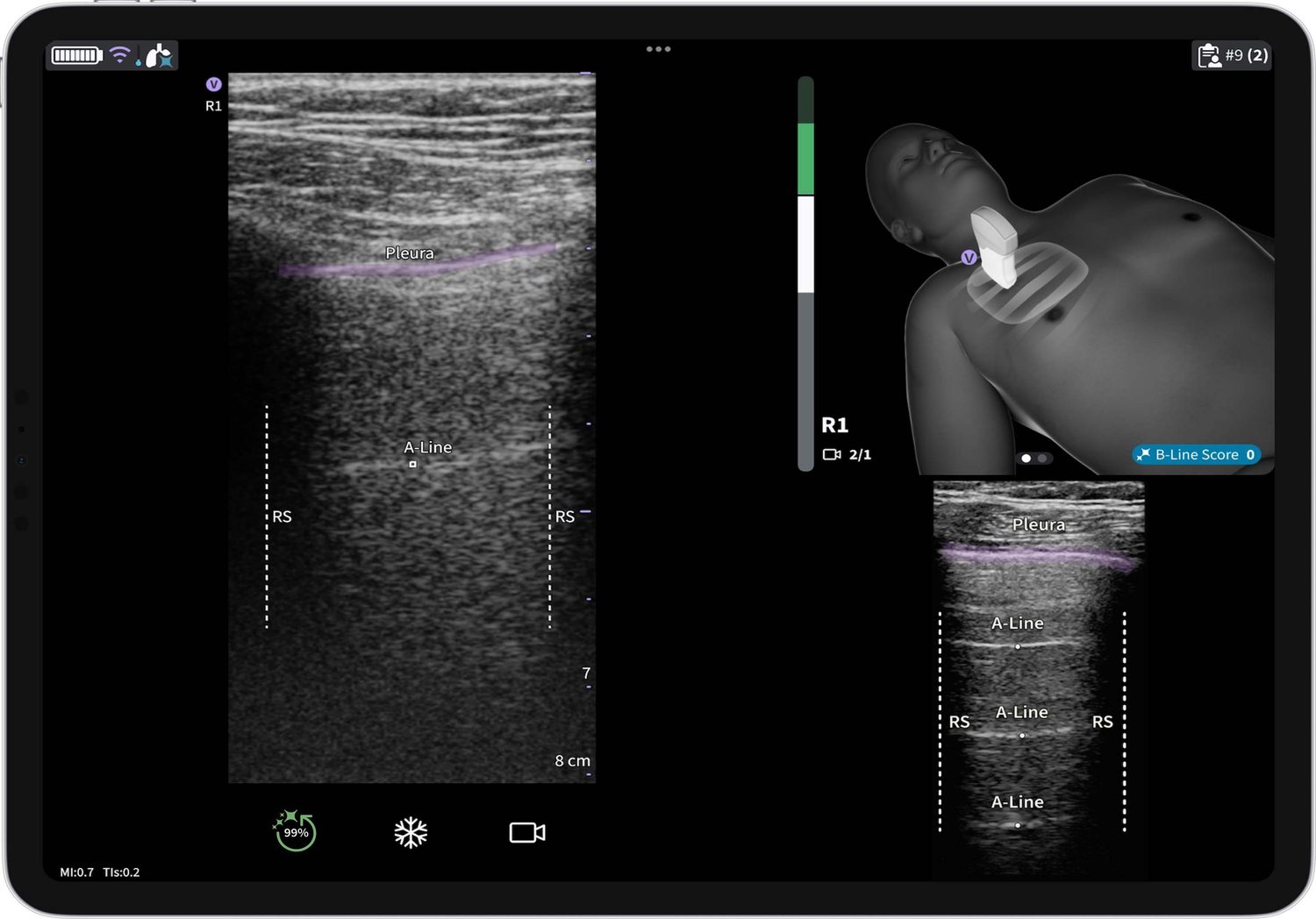
- Lung Guidance delivers real-time anatomical navigation across the standard 8-zone lung protocol, recognizing key acoustic landmarks—including the pleural line, A-lines, rib shadows, diaphragm, and abdominal boundaries.
The Cardiopulmonary AI Architecture
The rollout builds directly on GE HealthCare’s acquisition of Caption Health in 2023, expanding an integrated cardiopulmonary AI stack that already includes Caption AI for real-time cardiac probe guidance and Caption Interpretation Auto EF for automated ejection fraction calculation.
Operating across the standard clinical eight-zone lung examination protocol, Lung Guidance assists non-expert clinicians through real-time probe optimization. The vision algorithm continuously identifies critical sonographic landmarks, including the sliding pleural line, horizontal A-lines, rib acoustic shadows, the diaphragm, and abdominal boundary interfaces. The system triggers automatic clip recording the moment image-quality and landmark thresholds are satisfied, while a dedicated save feature buffers frames during challenging acoustic sweeps. In addition to automated identification and standardized scoring of vertical B-lines to monitor heart failure congestion, validation testing showed that Lung Guidance enabled non-expert sonographers to successfully complete diagnostic-quality lung examinations with a 95.2% success rate, operating at near parity with expert sonographers at 96.8%.
Complementing pulmonary assessment, AutoAS targets aortic stenosis, which often progresses silently and is notoriously difficult to diagnose through bedside auscultation in elderly or bariatric cohorts. Using the phased-array transducer of the Vscan Air SL, AutoAS requires at least two standard cardiac acoustic views—such as parasternal long-axis, parasternal short-axis at the aortic valve, or apical five-chamber. The software analyzes valve leaflet calcification, mobility, and spatial orifice dynamics to generate a binary visual estimation indicating whether image patterns suggest moderate-to-severe aortic stenosis, paired with an algorithmic confidence metric. Validated against a consensus panel of expert echocardiographers, the model reduces diagnostic variability and missed valvular disease compared to unassisted visual estimation by non-cardiologists.
“Clinicians at the point of care are often working with limited time and incomplete information, and a symptom like shortness of breath rarely announces if it’s coming from the heart, the lungs, or both,” said Karley Yoder, Chief Executive Officer of Ultrasound Solutions, Advanced Imaging Solutions at GE HealthCare. “Lung Guidance and AutoAS are designed to shorten the distance between the initial physical assessment and a clear next step, putting AI-enabled tools in the hands of the clinician who is already with the patient”.
