


In the AI era, “garbage in, garbage out” is no longer a technical warning. It is a business reality.
AI can optimize campaigns, identify audiences and recommend where to invest the next marketing dollar faster and more effectively than ever before. What it cannot do is recognize when the underlying data is incomplete, outdated or inaccurate. It simply builds on the information it is given.
As AI becomes increasingly commoditized, most brands now have access to similar models, platforms and capabilities. The competitive advantage no longer lies in the algorithm itself, but in the quality of the data that powers it. Organizations with strong data foundations can make decisions with greater confidence. Those operating on fragmented or unreliable data simply scale uncertainty faster.
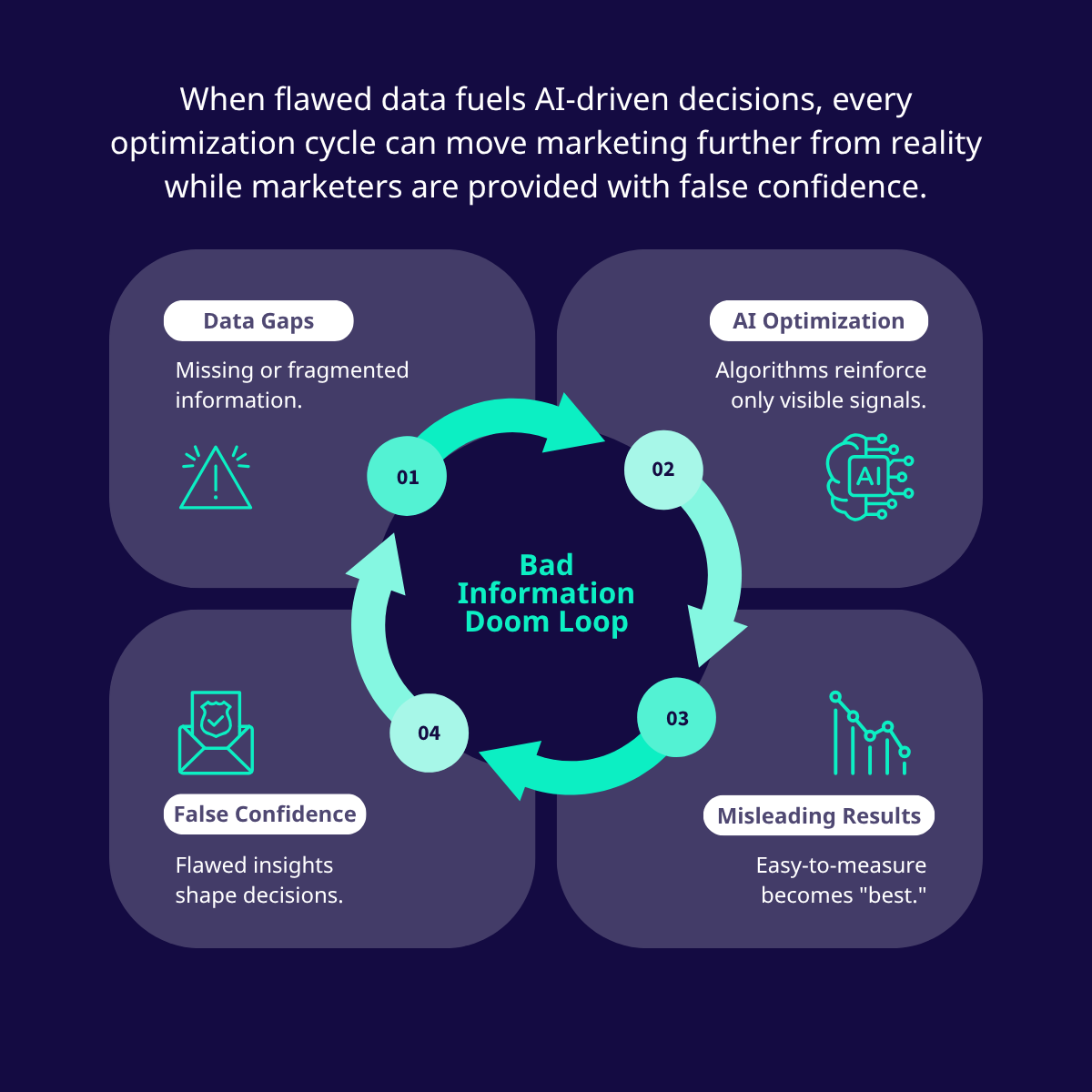
When incomplete records, weak identity linkages or unvalidated audience data feed AI systems, the result is more than underperformance. Budget is increasingly directed toward the wrong channels, audiences and tactics, often with growing confidence. AI optimizes around the signals it can see, not necessarily the ones that drive real-world outcomes. For marketers, that dynamic creates the Bad Information Doom Loop.
Performance may appear to improve as investment concentrates in areas where measurement is easiest rather than where impact is greatest. The system cannot distinguish between “this audience performs best” and “this is simply the audience we measure best.” As a result, incomplete data becomes reinforced as truth, and every optimization cycle further distances decision-making from reality.
This is not theoretical. Total net spending on medicines in the United States is expected to increase by approximately $200 billion between 2025 and 2030 as growth in utilization and the adoption of innovative therapies are partially offset by patent expirations and policy-driven price pressures.
At that scale, even small measurement errors carry significant consequences. Misidentifying customers, overcounting reach or failing to connect engagement across channels can translate into millions of dollars of misallocated investment and missed opportunities to reach the physicians and patients who matter most. The stakes are simply too high for “good enough” identity resolution and measurement.
Why “Good Enough” Data Is No Longer Enough
For years, marketers could operate with data that was directionally useful, even if imperfect. AI changes that. Human analysts can often recognize gaps, inconsistencies and missing context. AI cannot. It treats incomplete identities, disconnected signals and flawed assumptions as fact.
In the rush to embed AI across marketing, there is a risk of confusing automation with understanding. AI can process information at unprecedented speed, but it cannot determine whether the information it receives reflects reality. That responsibility still belongs to humans. Nowhere is that more important than healthcare, where decisions influence not only marketing performance, but how effectively pharmaceutical companies engage physicians, support patients and measure real-world outcomes of new therapies.
Campaigns must reach the right physicians, patients and caregivers while demonstrating a measurable impact on business and health outcomes. Strong engagement metrics provide little comfort if they come from the wrong audience. Marketers need data they can trust, not results that come with an asterisk.
This challenge extends far beyond digital engagement. The real test is connecting exposure, identity and outcomes into a single, coherent narrative. Healthcare organizations have long struggled with fragmented ecosystems that separate media activity from prescription behavior, medical activity and real-world results. Increasingly, industry leaders are recognizing that measurement must evolve from a retrospective report into a decision engine embedded throughout the marketing process, connecting signals across channels, audiences and outcomes to create a more complete picture of performance.
The need for that connection has never been greater. As healthcare organizations invest more heavily in analytics, AI, and increasingly, precision marketing, confidence can no longer come from data that is simply good enough. It must come from knowing that audiences, exposures and outcomes are correctly connected and that the insights being generated reflect reality rather than approximation.
When those connections break down, AI has no way of knowing. It simply treats flawed information as fact and continues to optimize around it. This is how the Bad Information Doom Loop begins. A small gap in identity, exposure or measurement becomes embedded in the model, reinforced through every recommendation and amplified with every optimization cycle. What starts as a minor data quality issue can quickly evolve into a much larger strategic problem.
In areas such as oncology, rare disease and other highly specialized therapeutic categories, the consequences may extend far beyond marketing efficiency. When audiences are smaller and every interaction carries greater weight, unseen blind spots can influence how resources are allocated, how performance is measured and ultimately how effectively organizations engage the physicians and patients they hope to serve.
Questions Marketers Should Be Asking
Marketers rigorously evaluate media investments and creative performance, yet the data powering those decisions often receives far less scrutiny. Before relying on a dataset or a model trained on it, marketers should ask:
- How large and complete is the dataset, and what are its limitations?
- What specific inputs and population coverage does it provide?
- How is identity resolved and validated across online and offline environments?
- What methodology ensures the data’s accuracy?
- How is the data sourced, and is it fully privacy compliant?
A pharmaceutical brand asking these questions of an outside vendor should ask its internal team the same ones, since first-party data can only be leveraged responsibly if it holds up to the same level of evaluation. Data clean rooms and dedicated measurement environments allow organizations to analyze first-party data with greater independence and confidence. Progress still depends on collaboration across data, analytics and marketing functions, as well as educating stakeholders about what the data can and cannot support.
Any claim that data fragmentation has been solved completely or overnight warrants careful examination. The same standard should apply when two partners generate differing results from comparable inputs without a clear, defensible explanation for the discrepancy.
Do Not Blindly Trust the Data
A defensible methodology starts with transparency. Marketers should understand the data being used, how it is connected and how conclusions are reached. The harder part is turning that complexity into something executives can use to make better decisions.
Methodologies should be judged by whether results remain consistent over time, not by a single outcome. If someone asks, “How did you get this number?” they deserve a real answer, not a request to trust a black box. Even in an AI-driven world, isolating signal from noise still requires human judgment grounded in category expertise.
Marketers are best protected from the Bad Information Doom Loop when they maintain an ongoing understanding of their own inputs, assumptions and limitations. Speed, scale and rigor do not have to be trade-offs.
Building a Stronger Data Foundation for AI-Driven Marketing
Avoiding the Bad Information Doom Loop starts with a clear understanding of what data is being used, how it was sourced and whether it can support the measurement claims built on top of it. That means vetting partners rigorously, validating assumptions before campaigns scale and measuring investments against outcomes that truly matter.
As AI becomes further embedded and increasingly commoditized across the industry, privacy-compliant, accurate and connected data becomes the competitive advantage. Human oversight remains just as essential. Marketers must stay actively engaged with outputs and question anomalies rather than accept them, because automated systems can quietly reinforce hidden biases, blind spots and inaccuracies.
Organizations should expect transparency and accountability from every data partner and be prepared to move away from sources that cannot clearly demonstrate how insights are derived.
As AI becomes a standard feature rather than a differentiator, competitive advantage will belong to organizations with the strongest data foundations and the confidence to act on them. Because in an industry built on precision, success will not come from having more AI. It will come from having information accurate enough to trust what AI is telling you.
About Justin Rosen
As Head of Measurement Product with IQVIA Digital, Justin leads the teams responsible for measurement and attribution strategy, capabilities and methodology, ensuring the product portfolio is clear, credible, and actionable for brand, agency, and media clients. This includes audience quality and conversion reporting, cross-channel capabilities, DSP measurement, data collaboration, and clean room strategy. He works in a consultative capacity with brand and agency marketers to ensure that the IQVIA Digital measurement product roadmap brings IQVIA’s best-in-class data to life with insights in ways that make them smarter and their lives easier.
