

What You Should Know
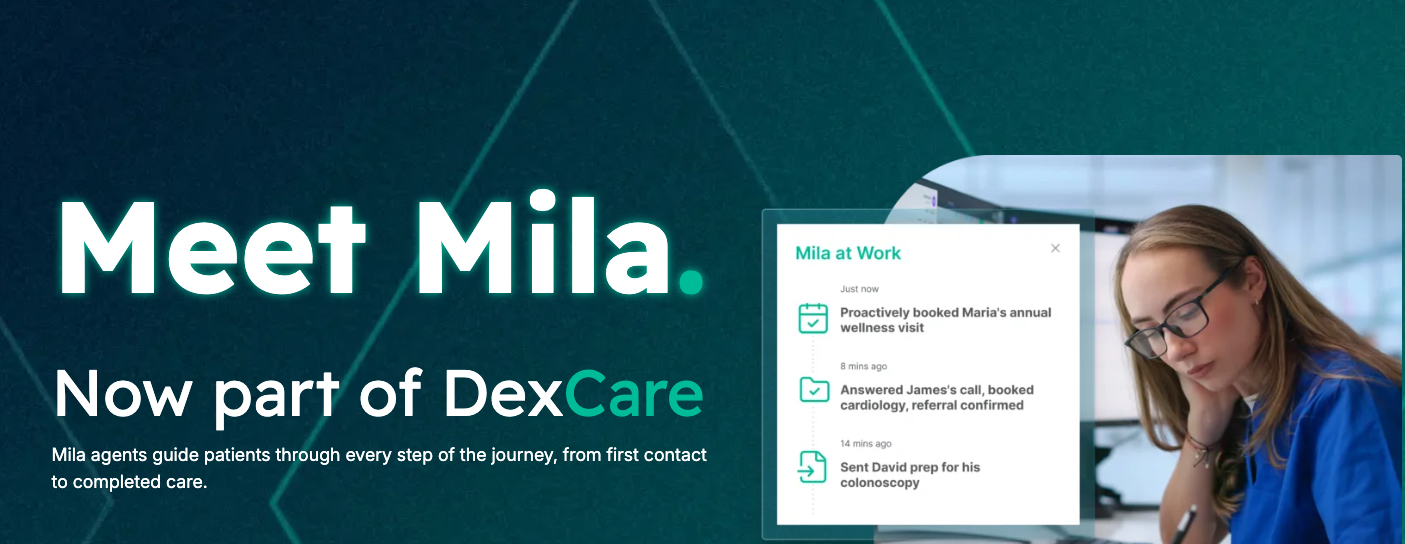
- Patient access and navigation leader DexCare, Inc. announced the acquisition of Mila Health, an AI-driven care coordination company whose conversational agents autonomously call, text, and chat with patients to manage scheduling, pre-visit preparation, and post-discharge follow-ups.
- The transaction represents DexCare’s second corporate acquisition, building on its 2022 purchase of Womp, Inc., and expands its capital-backed platform that has raised $146 million to date (including a $75M Series C led by ICONIQ Growth in 2023).
- Mila Health’s conversational AI layer runs directly on DexCare’s access data model—validated across more than 10 million completed patient bookings—which unifies electronic health records (EHRs), scheduling rules, subspecialty requirements, and institutional clinician preferences into a single standardized rulebook.
- DexCare’s footprint encompasses 57 million covered patients across all 50 states, serving major integrated health systems including Kaiser Permanente, Piedmont, Texas Health Resources, and Tampa General Hospital, while helping health systems schedule 40% more appointments with existing resources and reduce time-to-care by five days.
Pairing Governed Access Rules with Autonomous Conversational Agents
Spun out of Providence Health in 2021, Seattle-based DexCare has raised $146M in capital (including a $75 million Series C led by ICONIQ Growth in 2023) and serves 57 million patients across health system clients such as Kaiser Permanente, Piedmont, Texas Health Resources, and Tampa General Hospital. Financial terms were not disclosed. The transaction marks DexCare’s second acquisition, following its 2022 purchase of e-commerce search and booking engine Womp, Inc.
The acquisition merges DexCare’s foundational access infrastructure with Mila’s agentic conversational capabilities:
- Codified Scheduling Governance: DexCare’s platform standardizes complex provider scheduling rules, clinical templates, location rules, and referral constraints across more than 10 million bookings. At Tampa General Hospital, for instance, DexCare codified 260 distinct scheduling policies while identifying more than 50 operational gaps.
- Traceable, Multi-Channel Outreach: Built as an API-first framework, Mila deploys multimodal agents across voice phone calls, SMS, and web chat. The agents handle overdue visit recall, verify subspecialty eligibility, coordinate booking times, walk patients through pre-procedure prep, and execute post-discharge check-ins.
- Auditable Clinical Guardrails: Unlike generic foundation models that hallucinate or execute without an audit trail, Mila operates strictly within the health system’s pre-approved access rulebook, providing traceable decision logic for why an agent booked a specific slot, escalated a call, or navigated a patient to an alternate site of care.
Demonstrated Operational and Financial Performance
Across live deployments with payers, providers, and software platforms, Mila has generated significant operational gains over traditional call centers:
- 54% Outbound Response Rate: Achieves a 54% patient response rate on outbound outreach campaigns—an 80% improvement compared to standard manual call center benchmarks.
- 50% Reduction in No-Shows: Automated reminders, multi-channel prep instructions, and interactive rescheduling cut clinic no-show rates in half.
- 18% Net Revenue Expansion: Increases health system top-line capture by accelerating patient throughput, converting overdue care gaps into booked visits, and maximizing operating room and procedural slot utilization.
Eliminating the “Agentic AI Context Gap”
The acquisition underscores an evolving consensus in healthcare AI: autonomous agents cannot function reliably without deep, institutional systems of record. While commoditized voice AI platforms can hold natural-sounding conversations, they typically fail in health systems because they lack real-time visibility into complex provider scheduling rules, credentialing boundaries, insurance nuances, and EHR templates.
“Mila gives our data a voice, and our data gives Mila direction,” said Matt Blosl, CEO of DexCare. “AI solutions are everywhere, but health systems quickly realize that building the infrastructure, scaling the pilot, and managing the agent’s boundaries is untenable. Most agents lack contextual awareness to connect a health system, to know the relationships between service lines and the nuances and preferences of staff, locations and providers. Any agent can sound incredibly human, but ours understands the health system it speaks for.”
By anchoring Mila’s conversational agents directly inside DexCare’s governed access data model, DexCare provides its agents with the institutional context needed to navigate patients without manual human intervention—moving healthcare access from fragmented point solutions toward a unified, automated system of action.
