

What You Should Know
- The Peterson Health Technology Institute (PHTI) has released an independent health technology assessment evaluating virtual solutions for chronic kidney disease (CKD) management across stages 3–5.
- PHTI evaluated eight prominent commercial companies representing billions in private capital and market capitalization: DaVita Integrated Kidney Care (IKC), Evergreen Nephrology, Healthmap Solutions, Interwell Health, Kidneylink, Monogram Health, Somatus, and Strive Health.
- The solutions demonstrate no consistent evidence of slowing disease progression—measured by guideline-recommended medication adoption (ACEi/ARBs, SGLT2 inhibitors) or rate of kidney function decline (eGFR slope)—relative to standard care.
- Virtual programs achieved a statistically significant 12.4-percentage-point increase in optimal dialysis starts in 2023 under the Center for Medicare and Medicaid Innovation’s (CMMI) Comprehensive Kidney Care Contracting (CKCC) model.
Failure to Impact Disease Progression
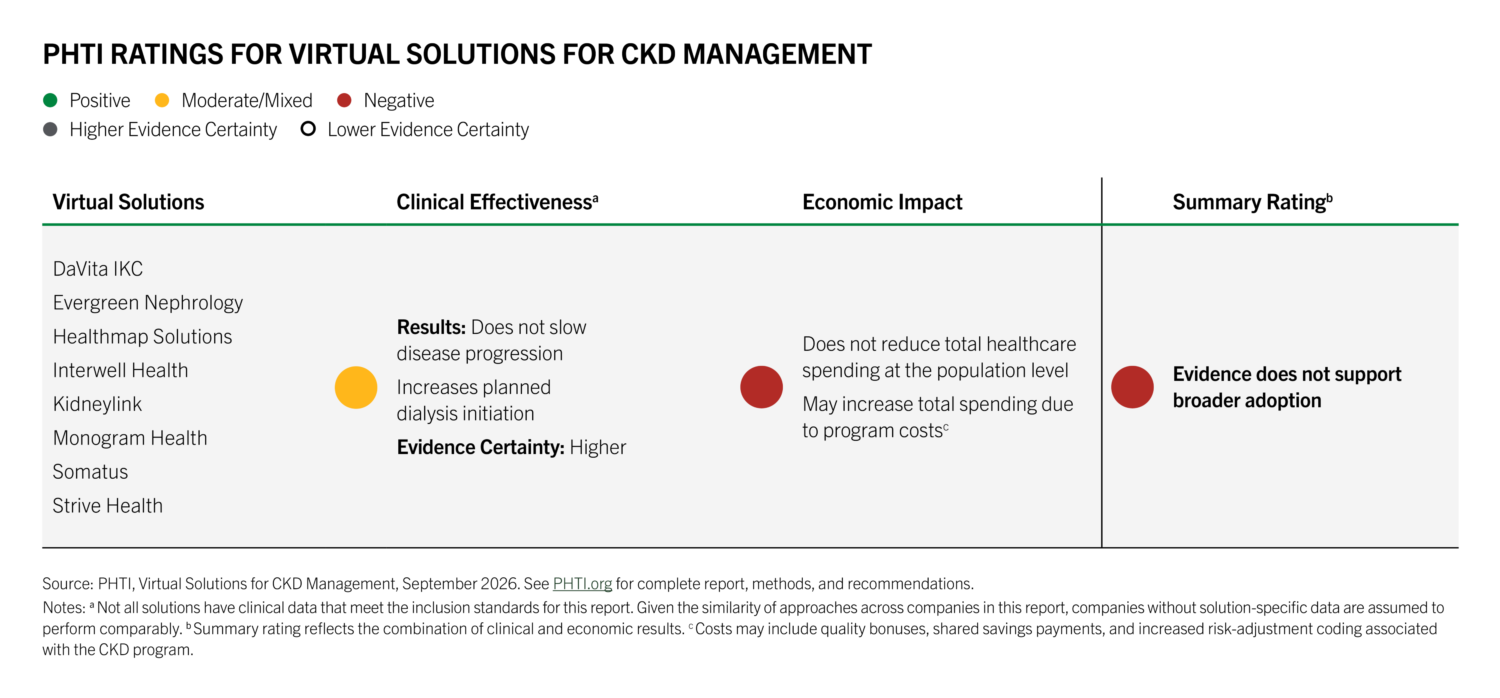
The evaluation examined eight commercial entities managing patients with CKD stages 3–5: DaVita Integrated Kidney Care (IKC), Evergreen Nephrology, Healthmap Solutions, Interwell Health, Kidneylink, Monogram Health, Somatus, and Strive Health.
PHTI’s systematic literature review—encompassing 34 unique clinical studies and multi-year evaluation data from CMS’s Kidney Care Choices (KCC) model—found no consistent evidence that virtual CKD platforms delay kidney function decline compared to routine clinical care:
- No Impact on Kidney Function Trajectory: Across comparative trials, virtual interventions did not significantly alter annual estimated glomerular filtration rate (eGFR) decline slopes or reduce progression toward end-stage kidney disease (ESKD) or doubling of serum creatinine.
- Flat Guideline-Directed Prescribing: While therapies such as SGLT2 inhibitors and ACEi/ARBs demonstrably slow renal decline, enrollment in virtual programs showed no meaningful differences in prescribing rates compared to usual care. In CMS’s Comprehensive Kidney Care Contracting (CKCC) data for 2022 and 2023, prescribing differences between aligned practices and matched non-participating controls remained under one percentage point.
- Scarce Company-Specific Clinical Evidence: Despite raising over $100 million each, five of the eight companies (DaVita IKC, Evergreen, Kidneylink, Monogram, and Somatus) produced zero peer-reviewed clinical evidence meeting review standards. Strive Health demonstrated the strongest evidence base—showing statistically significant reductions in 30-day post-discharge hospital readmissions and slower eGFR decline in a pre-post cohort—though generalizability was constrained by sampling and design limitations.
Meaningful Transition Gains Diluted Across Populations
The single demonstrated clinical benefit of virtual CKD solutions is supporting planned, outpatient dialysis transitions:
- Higher Optimal Dialysis Starts: In CKCC performance data, patients aligned with participating practices achieved a 12.4 percentage point higher optimal ESKD start rate in 2023 compared to non-participating practices (starting dialysis in outpatient settings with permanent vascular access or receiving preemptive transplants, rather than crashing in an inpatient unit with a central venous catheter).
- The 1-in-1,000 Dilution Effect: While avoiding an unplanned “crash” start saves approximately $57,000 in Medicare and $169,000 in commercial plans per patient, only about 0.7% to 1.9% of attributed CKD patients start dialysis in any single year. Consequently, only 1 in every 1,000 attributed patients actually experiences an improved transition.
- Nominal Population Savings: When savings from improved starts are spread across the full attributed pool, the gross reduction in spend is just $53 per member per year in Traditional Medicare, $62 in Medicare Advantage, and $401 in commercial plans (equivalent to a PMPM reduction of -$0.13 to -$0.65). These modest savings are easily wiped out by program overhead, care coordination fees, and quality bonuses.
Why the Current Model Stalls: The Upstream Disconnect
PHTI concluded that these shortfalls stem from misaligned payment incentives rather than clinician intent:
- The Primary Care Gap: Approximately 87% of adults with CKD are unaware they have it. Because virtual vendors are attributed patients only after a formal ICD-10 diagnosis and partner almost exclusively with nephrologists, they have limited reach into primary care where early-stage (3a/3b) intervention must happen.
- Coding vs. True Cost Reduction: Under Medicare Advantage “Medical Loss Ratio (MLR) reduction guarantees,” vendors can hit performance targets by improving diagnostic risk documentation to boost CMS benchmark revenue, delivering financial returns to the plan without actually curbing medical utilization.
- KCC Demonstration Losses: In Traditional Medicare, participating CKCC practices earned $311 million in gross shared savings against administrative benchmarks in 2024. However, CMS’s formal difference-in-difference evaluation against non-participating control practices revealed no statistically significant reduction in Medicare Parts A and B claims, generating a net financial loss of $275.4 million for Medicare in 2023 once program fees were accounted for.
PHTI urges purchasers and CMS to restructure kidney value-based contracts away from blunt population benchmarks, shifting instead toward discrete patient-level milestone payments for early eGFR/uACR testing, verified PCP initiation of generic kidney-protective drugs, and utilization-based cost offsets.
Click here to download the report.
