
What You Should Know
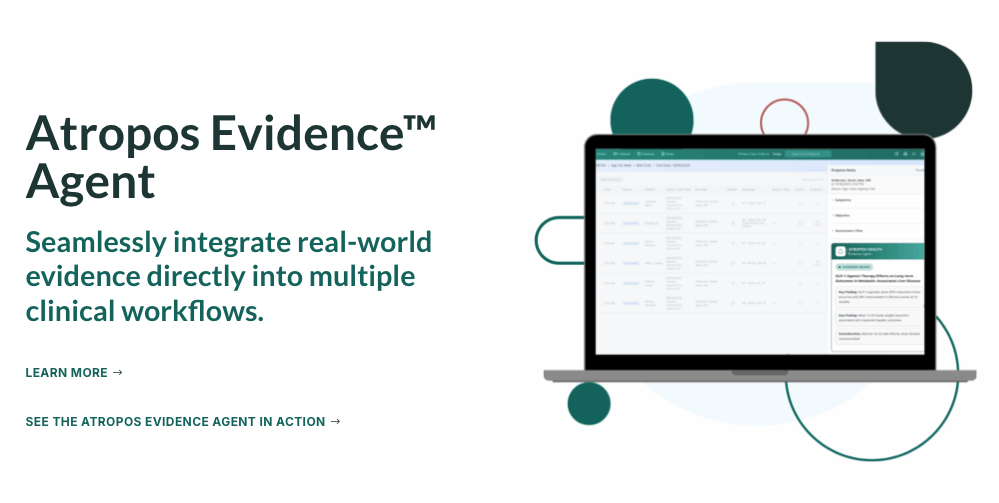
- The Integration: Atropos Health has officially integrated its Atropos Evidence Agent with Microsoft Dragon Copilot, bringing personalized real-world evidence (RWE) directly into the electronic health record (EHR).
- The Deployment: The joint solution is already live at Stanford Medicine. It actively analyzes patient records alongside ambient data captured by Dragon Copilot to proactively present physicians with evidence-based clinical summaries.
- The Tech Synergy: The collaboration bridges Microsoft’s ambient intelligence footprint with Atropos Health’s proprietary evidence-generation engine (GENEVA OS).
- The Workflow Impact: Clinicians can now review curated medical literature or instruct the AI to generate entirely new, personalized observational studies based on local data—without ever leaving their native EHR workflow.
How Agentic RWE Actually Works
Historically, if a physician encountered a complex patient—say, a diabetic with a specific subset of liver disease—and wanted to know whether a GLP-1 or Metformin yielded better historical outcomes for that exact phenotype, they had to rely on generalized clinical guidelines or spend hours digging through PubMed.
With this new integration, the workflow is entirely inverted. Dragon Copilot ambiently captures the context of the patient visit. The Atropos Evidence Agent ingests that context, scans the patient’s EHR, and proactively generates a succinct, evidence-based summary answering the exact clinical questions relevant to that specific patient.
The system is already live at Stanford Medicine, where the initial feedback highlights the power of predictive, agentic AI.
“It’s like the Atropos Evidence Agent is reading my mind,” noted Dr. Andrew D. Schechtman, Adjunct Clinical Assistant Professor at Stanford. “It reviews the patient record and presents me with succinct evidence-based summaries to questions that are relevant to the patient I’m seeing, which I might not have thought to ask. I can hover over the link to view a quick summary and then decide whether I want to click through to read the whole article or not.”
