

• Skip to main content
  • Skip to secondary menu
  • Skip to primary sidebar
  • Skip to secondary sidebar
  • Skip to footer

  • Opinion
  • Health IT
    • Behavioral Health
    • Care Coordination
    • EMR/EHR
    • Interoperability
    • Patient Engagement
    • Population Health Management
    • Revenue Cycle Management
    • Social Determinants of Health
  • Digital Health
    • AI
    • Blockchain
    • Precision Medicine
    • Telehealth
    • Wearables
  • Life Sciences
  • Investments
  • M&A
  • Value-based Care
    • Accountable Care (ACOs)
    • Medicare Advantage

WHAM 2026: The Economic Case for Women’s Health Investment

by Jasmine Pennic 01/16/2026 Leave a Comment

  • LinkedIn
  • Twitter
  • Facebook
  • Email
  • Print
WHAM 2026: The Economic Case for Women’s Health Investment

What You Should Know: 

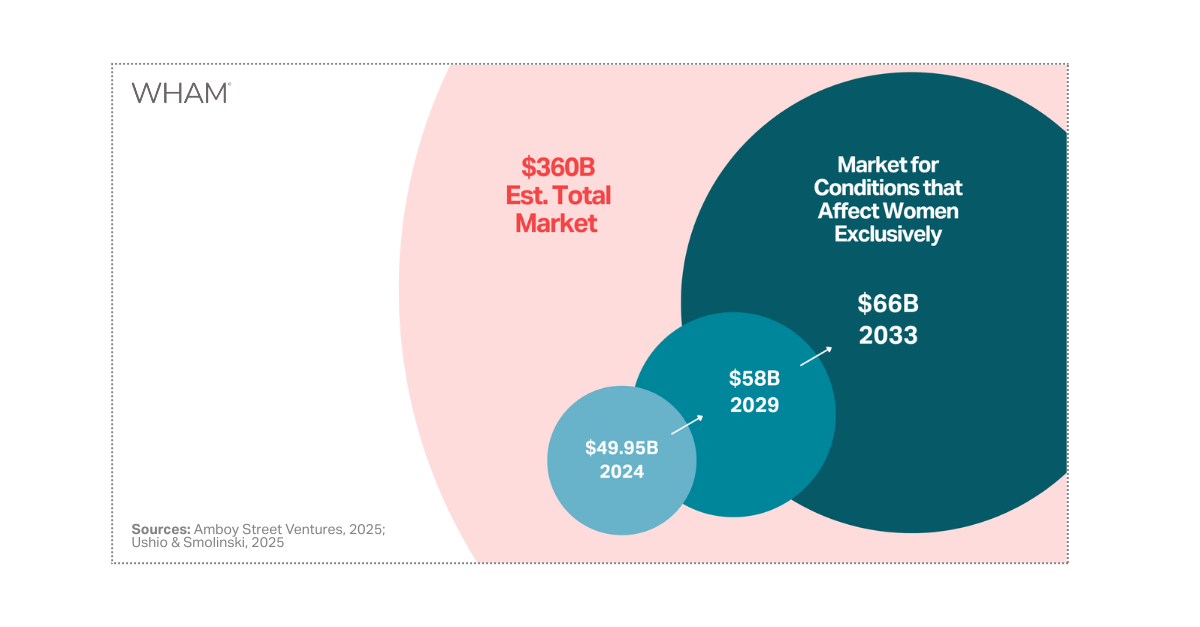
– The 2026 WHAM Investment Report, released at the 44th Annual JPMorgan Healthcare Conference, establishes women’s health as a high-growth precision medicine category. 

– Redefining the market beyond reproductive care, the report provides a roadmap for capital allocation into conditions that affect women exclusively, differently, or disproportionately. It features six in-depth case studies demonstrating real-world commercial success and durable long-term value.

The Economic Catalyst: Quantifying the Return on Investment

Produced in collaboration with the KPMG Foundation and KPMG LLP, the report reframes women’s health from a social advocacy issue to a rigorous economic engine. The data-driven microsimulation models developed by the RAND Corporation for WHAM highlight the profound societal cost of the current “funding gap”.

Redefining the “Bikini Medicine” Paradigm

The report challenges persistent misconceptions that limit capital allocation. For decades, “women’s health” was synonymous with maternal and reproductive care—a paradigm often referred to as “bikini medicine.” WHAM’s 2026 analysis pushes into the “other 95%” where diseases impact women exclusively, differently, or disproportionately.

  • Autoimmune Diseases: 78-80% of patients are women (nearly 40 million), yet women-focused research in rheumatoid arthritis has received as little as 7% of the NIH budget in recent years.
  • Brain Health: 66% of Alzheimer’s patients are women, but historically only 12% of the NIH Alzheimer’s budget focused on women.
  • Heart Health: Women are 50% more likely to die than men in the first year following a heart attack, yet cardiovascular research has historically allocated only 4%–4.5% of its budget to women-focused projects.

“We are at a true inflection point,” said Janet Foutty, Former Chair Deloitte, WHAM Senior Advisor. “The science has matured, the market demand is undeniable, and the economic case is now rigorously quantified. The question for leaders is no longer whether to invest in women’s health—but whether they are prepared to lead as this market rapidly takes shape.”

  • LinkedIn
  • Twitter
  • Facebook
  • Email
  • Print

Tagged With: Femtech

Tap Native

Get in-depth healthcare technology analysis and commentary delivered straight to your email weekly

Reader Interactions

Primary Sidebar

Subscribe to HIT Consultant

Latest insightful articles delivered straight to your inbox weekly.

Submit a Tip or Pitch

2026 Predictions & Trends

Healthcare 2026 Forecast: Executives on AI Survival, Financial Reckoning, and the End of Point Solutions

2026 Healthcare Executive Predictions: Why the AI “Pilot Era” Is Officially Over

Featured Research Report

Digital Health Funding Hits $14.2B in 2025: A Year of AI Exuberance and Market Bifurcation

Most-Read

Trump Unveils 'The Great Healthcare Plan': A Global Price-Matching Pivot to Settle the Affordability Crisis

Price Reset 2026: How Trump’s ‘Great Healthcare Plan’ Slashes Drug Costs at Trumprx.gov

Anthropic Debuts ‘Claude for Healthcare’ and Opus 4.5 to Engineer the Future of Life Sciences

Anthropic Debuts ‘Claude for Healthcare’ and Opus 4.5 to Engineer the Future of Life Sciences

OpenAI Debuts ChatGPT Health: A ‘Digital Front Door’ That Connects Medical Records to Agentic AI

OpenAI Debuts ChatGPT Health: A ‘Digital Front Door’ That Connects Medical Records to Agentic AI

From Genes to Hackers: The Hidden Cybersecurity Risks in Life Sciences

From Genes to Hackers: The Hidden Cybersecurity Risks in Life Sciences

Utah Becomes First State to Approve AI System for Prescription Renewals

Utah Becomes First State to Approve AI System for Prescription Renewals

NYC Health + Hospitals to Acquire Maimonides in $2.2B Safety Net Overhaul

NYC Health + Hospitals to Acquire Maimonides in $2.2B Safety Net Overhaul

KLAS Report: Why Hospitals Are Choosing Efficiency Over 'Agentic' AI Hype in 2025

KLAS Report: Why Hospitals Are Choosing Efficiency Over ‘Agentic’ AI Hype in 2025

Advanced Primary Care 2026: Top 6 Investments for Health Systems According to Harvard Medical School

Advanced Primary Care 2026: Top 6 Investments for Health Systems According to Harvard Medical School

AI Nutrition Labels: The Key to Provider Adoption and Patient Trust?

AI Nutrition Labels: The Key to Provider Adoption and Patient Trust?

Kristen Hartsell, VP of Clinical Services, RedSail Technologies

The Pharmacy Closures Crisis: How Independent Pharmacies Are Fixing Pharmacy Deserts

Secondary Sidebar

Footer

Company

  • About Us
  • 2026 Editorial Calendar
  • Advertise with Us
  • Reprints and Permissions
  • Op-Ed Submission Guidelines
  • Contact
  • Subscribe

Editorial Coverage

  • Opinion
  • Health IT
    • Care Coordination
    • EMR/EHR
    • Interoperability
    • Population Health Management
    • Revenue Cycle Management
  • Digital Health
    • Artificial Intelligence
    • Blockchain Tech
    • Precision Medicine
    • Telehealth
    • Wearables
  • Startups
  • Value-Based Care
    • Accountable Care
    • Medicare Advantage

Connect

Subscribe to HIT Consultant Media

Latest insightful articles delivered straight to your inbox weekly

Copyright © 2026. HIT Consultant Media. All Rights Reserved. Privacy Policy |