

• Skip to main content
  • Skip to secondary menu
  • Skip to primary sidebar
  • Skip to secondary sidebar
  • Skip to footer

How eClinicalWorks Agentic AI Is Helping Revenue Cycle Leaders Improve Financial Performance
  • Opinion
  • Health IT
    • Behavioral Health
    • Care Coordination
    • EMR/EHR
    • Interoperability
    • Patient Engagement
    • Population Health Management
    • Revenue Cycle Management
    • Social Determinants of Health
  • Digital Health
    • AI
    • Blockchain
    • Precision Medicine
    • Telehealth
    • Wearables
  • Life Sciences
  • Investments
  • M&A
  • Value-based Care
    • Accountable Care (ACOs)
    • Medicare Advantage

8 Common Characteristics of Successful Standalone Hospitals

by Fred Pennic 11/24/2018 Leave a Comment

  • LinkedIn
  • Twitter
  • Facebook
  • Email
  • Print

8 Common Characteristics of Successful Standalone Hospitals

The Chartis Group shares 8 characteristics of successful independent hospitals and provides an assessment for hospital executives. 

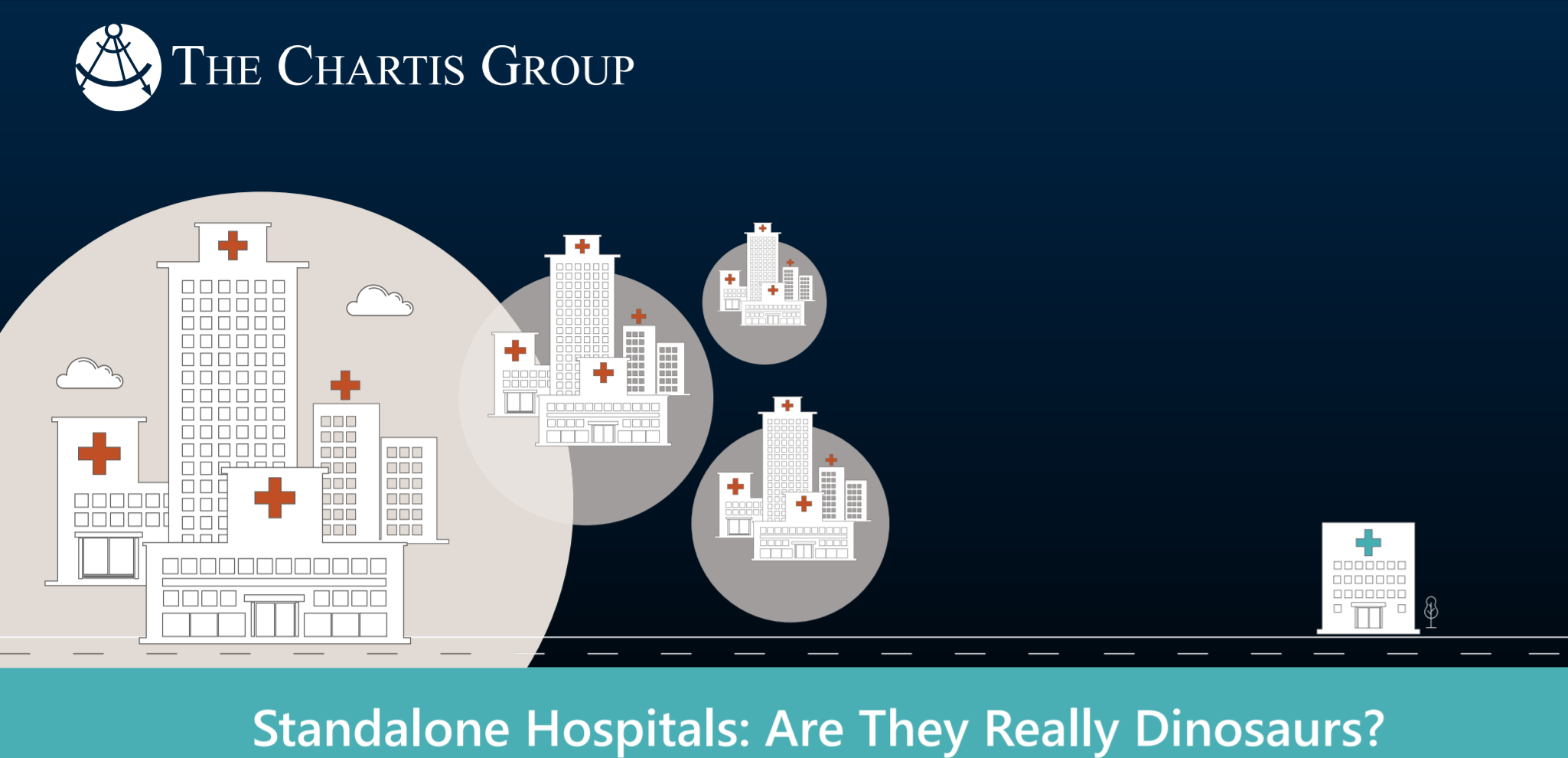
Over the last 20 years, the percentage of U.S. hospitals over 200 beds, that are part of health systems, has risen from 56 percent to 77 percent. This trend continues as local regional and national health systems expand in search of greater scale, financial stability, and market presence. This seemingly inexorable trend towards systems expansion has caused industry observers to state frequently that standalone community hospitals are “dinosaurs.”

However, there are circumstances under which stand-alone hospitals can continue to thrive, at least for the foreseeable future, according to a new white paper from The Chartis Group, a healthcare-focused provider of advisory services and analytics to healthcare organizations. The white paper, “Standalone Hospitals: Are They Really Dinosaurs?” includes a strategic framework for executives and boards of independent hospitals to assess current positioning and future prospects.

8 Common Characteristics of Standalone Hospitals

The study found that successful independent hospitals share many of the same advantages. These market and internal characteristics enable many of the remaining standalone hospitals to meet their mission objectives, fund routine and strategic capital needs, build robust ambulatory and physician networks and fend off competition from larger systems. These eight common characteristics of standalone hospitals include:

1.    The hospital is the sole or predominant community provider in the market(s) it serves.

2.   The hospital is located within an attractive, stable or growing market with a favorable payor mix.

3.   The hospital is of a size sufficient to promote efficient care delivery and cost management.

4.   The hospital provides a wide array of profitable specialty care services and has a high case mix index, enabling it to earn favorable margins per case.

5.  The hospital has a strong balance sheet, including over 200 days cash on hand and a favorable debt to capitalization ratio.

6.  The hospital has built an integrated, closely-aligned physician network that is growing and well distributed across the service area.

7.  The hospital benefits from strong community support, including philanthropy.

8.  The hospital has created a level of “network essentiality” that enables the organization to negotiate favorable commercial and other payor contracts.

While stand-alone hospitals will continue to join local, regional and national health systems, a subset of institutions that are well-positioned across the above dimensions will continue to enjoy independence, support their communities and demonstrate the ability to thrive.

Healthcare Organizations Should Conduct Evaluation of Their Positionings and Future Prospects

 “It is critical for all organizations to periodically conduct a rigorous, thoughtful evaluation of their current positioning and future prospects; they should assess the range of options that best preserve the mission and meet their needs and those of the communities they serve,” said Chris Regan, Managing Director for The Chartis Group and co-author of the study.

The assessment should involve a thorough board and executive team evaluation process that considers the following types of questions:

1.  Does our institution fit the profile of a strong, independent hospital?

2.  Is it realistic to think we can independently close gaps in our positioning and operational performance?

3.  How should we involve the board in an objective, periodic evaluation process?

  • LinkedIn
  • Twitter
  • Facebook
  • Email
  • Print

Tagged With: The Chartis Group, Value-Based Care

Tap Native

Get in-depth healthcare technology analysis and commentary delivered straight to your email weekly

Reader Interactions

Primary Sidebar

Subscribe to HIT Consultant

Latest insightful articles delivered straight to your inbox weekly.

Submit a Tip or Pitch

Featured Insights

How eClinicalWorks Agentic AI Is Helping Revenue Cycle Leaders Improve Financial Performance

Most-Read

Innovaccer-CHIME 2030 Survey Reveals AI Will Automate Nearly Two-Thirds of Administrative Work and Do 3x the Work With the Same Staff

Innovaccer-CHIME 2030 Survey Reveals AI Will Automate Nearly Two-Thirds of Administrative Work and Do 3x the Work With the Same Staff

CB Insights’ 2026 Digital Health 50 Reveals How Agentic AI Is Becoming the Clinical Provider and Medication Access Engine

Oura Acquires Counsel Health for $625M: Scaling Continuous Biometrics into On-Demand Medical Care

M&A: Oura Acquires Counsel Health for $625M: Scaling Continuous Biometrics into On-Demand Medical Care

WittKieffer 2026 Healthcare CIO Survey: 82% Sit on Executive Teams, Yet Only 36% Have Formal Succession Plans

WittKieffer 2026 Healthcare CIO Survey: 82% Sit on Executive Teams, Yet Only 36% Have Formal Succession Plans

CVS Rebrands Health Services Segment, Launches Model for Retail Pharmacy Reimbursement

CVS Health Formalizes Tax-Free Split-Off to Carve Out CVS Pharmacy by 2028

SAMHSA and ONC Invest $20M in Behavioral Health IT Initiative

ONC Finalizes HTI-5 Deregulatory Rule to Cut $1.55B in Health IT Compliance and Accelerate FHIR APIs

Redesign Health Merges with Sheba Medical Center’s ARC Global and Agrees to Acquire AVIA

Redesign Health Merges with Sheba Medical Center’s ARC Global and Agrees to Acquire AVIA

Sword Acquires Headspace in All-Cash Deal Worth Up to $300M to Unify Physical and Mental AI Care

M&A: Sword Acquires Headspace in All-Cash Deal Worth Up to $300M to Unify Physical and Mental AI Care

M&A: Francisco Partners to Acquire Weave in $650M Take-Private Deal

M&A: Francisco Partners to Acquire Weave in $650M Take-Private Deal

Epic Launches One-Click Care Everywhere Diagnostic Image Exchange

Epic Launches One-Click Care Everywhere Diagnostic Image Exchange

Secondary Sidebar

Footer

Company

  • About Us
  • 2026 Editorial Calendar
  • Advertise with Us
  • Reprints and Permissions
  • Op-Ed Submission Guidelines
  • Contact
  • Subscribe

Editorial Coverage

  • Opinion
  • Health IT
    • Care Coordination
    • EMR/EHR
    • Interoperability
    • Population Health Management
    • Revenue Cycle Management
  • Digital Health
    • Artificial Intelligence
    • Blockchain Tech
    • Precision Medicine
    • Telehealth
    • Wearables
  • Startups
  • Value-Based Care
    • Accountable Care
    • Medicare Advantage

Connect

Subscribe to HIT Consultant Media

Latest insightful articles delivered straight to your inbox weekly

Copyright © 2026. HIT Consultant Media. All Rights Reserved. Privacy Policy |