

• Skip to main content
  • Skip to secondary menu
  • Skip to primary sidebar
  • Skip to secondary sidebar
  • Skip to footer

  • Opinion
  • Health IT
    • Behavioral Health
    • Care Coordination
    • EMR/EHR
    • Interoperability
    • Patient Engagement
    • Population Health Management
    • Revenue Cycle Management
    • Social Determinants of Health
  • Digital Health
    • AI
    • Blockchain
    • Precision Medicine
    • Telehealth
    • Wearables
  • Life Sciences
  • Investments
  • M&A
  • Value-based Care
    • Accountable Care (ACOs)
    • Medicare Advantage

#HIMSS15: 70% of Physicians Believe Health IT Decreased Patient Engagement

by Jasmine Pennic 04/13/2015 Leave a Comment

  • LinkedIn
  • Twitter
  • Facebook
  • Email
  • Print

#HIMSS15: 70% of Physicians Believe Health IT Decreased Patient Engagement

Despite U.S. doctors’ increased use of technology, more than two-thirds (70 percent) of them believe that health IT has decreased the amount of time they spend with patients, according to a new survey by Accenture. The findings revealed during HIMSS15 is part of a six-country survey of more than 2,600 physicians, including roughly 600 in the United States found about three-fourths (76 percent) of those surveyed believe that interoperability of the tools currently available limits their ability to improve the quality of patient care through healthcare IT.

EMR adoption rates have reached record highs; however, the survey found fewer physicians believe that EMRs has improved treatment decisions (46 percent in 2015 vs. 62 percent in 2012), reduced medical errors (64 vs. 72 percent) and improved health outcomes for patients (46 vs. 58 percent). On the opposite end of this, nearly all U.S. doctors (90 percent) said that better functionality and easy-to-use data-entry systems are important for improving the quality of patient care through healthcare IT, more than half (58 percent) said that the electronic health record system in their organization is hard to use.

Top 5 IT capabilities that U.S. Doctors Use the Most

#HIMSS15: 70% of Physicians Believe Health IT Decreased Patient Engagement

The survey found that the vast majority – 79 percent – of U.S. doctors are more proficient using EMRs than they were two years ago. The number of U.S. doctors who routinely use digital tools, such as secure e-mail, for communicating with patients has more than doubled since the last survey, to 30 percent, versus just 13 percent in 2012.

The five IT capabilities that U.S. doctors use the most are:

1. Entering patient notes electronically (82 percent);

2. Prescribing drugs electronically (72 percent)

3. Receiving clinical results directly into a patient’s EMR (65 percent)

4. Using electronic administration tools (63 percent)

5. Sending e-order requests to laboratories (62 percent)

Growing Demand for Patient Engagement

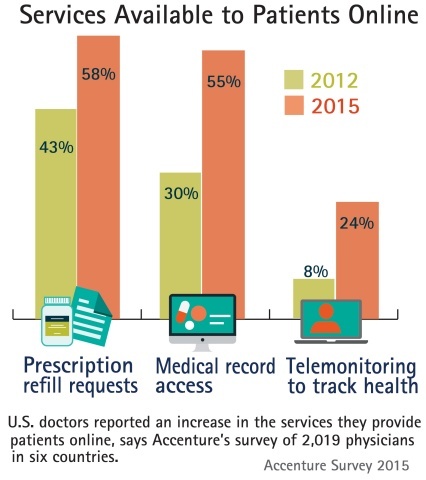
Driven by growing demand for patient engagement, the majority of U.S. doctors surveyed reported an increase in the services they now provide patients online. The number of physicians offering tele-monitoring devices that enable patients to monitor their health has tripled since the last survey, from just 8 percent in 2012 to 24 percent now. Many U.S. doctors now provide patients with:

– access to online medical records (55 percent)

– electronic reminders for follow-up care (55 percent)

– ability to book appointments online (46 percent)

– access to view health-related information during consultation (36 percent)

– consultations through videoconferencing (14 percent).

The survey also showed that U.S. doctors believe that allowing patients to update their own medical records increases their engagement in their own health (cited by 82 percent of respondents), improves patient satisfaction (81 percent), boosts understanding of their health conditions (72 percent), increases patient and physician communication (71 percent), and increases the accuracy of their medical records (60 percent).

  • LinkedIn
  • Twitter
  • Facebook
  • Email
  • Print

Tagged With: HIMSS 2015

Tap Native

Get in-depth healthcare technology analysis and commentary delivered straight to your email weekly

Reader Interactions

Primary Sidebar

Subscribe to HIT Consultant

Latest insightful articles delivered straight to your inbox weekly.

Submit a Tip or Pitch

2026 Predictions & Trends

Healthcare 2026 Forecast: Executives on AI Survival, Financial Reckoning, and the End of Point Solutions

2026 Healthcare Executive Predictions: Why the AI “Pilot Era” Is Officially Over

Featured Research Report

Digital Health Funding Hits $14.2B in 2025: A Year of AI Exuberance and Market Bifurcation

Most-Read

Trump Unveils 'The Great Healthcare Plan': A Global Price-Matching Pivot to Settle the Affordability Crisis

Price Reset 2026: How Trump’s ‘Great Healthcare Plan’ Slashes Drug Costs at Trumprx.gov

Anthropic Debuts ‘Claude for Healthcare’ and Opus 4.5 to Engineer the Future of Life Sciences

Anthropic Debuts ‘Claude for Healthcare’ and Opus 4.5 to Engineer the Future of Life Sciences

OpenAI Debuts ChatGPT Health: A ‘Digital Front Door’ That Connects Medical Records to Agentic AI

OpenAI Debuts ChatGPT Health: A ‘Digital Front Door’ That Connects Medical Records to Agentic AI

From Genes to Hackers: The Hidden Cybersecurity Risks in Life Sciences

From Genes to Hackers: The Hidden Cybersecurity Risks in Life Sciences

Utah Becomes First State to Approve AI System for Prescription Renewals

Utah Becomes First State to Approve AI System for Prescription Renewals

NYC Health + Hospitals to Acquire Maimonides in $2.2B Safety Net Overhaul

NYC Health + Hospitals to Acquire Maimonides in $2.2B Safety Net Overhaul

KLAS Report: Why Hospitals Are Choosing Efficiency Over 'Agentic' AI Hype in 2025

KLAS Report: Why Hospitals Are Choosing Efficiency Over ‘Agentic’ AI Hype in 2025

Advanced Primary Care 2026: Top 6 Investments for Health Systems According to Harvard Medical School

Advanced Primary Care 2026: Top 6 Investments for Health Systems According to Harvard Medical School

AI Nutrition Labels: The Key to Provider Adoption and Patient Trust?

AI Nutrition Labels: The Key to Provider Adoption and Patient Trust?

Kristen Hartsell, VP of Clinical Services, RedSail Technologies

The Pharmacy Closures Crisis: How Independent Pharmacies Are Fixing Pharmacy Deserts

Secondary Sidebar

Footer

Company

  • About Us
  • 2026 Editorial Calendar
  • Advertise with Us
  • Reprints and Permissions
  • Op-Ed Submission Guidelines
  • Contact
  • Subscribe

Editorial Coverage

  • Opinion
  • Health IT
    • Care Coordination
    • EMR/EHR
    • Interoperability
    • Population Health Management
    • Revenue Cycle Management
  • Digital Health
    • Artificial Intelligence
    • Blockchain Tech
    • Precision Medicine
    • Telehealth
    • Wearables
  • Startups
  • Value-Based Care
    • Accountable Care
    • Medicare Advantage

Connect

Subscribe to HIT Consultant Media

Latest insightful articles delivered straight to your inbox weekly

Copyright © 2026. HIT Consultant Media. All Rights Reserved. Privacy Policy |