

• Skip to main content
  • Skip to secondary menu
  • Skip to primary sidebar
  • Skip to secondary sidebar
  • Skip to footer

  • Opinion
  • Health IT
    • Behavioral Health
    • Care Coordination
    • EMR/EHR
    • Interoperability
    • Patient Engagement
    • Population Health Management
    • Revenue Cycle Management
    • Social Determinants of Health
  • Digital Health
    • AI
    • Blockchain
    • Precision Medicine
    • Telehealth
    • Wearables
  • Life Sciences
  • Investments
  • M&A
  • Value-based Care
    • Accountable Care (ACOs)
    • Medicare Advantage

10 Health Information Exchange Trends in Hospitals and Physicians Offices

by Fred Pennic 08/12/2014 Leave a Comment

  • LinkedIn
  • Twitter
  • Facebook
  • Email
  • Print

10 Health Information Exchange Trends in Hospitals and Physicians Offices

The ONC recently released a report on the “National Health Information Exchange and Interopability Landscape” highlighting health information exchange trends from office based physicians and hospitals, individuals and state HIE program grantees. The report found growth in exchange capability and activity, but also show there is still substantial room for improvement. 

Data sources for the report include:

– Meaningful Use data

– National survey data

– National EHR survey

– AHA Health IT Supplement

– ONC Survey of Clinical Laboratories

– Self reported data by state HIE program grantees

Key Trends/Findings

Here are ten key trends/findings on health information exchange activity from this report:

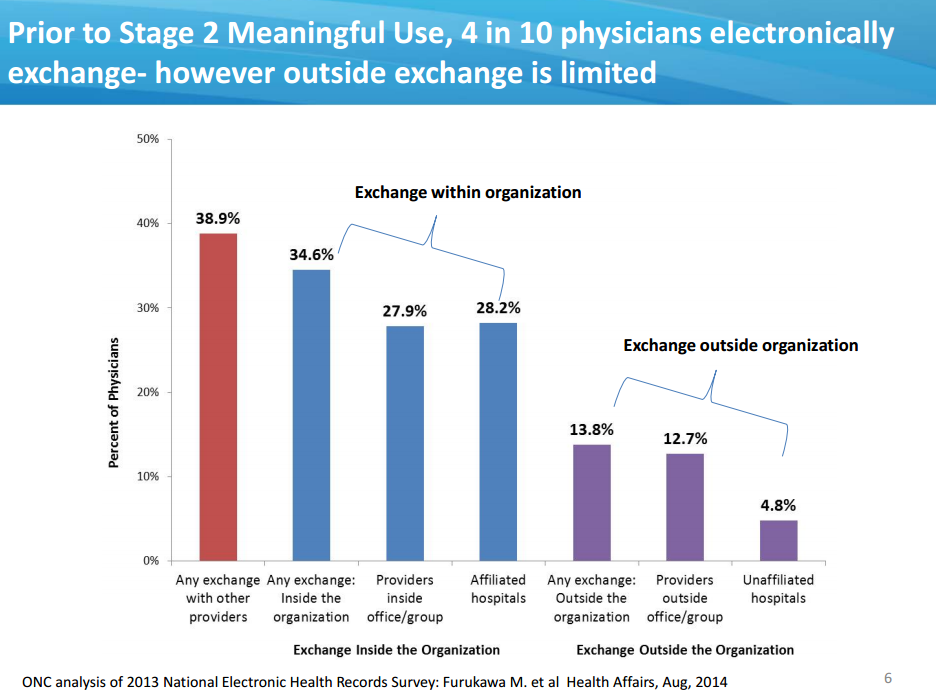
1. Prior to Stage 2 Meanignful Use, 4 in 10 physicians electronically exchange; however outside exchange is limited

2. Majority of physicians who electronically exchange data with other providers report quality and efficiency benefits

3. Hospital exchange with outside providers has grown significantly since 2008

4. Prior to MU Stage 2, 40-50 percent of hospitals had the capability to query and send secure messages

5. In 2013, about one-third of physicians exchnged different types of data

6. In 2012, 5 in 10 physicians receive discharge summaries routinely, but only 25% receive it electronically

7 Prior to MU Stage 2, hospital exchange with outside providers varied by type of data

– 70% of hospitals reported they had the capability to send care summaries in a structured format (CCR, CDA, or CCD)

– 49% of hospitals reported they had the capability to send care summaries to an outside organization using a different EHR

8. Almost half of hospitals send ED notifications— though primarily to affiliated PCPs

9. Individuals are consistently experiencing gaps in information exchange with approximately 1 in 3 indivduals experienced at least one gap in heath information.

10. Among the 28% of the U.S. adult population given access to their online medical record, almost half viewed their information.

– Click here to download the full report 

  • LinkedIn
  • Twitter
  • Facebook
  • Email
  • Print

Tap Native

Get in-depth healthcare technology analysis and commentary delivered straight to your email weekly

Reader Interactions

Primary Sidebar

Subscribe to HIT Consultant

Latest insightful articles delivered straight to your inbox weekly.

Submit a Tip or Pitch

2026 Predictions & Trends

Healthcare 2026 Forecast: Executives on AI Survival, Financial Reckoning, and the End of Point Solutions

2026 Healthcare Executive Predictions: Why the AI “Pilot Era” Is Officially Over

Featured Research Report

Digital Health Funding Hits $14.2B in 2025: A Year of AI Exuberance and Market Bifurcation

Most-Read

Anthropic Debuts ‘Claude for Healthcare’ and Opus 4.5 to Engineer the Future of Life Sciences

Anthropic Debuts ‘Claude for Healthcare’ and Opus 4.5 to Engineer the Future of Life Sciences

OpenAI Debuts ChatGPT Health: A ‘Digital Front Door’ That Connects Medical Records to Agentic AI

OpenAI Debuts ChatGPT Health: A ‘Digital Front Door’ That Connects Medical Records to Agentic AI

From Genes to Hackers: The Hidden Cybersecurity Risks in Life Sciences

From Genes to Hackers: The Hidden Cybersecurity Risks in Life Sciences

Utah Becomes First State to Approve AI System for Prescription Renewals

Utah Becomes First State to Approve AI System for Prescription Renewals

NYC Health + Hospitals to Acquire Maimonides in $2.2B Safety Net Overhaul

NYC Health + Hospitals to Acquire Maimonides in $2.2B Safety Net Overhaul

KLAS Report: Why Hospitals Are Choosing Efficiency Over 'Agentic' AI Hype in 2025

KLAS Report: Why Hospitals Are Choosing Efficiency Over ‘Agentic’ AI Hype in 2025

Advanced Primary Care 2026: Top 6 Investments for Health Systems According to Harvard Medical School

Advanced Primary Care 2026: Top 6 Investments for Health Systems According to Harvard Medical School

AI Nutrition Labels: The Key to Provider Adoption and Patient Trust?

AI Nutrition Labels: The Key to Provider Adoption and Patient Trust?

Kristen Hartsell, VP of Clinical Services, RedSail Technologies

The Pharmacy Closures Crisis: How Independent Pharmacies Are Fixing Pharmacy Deserts

HHS Launches 'OneHHS' AI Strategy to Integrate AI Across CDC, CMS, and FDA for Efficiency and Public Trust

HHS Launches ‘OneHHS’ AI Strategy to Integrate AI Across CDC, CMS, and FDA for Efficiency and Public Trust

Secondary Sidebar

Footer

Company

  • About Us
  • 2026 Editorial Calendar
  • Advertise with Us
  • Reprints and Permissions
  • Op-Ed Submission Guidelines
  • Contact
  • Subscribe

Editorial Coverage

  • Opinion
  • Health IT
    • Care Coordination
    • EMR/EHR
    • Interoperability
    • Population Health Management
    • Revenue Cycle Management
  • Digital Health
    • Artificial Intelligence
    • Blockchain Tech
    • Precision Medicine
    • Telehealth
    • Wearables
  • Startups
  • Value-Based Care
    • Accountable Care
    • Medicare Advantage

Connect

Subscribe to HIT Consultant Media

Latest insightful articles delivered straight to your inbox weekly

Copyright © 2026. HIT Consultant Media. All Rights Reserved. Privacy Policy |