

Two years ago, ambient AI scribes were a mere curiosity. A handful of health systems ran the pilots. Conference demos drew crowds but not purchase orders. That phase is over.
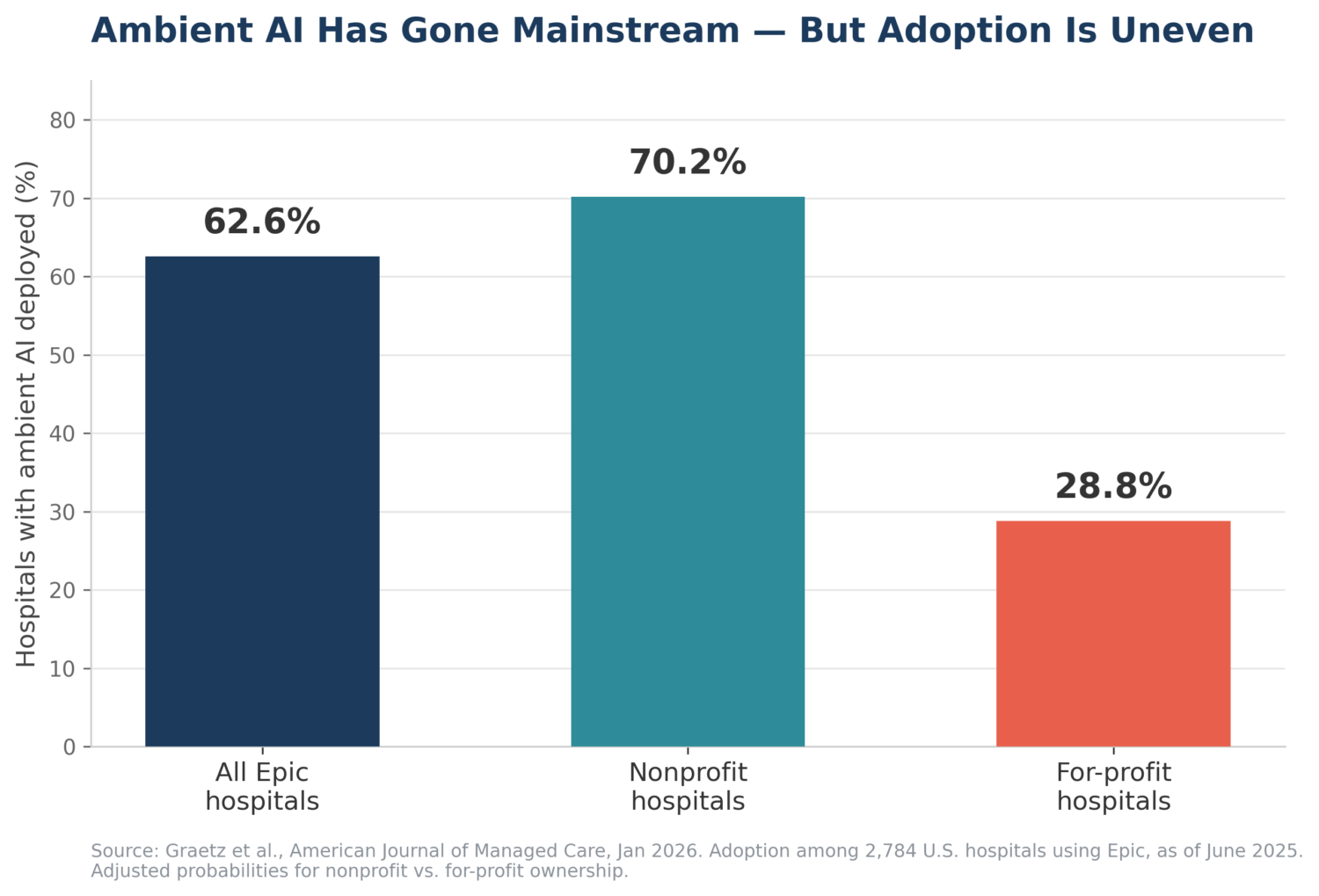
Nearly two-thirds of U.S hospitals running Epic had deployed an ambient AI documentation tool by mid-2025 – 1,744 of them – according to a study published in the American Journal of Managed Care. Among the individual physicians, ambient documentation is the fastest-growing AI use case. Doximity’s 2026 survey of more than 3,100 physicians found voice-based documentation use jumped from 20 to 29 percent in under a year. Analysts at Grand View Research project the U.S. medical scribe market will approach $3 billion by 2033, up from roughly $400 million in 2024.
Unlike most health IT rollouts, which drag through an 18-month procurement cycle and grudging physician adoption, ambient AI spread partly through grassroots demand. Doctors told other doctors it worked.
But speed creates its own problems. Organizations that moved fast on ambient documentation are now discovering that the technology is evolving faster than their governance structures can keep up. At one multispecialty ambulatory practice in Texas, Suki went live for outpatient providers earlier this year. The response was mostly positive, but two of the 27 providers declined the tool, citing concerns about the confidentiality of their patient conversations. It is a small number, but the reason matters. These were not providers skeptical of technology. They were providers thinking carefully about what it means to have an AI system in the room.
The Promise Still Holds – Mostly
Two years ago, ambient AI scribes were a mere curiosity.
The core pitch is simple enough. Software listens to doctor-patient conversations, generates a structured clinical note and providers verify and push it into the EHR.
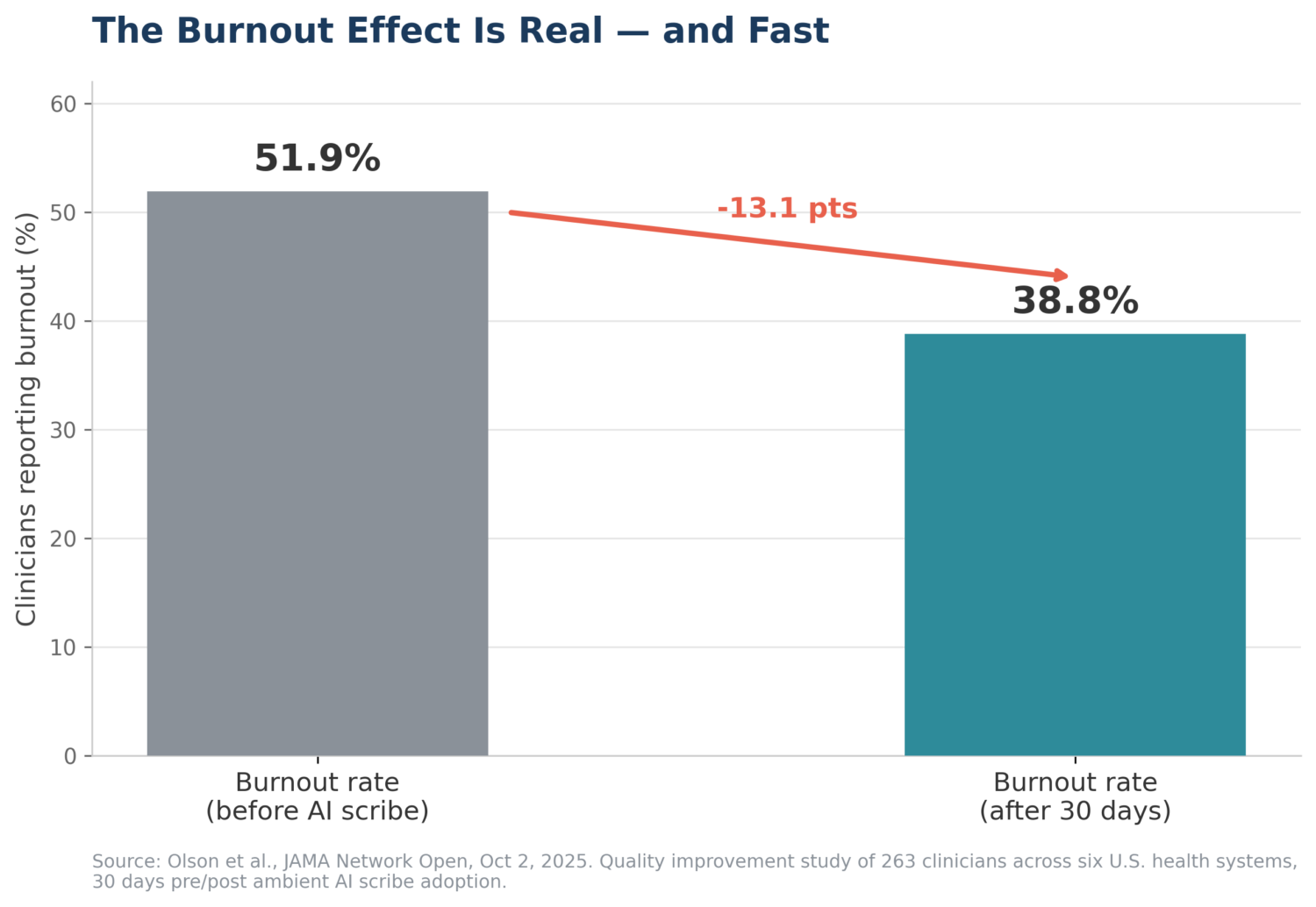
The evidence has gotten harder to ignore. A study published in JAMA Network Open in October 2025, covering 263 clinicians across six health systems, found burnout dropped from 51.9 to 38.8 percent after just 30 days of ambient scribe use alongside measurable improvements in cognitive load, after-hours documentation and focused attention on patients.
The fine print tells a different story. A study of AI scribe ROI across five academic medical centers Mass General Brigham, Emory Healthcare, UC-San Francisco, UC-Davis and Yale New Haven Health found more modest gains. 16 fewer minutes on documentation and 13 fewer minutes in the EHR per eight hours of scheduled care. Meaningful, but a long way from the transformation in the sales deck.
The gap between enthusiasm and evidence is worth sitting on. ROI depends heavily on implementation quality and whether organizations redesign workflows around the tool or simply drop it on top of existing ones. The Texas practice built a consent step into their workflow, a prompt at the start of each encounter that lets the patient choose yes or no before recording starts. No consent, no recording. Only 8 percent of adopters reached positive ROI in year one, according to Black Book Research. Most expect returns within 24 to 30 months.
From Scribe to Agent: The Shift Nobody Is Governing
Ambient AI started as a documentation tool. It listened and typed. But vendors are building towards something more ambitious: autonomous clinical agents that do not just document the visit but act on it.
The next generation can listen to an encounter, identify a care gap, such as a diabetic patient not on station, pre-populate orders for physicians to sign and draft a prior authorization request. All in real time.
That is a different kind of product. Documentation is clerical work. Clinical decision support is medicine. The liability exposure changes, the regulatory requirements change and the procurement conversion should change too. Yet most health systems are treating this as a natural feature upgrade rather than a category change.
What CIOs Should be Asking Before the Next Software Update
The FDA’s January 2026 revised guidance on clinical decision support draws a clear line: CDS software escapes medical device regulation only if the clinician can independently verify the underlying logic. Most ambient documentation tools sit safely on the documentation side of that line. But as vendors add care gap detection and order pre-population, that line blurs fast. A tool that drafts a note is one thing. A tool that queues a prescription is something else entirely and the guidance never actually uses the word “AI”, leaving a gap the industry will have to navigate on its own.
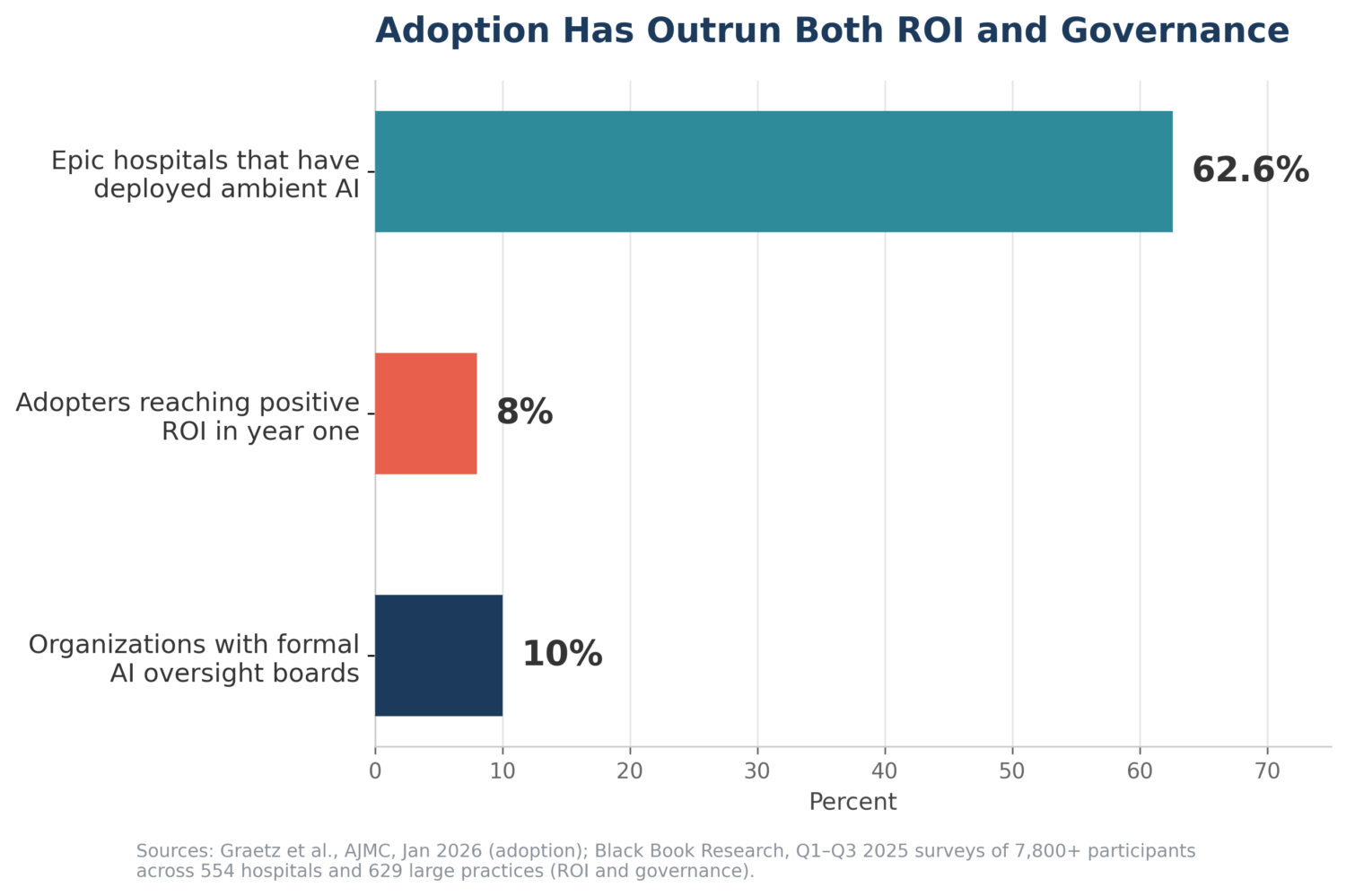
For health IT leaders, three questions matter most right now. First: where does documentation end and clinical decision support begin in your vendor’s roadmap? If those features are coming, compliance and legal need to be in the conversation now. Second: what happens when the tool is wrong? Push for error rates from real production deployments, not curated case studies. Third: do you have governance in place? Only 10 percent of organizations have formal AI oversight boards, per Black Book Research. The confidentiality concern raised by those two providers in Texas is not an edge case; it is a signal. If your framework does not define what ambient AI is appropriate and when it is not, providers will decide for themselves, inconsistently.
Where this leaves us?
Ambient clinical intelligence is now table stake for physician recruitment. It is no longer an innovation story; it is an infrastructure story. But going mainstream does not mean the hard questions got answered along the way.
Health IT leaders who treat ambient AI as just another software purchase will get the 16-minute-a-day version of the story. The organizations getting more out of it are treating it as a clinical operations decision, with governance, training and workflow redesign behind it. The technology is ready. The question is whether the organizations buying it are.
About Akhila Akula
Akhila Akula is a Data Architect and Senior Data Engineer at Midland Health. She designs clinical and financial data systems. She writes about health IT, AI governance and the operational realities of deploying clinical AI in the healthcare industry.
Sources:
- Graetz et al., “Ambient AI Tool Adoption in US Hospitals and Associated Factors,” American Journal of Managed Care (Jan 2026)
https://www.ajmc.com/view/ambient-ai-tool-adoption-in-us-hospitals-and-associated-factors - Doximity, 2026 State of AI in Medicine Report
https://www.doximity.com/reports/state-of-ai-medicine-report/2026 - Grand View Research, U.S. medical scribe market forecast
https://www.grandviewresearch.com/industry-analysis/us-ai-medical-scribing-market-report - Olson et al., “Use of Ambient AI Scribes to Reduce Administrative Burden and Professional Burnout,” JAMA Network Open (Oct 2, 2025)
https://jamanetwork.com/journals/jamanetworkopen/fullarticle/2839542 - Five-center AI scribe ROI study: Mass General Brigham, Emory, UCSF, UC-Davis, Yale New Haven Health (2026)
https://pmc.ncbi.nlm.nih.gov/articles/PMC13044793/ - Black Book Research, AI in Clinical Documentation surveys, Q1-Q3 2025
https://blackbookmarketresearch.com/uploads/pdf/399U19-TBB-Global-Healthcare-IT-Q2-2025-Update.pdf - FDA Clinical Decision Support Software Guidance, issued Jan 6, 2026 (re-issued Jan 29, 2026)
https://www.fda.gov/media/191560/download
