
What You Should Know
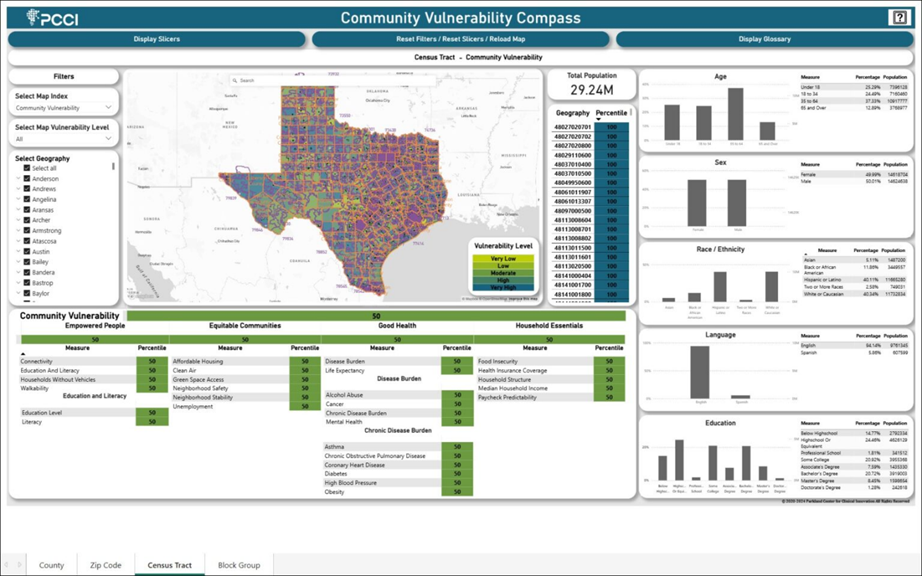
- The Finding: An analysis using the Parkland Center for Clinical Innovation’s (PCCI) Community Vulnerability Compass (CVC) reveals that four out of five rural Texans live in communities highly vulnerable to life-threatening chronic diseases.
- The Distinction: Rural vulnerability is structurally different from urban vulnerability. While urban challenges are often driven by environmental exposures and behavioral risks, rural vulnerability is deeply tied to entrenched clinical conditions and severe access constraints (like lack of broadband and massive travel distances).
- The Paradox: Rural communities possess strong foundational assets, including stable two-parent families and low unemployment. However, these strengths are undermined by low median incomes and the rapid erosion of healthcare infrastructure, creating “obstetric deserts” and forcing crisis-driven care.
The Paradox of Rural Texas
Rural Texas communities possess significant strengths:
- Stable Families: Only 24% of rural census tracts show high vulnerability regarding family structure.
- Low Unemployment: Only 31% of tracts have high unemployment vulnerability.
However, these strengths are undermined by severe barriers:
- Low Income & Access Constraints: 54% of rural tracts have high vulnerability regarding median income and access to care, allowing chronic illnesses to devastate these communities.
The Heavy Burden of Chronic Disease
The CVC analysis paints a stark picture of the clinical burden facing rural Texans, where four out of five live in communities highly vulnerable to life-threatening chronic diseases. Out of 1.25 million rural residents, over 53% (nearly 670,000 individuals) live in high or very high vulnerability areas.
The prevalence of chronic conditions is alarming:
- Coronary Heart Disease: 88% of rural tracts are highly vulnerable.
- High Blood Pressure: 87% of rural tracts are highly vulnerable.
- Cancer: Nearly 85% of rural tracts are highly vulnerable.
- Mental Health: Over 40% of rural Texans live in areas with high mental health vulnerability.
These conditions result in significantly higher age-adjusted mortality rates compared to urban areas, driven by delayed diagnosis and poor continuity of treatment.
The Amplifier: Distance and Infrastructure Erosion
Access to healthcare is the primary multiplier of rural vulnerability. Distance in rural Texas is often an insurmountable barrier, not just an inconvenience.
- Hospital Shortages: 74 Texas counties have no hospital.
- Physician Shortages: Nearly 1 in 5 rural counties lack a licensed primary care physician.
- Travel Distances: Residents travel an average of 59 miles to referral centers, and over 100 miles in parts of West Texas.
- Obstetric Deserts: Large regions require 70+ miles of travel for delivery care.
A specific example highlights this crisis: A cluster of four East Texas counties (Trinity, Angelina, Houston, and Leon) with nearly 150,000 residents has access to only 182 inpatient hospital beds within a 100-mile radius.
The Connectivity Gap: A Barrier to Modern Care
The erosion of physical infrastructure is compounded by a severe lack of digital infrastructure, which cripples the potential for modern care delivery like telehealth and remote monitoring.
- Internet Vulnerability: Nearly 74% of rural census tracts (and 73% of the population within them) experience high or very high vulnerability regarding internet connectivity.
Initiatives like the State of Texas’s Rural Texas Strong project, which plans a $150 million investment in rural broadband and technology, are critical to bridging this gap.
Deep Dive: The Maternal Health Crisis
Maternal health perfectly illustrates the consequences of access constraints. Over 107,000 women aged 18-34 live in rural Texas (8% of the rural population). The existence of “obstetric deserts” means pregnant individuals must travel long distances for care, disrupting continuity and increasing the risk of adverse outcomes and maternal mortality.
Furthermore, nearly all rural Texas counties are designated Mental Health Professional Shortage Areas, forcing emergency departments to handle behavioral health crises rather than providing preventative care.
Programs like the North Texas Maternal Health Accelerator (NTX-MHA) are testing scalable models that use data to identify high-risk populations and provide proactive outreach, care navigation, and clinical support, which could be vital for rural regions.
Moving Forward: Tailored Solutions
PCCI President and CEO Dr. Steve Miff emphasizes that “Urban solutions don’t solve rural health problems.” Interventions cannot simply be parachuted in from urban centers; they must be proactively designed for the specific realities of rural life.
Despite the challenges, rural communities offer a strong foundation for new care models due to:
- Strong social cohesion and informal caregiving networks.
- High trust in local providers.
- Deep community identity.
For more information about the report, visit https://pccinnovation.org/news-events/jamia-open-publishes-a-paper-on-pccis-community-vu-365
