
What You Should Know:
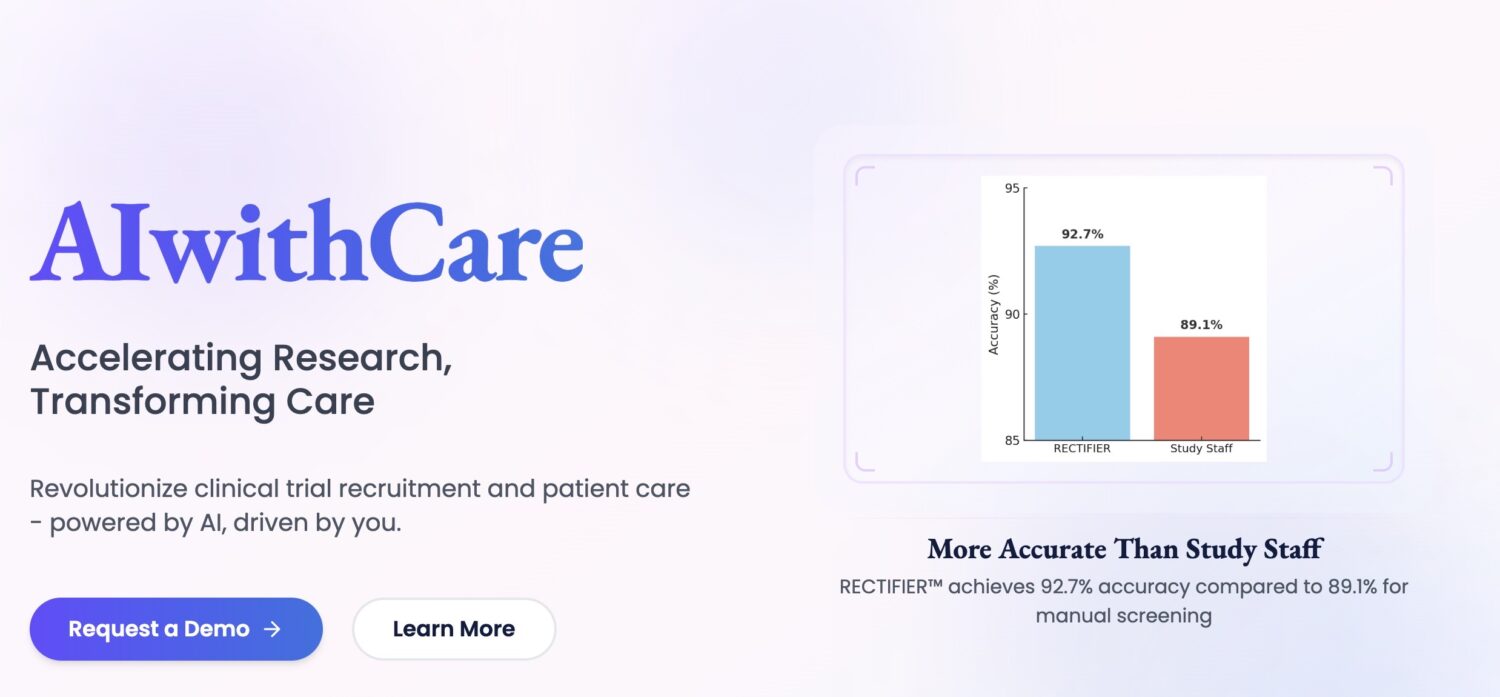
– Mass General Brigham is announcing the spinout of AIwithCare, a company founded by researchers from the health system who developed an artificial intelligence (AI) screening tool that significantly outperformed manual screening for determining a patient’s eligibility and enrolling them in a clinical trial.
– The tool, RECTIFIER (RAG-Enabled Clinical Trial Infrastructure for Inclusion Exclusion Review), was first developed and studied by researchers at Mass General Brigham’s Accelerator for Clinical Transformation.
Validated Impact Across Trials, Population Health, and Specialty Care
Following the publication of a proof-of-concept study in June 2024 and a randomized, blinded controlled trial in February 2025, RECTIFIER has rapidly expanded its footprint across the healthcare system. The AI-powered platform is now active or onboarding in more than 20 research and clinical operations use cases spanning cardiology, oncology, gastroenterology, neurology, pathology, and psychiatry. RECTIFIER is notable as the first company spun out of Mass General Brigham built around a Retrieval-Augmented Generation (RAG) application developed internally by health system researchers, marking a significant milestone in translating enterprise-grade clinical AI from research into operational deployment.
RECTIFIER was designed to address one of the most persistent bottlenecks in clinical research and care delivery: the manual review of unstructured electronic health record data. Using generative AI, the platform screens clinical notes and reports to identify diagnoses, health indicators, medications, and other eligibility-defining features that are typically buried in free text. This capability allows research coordinators and clinical teams to move beyond labor-intensive chart review, improving both speed and accuracy in patient identification while reducing operational burden.
Clinical validation has been central to RECTIFIER’s development. In a 2024 study published in NEJM AI, the tool demonstrated superior accuracy and lower cost compared to manual screening when identifying eligible patients for a heart failure trial. A subsequent randomized trial involving nearly 4,500 patients, published in JAMA in 2025, showed that patient enrollment rates using RECTIFIER were nearly double those achieved through traditional screening methods. Importantly, the analysis found no significant differences in eligibility or enrollment when stratified by race, gender, or ethnicity, underscoring the platform’s potential to support equitable research participation.
Beyond clinical trials, Mass General Brigham teams are deploying RECTIFIER across a growing set of clinical and population health workflows. Pediatric gastroenterologists are using the tool for referral triage, achieving 94.7% overall accuracy and 98% accuracy in identifying urgent symptoms and laboratory findings embedded within clinical notes. The Mass General Brigham Population Health Service Organization, which oversees care for more than 650,000 patients in value-based models, has applied RECTIFIER to streamline eligibility assessment for heart failure management programs and to identify patients with uncontrolled blood pressure, enabling more targeted allocation of health system resources. Additional groups are leveraging the platform for high-resolution phenotyping in sickle cell disease and across ALS trials to accelerate access to potentially life-altering therapies.
To support broader adoption, the RECTIFIER team plans to scale the technology through AIwithCare and its AIwithCare Studio platform, enabling other health systems, hospitals, and clinics to deploy similar capabilities for clinical trial matching and advanced analytics. According to Jane Moran, Chief Information and Data Officer at Mass General Brigham, the success of RECTIFIER reflects the importance of cross-functional collaboration spanning clinical expertise, software development, information security, and change management. With the foundational work now complete, the path is clearer for external organizations to implement and benefit from these capabilities.
The spinout was facilitated by Mass General Brigham Innovation, which oversees technology transfer, intellectual property management, and commercialization across the health system. In the past year alone, the group supported more than 1,400 active licenses, processed over 600 new invention disclosures, and secured nearly 200 issued U.S. patents—highlighting the scale and maturity of Mass General Brigham’s innovation engine as RECTIFIER moves from internal success to broader healthcare impact.
