
• Skip to main content
  • Skip to secondary menu
  • Skip to primary sidebar
  • Skip to secondary sidebar
  • Skip to footer

  • Opinion
  • Health IT
    • Behavioral Health
    • Care Coordination
    • EMR/EHR
    • Interoperability
    • Patient Engagement
    • Population Health Management
    • Revenue Cycle Management
    • Social Determinants of Health
  • Digital Health
    • AI
    • Blockchain
    • Precision Medicine
    • Telehealth
    • Wearables
  • Life Sciences
  • Investments
  • M&A
  • Value-based Care
    • Accountable Care (ACOs)
    • Medicare Advantage

KLAS Report: Oracle Health Faces Customer Losses and Declining Satisfaction

by Fred Pennic 08/22/2025 Leave a Comment

  • LinkedIn
  • Twitter
  • Facebook
  • Email
  • Print
KLAS Report: Oracle Health Faces Customer Losses and Declining Satisfaction
Image Credit: KLAS Report: Oracle Health

What You Should Know: 

– A new report from KLAS Research examines the state of Oracle Health three years after its acquisition of Cerner. The findings reveal that while Oracle Health has made big promises, customer satisfaction has not improved, and the vendor has lost a significant number of customers. The report is based on findings from seven rounds of interviews with a longitudinal feedback group of Oracle Health customers from 2022 to 2025.

– The report reveals a dissatisfied customer base was inherited from Cerner, and post-acquisition, the customer experience has not been enhanced. Customers in the longitudinal feedback group report that their relationship with the vendor has declined, citing a lack of clear communication, undelivered promises, and an increased focus on collections.

Customer Exodus and Satisfaction Metrics

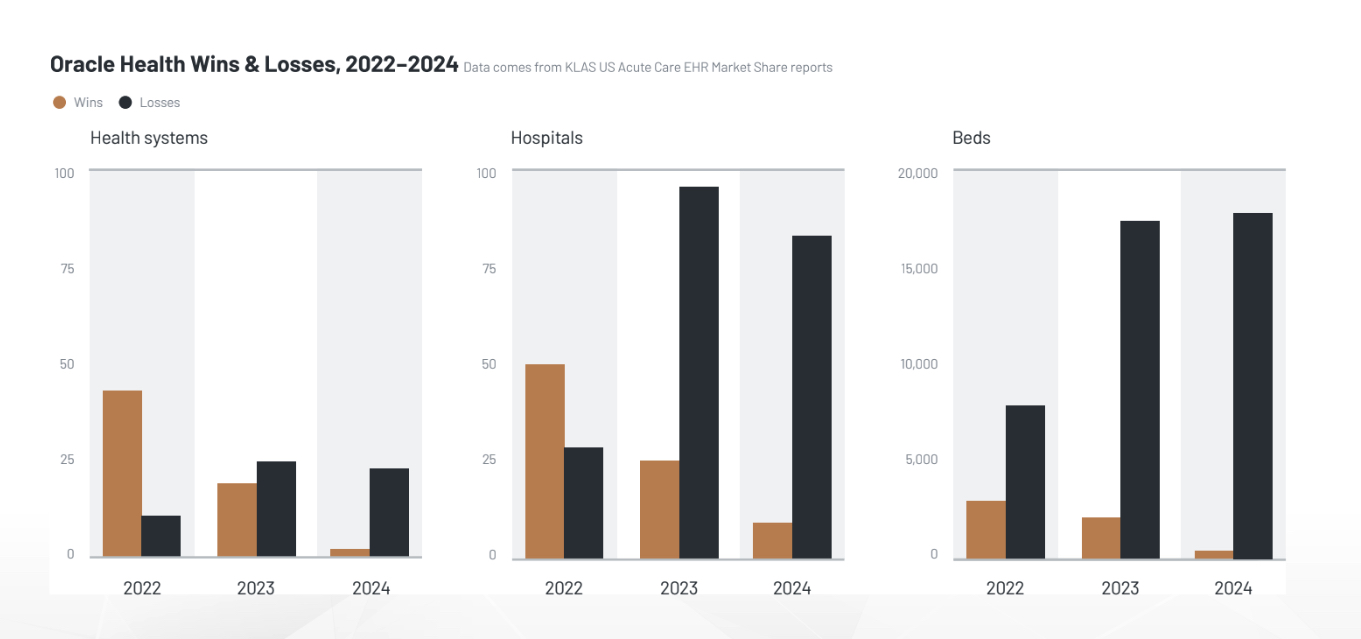
Since 2022, Oracle Health’s market share has significantly declined, particularly among large health systems. KLAS data shows that the vendor has lost 57 unique acute care customers in the past three years, including 12 health systems with over 1,000 beds. In 2024, Oracle Health received a “D+” for its overall performance and a “D” for its relationship score.

The “Evangelism” score, which measures a customer’s willingness to recommend the vendor, has also declined from -40% in 2022 to -49% in 2024. Due to this low satisfaction, 50% of interviewed Oracle Health customers stated they would not buy the EHR again.

Clinical AI Agent Sparks Optimism

Despite the widespread dissatisfaction, the report indicates a noticeable improvement in customers’ opinions of Oracle Health’s long-term vision in the first quarter of 2025. This optimism, which has reached a three-year high, is being driven by early signs of progress, such as improved code quality in new releases and the delivery of promised technologies like the

The Clinical AI Agent has received high satisfaction scores from early adopters, who describe it as meaningful technology that streamlines workflows and provides relevant, real-time insights. One CIO noted that physicians using the solution are seeing two additional patients a day and are complimentary about the quality of the work.

Lingering Questions and Concerns

While new offerings like the Clinical AI Agent are a positive sign, customers still have lingering questions about Oracle Health’s road map. Concerns remain about the seamless integration of all solutions, the vendor’s ability to reliably deliver on priorities without disrupting current stability, and whether the focus on government work will come at the expense of commercial clients.

Customers also express concerns about the loss of skilled implementation resources following restructurings, reporting difficulties in escalating support tickets and feeling that the vendor is not proactive. 

For more information about this KLAS report, visit https://klasresearch.com/report/oracle-health-2025-how-are-customers-faring-three-years-post-acquisition/3827

  • LinkedIn
  • Twitter
  • Facebook
  • Email
  • Print

Tagged With: Healthcare Mergers & Acquisitions, Oracle

Tap Native

Get in-depth healthcare technology analysis and commentary delivered straight to your email weekly

Reader Interactions

Primary Sidebar

Subscribe to HIT Consultant

Latest insightful articles delivered straight to your inbox weekly.

Submit a Tip or Pitch

2026 Predictions & Trends

Healthcare 2026 Forecast: Executives on AI Survival, Financial Reckoning, and the End of Point Solutions

2026 Healthcare Executive Predictions: Why the AI “Pilot Era” Is Officially Over

Most-Read

KLAS Report: Why Hospitals Are Choosing Efficiency Over 'Agentic' AI Hype in 2025

KLAS Report: Why Hospitals Are Choosing Efficiency Over ‘Agentic’ AI Hype in 2025

Advanced Primary Care 2026: Top 6 Investments for Health Systems According to Harvard Medical School

Advanced Primary Care 2026: Top 6 Investments for Health Systems According to Harvard Medical School

AI Nutrition Labels: The Key to Provider Adoption and Patient Trust?

AI Nutrition Labels: The Key to Provider Adoption and Patient Trust?

Kristen Hartsell, VP of Clinical Services, RedSail Technologies

The Pharmacy Closures Crisis: How Independent Pharmacies Are Fixing Pharmacy Deserts

HHS Launches 'OneHHS' AI Strategy to Integrate AI Across CDC, CMS, and FDA for Efficiency and Public Trust

HHS Launches ‘OneHHS’ AI Strategy to Integrate AI Across CDC, CMS, and FDA for Efficiency and Public Trust

From Overwhelmed to Optimized: How AI Agents Address Staffing Challenges and Burnout in Healthcare

From Overwhelmed to Optimized: How AI Agents Address Staffing Challenges and Burnout in Healthcare

The VBC Paradox: Why Hospitals Are Doubling Down on Value-Based Care While Revenue at Risk Lags

The VBC Paradox: Why Hospitals Are Doubling Down on Value-Based Care While Revenue at Risk Lags

Tebra Secures $250M to Challenge Legacy EHRs with AI-Powered Automation

Tebra Secures $250M to Challenge Legacy EHRs with AI-Powered Automation

AstraZeneca Selects Salesforce Agentforce Life Sciences to Deploy AI-Powered Global Customer Engagement

AstraZeneca Selects Salesforce Agentforce Life Sciences to Deploy AI-Powered Global Customer Engagement

Aidoc Partners with NVIDIA MONAI to Scale Open-Source Clinical AI

Aidoc Partners with NVIDIA MONAI to Scale Open-Source Clinical AI

Secondary Sidebar

Footer

Company

  • About Us
  • Advertise with Us
  • Reprints and Permissions
  • Op-Ed Submission Guidelines
  • Contact
  • Subscribe

Editorial Coverage

  • Opinion
  • Health IT
    • Care Coordination
    • EMR/EHR
    • Interoperability
    • Population Health Management
    • Revenue Cycle Management
  • Digital Health
    • Artificial Intelligence
    • Blockchain Tech
    • Precision Medicine
    • Telehealth
    • Wearables
  • Startups
  • Value-Based Care
    • Accountable Care
    • Medicare Advantage

Connect

Subscribe to HIT Consultant Media

Latest insightful articles delivered straight to your inbox weekly

Copyright © 2025. HIT Consultant Media. All Rights Reserved. Privacy Policy |