
• Skip to main content
  • Skip to secondary menu
  • Skip to primary sidebar
  • Skip to secondary sidebar
  • Skip to footer

  • Opinion
  • Health IT
    • Behavioral Health
    • Care Coordination
    • EMR/EHR
    • Interoperability
    • Patient Engagement
    • Population Health Management
    • Revenue Cycle Management
    • Social Determinants of Health
  • Digital Health
    • AI
    • Blockchain
    • Precision Medicine
    • Telehealth
    • Wearables
  • Life Sciences
  • Investments
  • M&A
  • Value-based Care
    • Accountable Care (ACOs)
    • Medicare Advantage

77% of Sponsors, CROs Plan to Run Agile Clinical Trials in Next Months

by Jasmine Pennic 11/17/2021 Leave a Comment

  • LinkedIn
  • Twitter
  • Facebook
  • Email
  • Print
77% of Sponsors, CROs Plan to Run Agile Clinical Trials in Next Months

What You Should Know:

– Today Science 37 published a new report suggesting a momentous shift in the way that clinical trials are conducted.

– For the first time, more research sponsors and CROs are planning to run Agile/Hybrid Clinical Trials than ever before. Findings show that the vast majority or 77% of respondents plan to run an agile clinical trial in the next 12 months, compared to 59% for the previous 12 months.


Science 37 Holdings, Inc. (Nasdaq: SNCE) (“Science 37”), a LA-based pioneer of decentralization and Operating System for today’s more agile clinical trials™, has published new data suggesting that the clinical research industry has reached a pivotal shift in the way that clinical trials are conducted, as Sponsors and CROs report they plan to run more agile (or hybrid) clinical trials in 2022 than traditional, site-based studies.

Report Background

Findings are the result of a sentiment study among 127 senior clinical research executives in September and October 2021. Nearly eight of 10 respondents said they plan to run an agile clinical trial in the next 12 months. Conversely, just seven of 10 said they are planning to run a traditional, site-based study in the next 12 months.

Defining Agile Clinical Trials

Use of decentralized tools and methodologies is increasing. With these advances, patients will be able to participate from their home, a site, or a combination of home and site; and providers will be able to participate on or off-premises. This symbiotic clinical trial or the “agile clinical trial” requires: The ability to activate any provider and any patient, regardless of premises; a network of patient communities, telemedicine investigators, mobile nurses, and remote coordinators—all with a flexible Operating System to seamlessly navigate between on-site and off-site. 

Key Findings

In addition to documenting this fundamental shift, the survey data also paints a vivid picture of the decentralized clinical trial (DCT) landscape for the year ahead, suggesting significant increases in DCT activity across multiple therapeutic areas and study phases. Among the findings:

– 46% of respondents expect to run an oncology study utilizing DCT in the next year, vs. 35% for the previous year—making oncology the most prevalent DCT category.

– Oncology, CNS, rare diseases, and immunology should see the biggest uptake in DCT use.

– The report suggests significant increases in DCT activity across Phase II, III, and IV studies.

– We also expect to see big increases in the deployment of most individual DCT components, particularly eConsent, telemedicine, mobile nurses, and remote sites in a hybrid model.

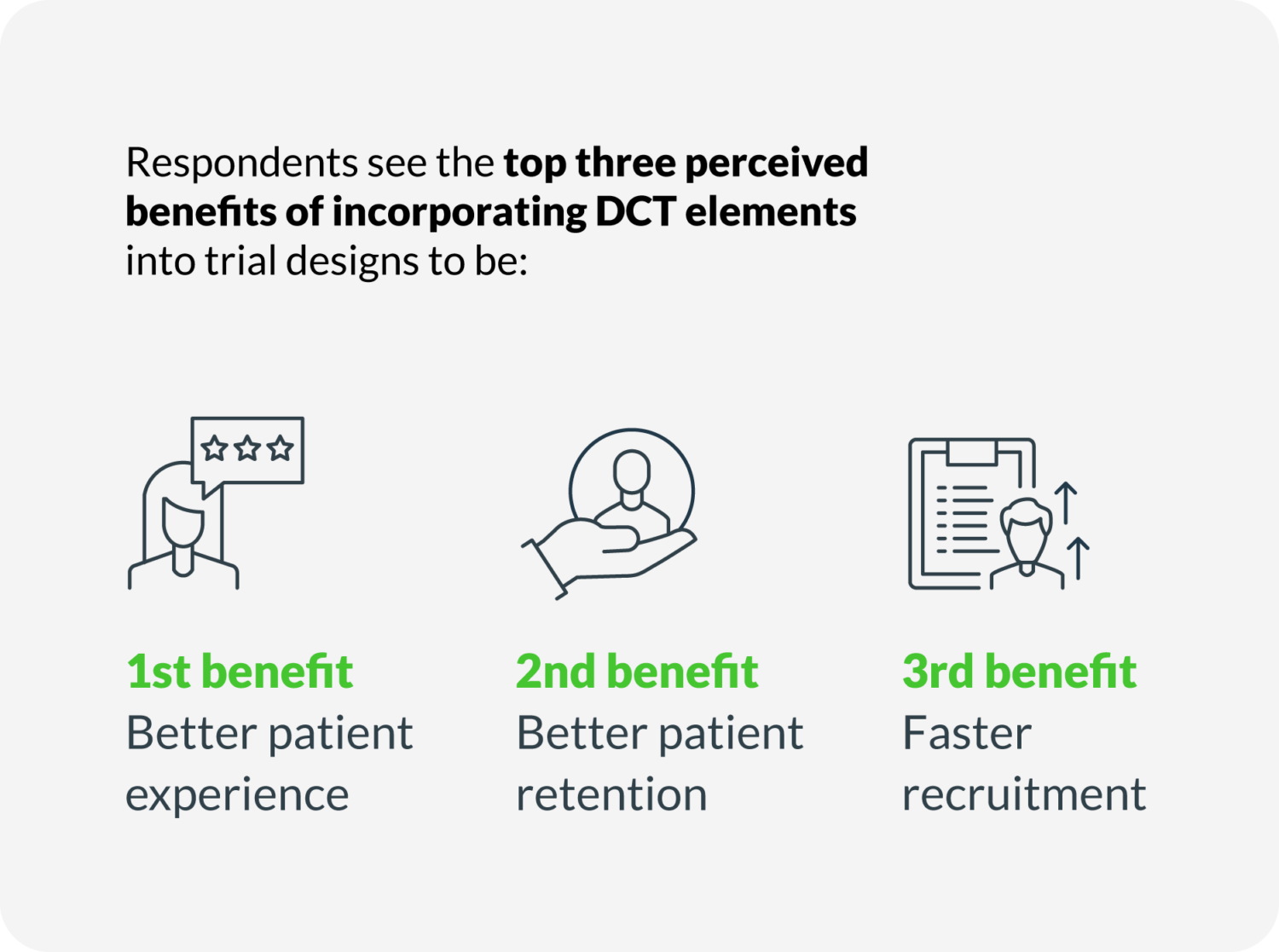
– The top-3 perceived benefits of DCT are better patient experience, better patient retention, and faster recruitment.                                                                     

– The top-3 perceived challenges of DCT are integrating traditional sites with DCT, lack of in-house capabilities, and regulatory concerns.    

“The power of increased decentralization is becoming undeniable as more sponsors benefit from faster enrollment, greater retention and increased diversity,” said David Coman, Chief Executive Officer at Science 37.  “Leveraging the Science 37 Operating System, our customers are enabling much more agile clinical trial designs that realize these benefits while significantly reducing patient burden and delivering more universal access for patients and providers, anywhere.”

  • LinkedIn
  • Twitter
  • Facebook
  • Email
  • Print

Tagged With: Clinical Trials, Decentralized Clinical Trials

Tap Native

Get in-depth healthcare technology analysis and commentary delivered straight to your email weekly

Reader Interactions

Primary Sidebar

Subscribe to HIT Consultant

Latest insightful articles delivered straight to your inbox weekly.

Submit a Tip or Pitch

2026 Predictions & Trends

Healthcare 2026 Forecast: Executives on AI Survival, Financial Reckoning, and the End of Point Solutions

2026 Healthcare Executive Predictions: Why the AI “Pilot Era” Is Officially Over

Most-Read

NYC Health + Hospitals to Acquire Maimonides in $2.2B Safety Net Overhaul

NYC Health + Hospitals to Acquire Maimonides in $2.2B Safety Net Overhaul

KLAS Report: Why Hospitals Are Choosing Efficiency Over 'Agentic' AI Hype in 2025

KLAS Report: Why Hospitals Are Choosing Efficiency Over ‘Agentic’ AI Hype in 2025

Advanced Primary Care 2026: Top 6 Investments for Health Systems According to Harvard Medical School

Advanced Primary Care 2026: Top 6 Investments for Health Systems According to Harvard Medical School

AI Nutrition Labels: The Key to Provider Adoption and Patient Trust?

AI Nutrition Labels: The Key to Provider Adoption and Patient Trust?

Kristen Hartsell, VP of Clinical Services, RedSail Technologies

The Pharmacy Closures Crisis: How Independent Pharmacies Are Fixing Pharmacy Deserts

HHS Launches 'OneHHS' AI Strategy to Integrate AI Across CDC, CMS, and FDA for Efficiency and Public Trust

HHS Launches ‘OneHHS’ AI Strategy to Integrate AI Across CDC, CMS, and FDA for Efficiency and Public Trust

From Overwhelmed to Optimized: How AI Agents Address Staffing Challenges and Burnout in Healthcare

From Overwhelmed to Optimized: How AI Agents Address Staffing Challenges and Burnout in Healthcare

The VBC Paradox: Why Hospitals Are Doubling Down on Value-Based Care While Revenue at Risk Lags

The VBC Paradox: Why Hospitals Are Doubling Down on Value-Based Care While Revenue at Risk Lags

Tebra Secures $250M to Challenge Legacy EHRs with AI-Powered Automation

Tebra Secures $250M to Challenge Legacy EHRs with AI-Powered Automation

AstraZeneca Selects Salesforce Agentforce Life Sciences to Deploy AI-Powered Global Customer Engagement

AstraZeneca Selects Salesforce Agentforce Life Sciences to Deploy AI-Powered Global Customer Engagement

Secondary Sidebar

Footer

Company

  • About Us
  • Advertise with Us
  • Reprints and Permissions
  • Op-Ed Submission Guidelines
  • Contact
  • Subscribe

Editorial Coverage

  • Opinion
  • Health IT
    • Care Coordination
    • EMR/EHR
    • Interoperability
    • Population Health Management
    • Revenue Cycle Management
  • Digital Health
    • Artificial Intelligence
    • Blockchain Tech
    • Precision Medicine
    • Telehealth
    • Wearables
  • Startups
  • Value-Based Care
    • Accountable Care
    • Medicare Advantage

Connect

Subscribe to HIT Consultant Media

Latest insightful articles delivered straight to your inbox weekly

Copyright © 2026. HIT Consultant Media. All Rights Reserved. Privacy Policy |