
• Skip to main content
  • Skip to secondary menu
  • Skip to primary sidebar
  • Skip to secondary sidebar
  • Skip to footer

  • Opinion
  • Health IT
    • Behavioral Health
    • Care Coordination
    • EMR/EHR
    • Interoperability
    • Patient Engagement
    • Population Health Management
    • Revenue Cycle Management
    • Social Determinants of Health
  • Digital Health
    • AI
    • Blockchain
    • Precision Medicine
    • Telehealth
    • Wearables
  • Life Sciences
  • Investments
  • M&A
  • Value-based Care
    • Accountable Care (ACOs)
    • Medicare Advantage

Study: Glooko’s Diabetes Mobile App Improved Glucose & A1C Rates

by HITC Staff 06/09/2017 Leave a Comment

  • LinkedIn
  • Twitter
  • Facebook
  • Email
  • Print

Study Glooko’s Diabetes App Improved Glucose & A1C Rates

Diabetes data management company Glooko announced that its mobile app was associated with a drop in average blood glucose, estimated A1C (eA1C) and hyperglycemia rates in people with diabetes, according to results of two retrospective studies. Furthermore, usage of the Glooko mobile app was also associated with an increase in blood glucose test rate. Increased blood glucose testing rates have been shown to directly correlate with improvements in glycemic control, as evidenced by this retrospective study and other studies as well.

Glooko is a mobile health app and cloud-based diabetes management system that enables PWDs to upload their self-monitored blood glucose SMBG, insulin pump, diet, exercise and medication data to the cloud and share those data with their care team. In addition, the system allows users to visualize their glycemic patterns by time period on their smartphone, and both digitally log and review that information alongside their diet, exercise and medication usage.

Study Overview

The retrospective studies show that Glooko mobile app users who used the app for self-management experienced the following clinical results compared to a control group of users who did not use the Glooko mobile app, but did upload their data in the clinic:

• Average Blood Glucose: After two months, mobile users experienced an additional 3.54% drop in average BG, over control group users.

• Estimated A1C (eA1C): The studies showed a drop in eA1C among Glooko mobile app users between 0.3% and 0.5% down to 7.14% – 6.98% after two months of using the Glooko mobile app alone.

• Reduction in hyperglycemic rates: Glooko mobile users exhibited an additional decrease in the probability of experiencing hyperglycemic events by 4.38% per month, compared to the control group (p<0.01). Overall, a mobile user could expect a 10.65% decrease in the probability of hyperglycemic events by the end of two months.

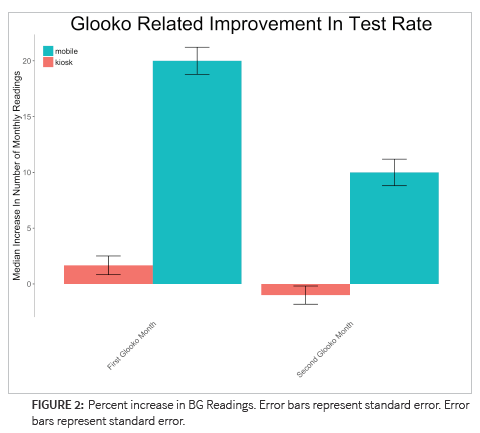
• Blood Glucose Test Rate: In addition, there was a statistically significant increase in the average blood glucose test rate of between 16.33% – 34.15% (p<0.01) increase after two months, compared to control.

• Relationship Between Test Rate and Average BG: These increases in blood glucose test rate show a modest but significant correlation to the percent decrease in BG Average (ρ=0.22, p<0.01) indicating that people with diabetes who increased their test rates more, compared to the previous month, also exhibited a decrease in average BG.

“We are thrilled to see this additional clinical evidence that shows the positive impact Glooko can have on people with diabetes,” Rick Altinger, CEO of Glooko said in a statement. “Glooko’s mission has always been to improve the clinical outcomes for people with diabetes by making diabetes management easier through digital tools. Our user satisfaction rates coupled with this clinical evidence adds credence to the investments that digital health companies have been making to improve the lives of people with chronic diseases.”

  • LinkedIn
  • Twitter
  • Facebook
  • Email
  • Print

Tagged With: diabetes app, Diabetes Management, Diabetes Management Platform, Diabetes Prevention Platform, digital diabetes management platform, Glooko

Tap Native

Get in-depth healthcare technology analysis and commentary delivered straight to your email weekly

Reader Interactions

Primary Sidebar

Subscribe to HIT Consultant

Latest insightful articles delivered straight to your inbox weekly.

Submit a Tip or Pitch

2026 Predictions & Trends

Healthcare 2026 Forecast: Executives on AI Survival, Financial Reckoning, and the End of Point Solutions

2026 Healthcare Executive Predictions: Why the AI “Pilot Era” Is Officially Over

Most-Read

KLAS Report: Why Hospitals Are Choosing Efficiency Over 'Agentic' AI Hype in 2025

KLAS Report: Why Hospitals Are Choosing Efficiency Over ‘Agentic’ AI Hype in 2025

Advanced Primary Care 2026: Top 6 Investments for Health Systems According to Harvard Medical School

Advanced Primary Care 2026: Top 6 Investments for Health Systems According to Harvard Medical School

AI Nutrition Labels: The Key to Provider Adoption and Patient Trust?

AI Nutrition Labels: The Key to Provider Adoption and Patient Trust?

Kristen Hartsell, VP of Clinical Services, RedSail Technologies

The Pharmacy Closures Crisis: How Independent Pharmacies Are Fixing Pharmacy Deserts

HHS Launches 'OneHHS' AI Strategy to Integrate AI Across CDC, CMS, and FDA for Efficiency and Public Trust

HHS Launches ‘OneHHS’ AI Strategy to Integrate AI Across CDC, CMS, and FDA for Efficiency and Public Trust

From Overwhelmed to Optimized: How AI Agents Address Staffing Challenges and Burnout in Healthcare

From Overwhelmed to Optimized: How AI Agents Address Staffing Challenges and Burnout in Healthcare

The VBC Paradox: Why Hospitals Are Doubling Down on Value-Based Care While Revenue at Risk Lags

The VBC Paradox: Why Hospitals Are Doubling Down on Value-Based Care While Revenue at Risk Lags

Tebra Secures $250M to Challenge Legacy EHRs with AI-Powered Automation

Tebra Secures $250M to Challenge Legacy EHRs with AI-Powered Automation

AstraZeneca Selects Salesforce Agentforce Life Sciences to Deploy AI-Powered Global Customer Engagement

AstraZeneca Selects Salesforce Agentforce Life Sciences to Deploy AI-Powered Global Customer Engagement

Aidoc Partners with NVIDIA MONAI to Scale Open-Source Clinical AI

Aidoc Partners with NVIDIA MONAI to Scale Open-Source Clinical AI

Secondary Sidebar

Footer

Company

  • About Us
  • Advertise with Us
  • Reprints and Permissions
  • Op-Ed Submission Guidelines
  • Contact
  • Subscribe

Editorial Coverage

  • Opinion
  • Health IT
    • Care Coordination
    • EMR/EHR
    • Interoperability
    • Population Health Management
    • Revenue Cycle Management
  • Digital Health
    • Artificial Intelligence
    • Blockchain Tech
    • Precision Medicine
    • Telehealth
    • Wearables
  • Startups
  • Value-Based Care
    • Accountable Care
    • Medicare Advantage

Connect

Subscribe to HIT Consultant Media

Latest insightful articles delivered straight to your inbox weekly

Copyright © 2025. HIT Consultant Media. All Rights Reserved. Privacy Policy |