

• Skip to main content
  • Skip to secondary menu
  • Skip to primary sidebar
  • Skip to secondary sidebar
  • Skip to footer

  • Opinion
  • Health IT
    • Behavioral Health
    • Care Coordination
    • EMR/EHR
    • Interoperability
    • Patient Engagement
    • Population Health Management
    • Revenue Cycle Management
    • Social Determinants of Health
  • Digital Health
    • AI
    • Blockchain
    • Precision Medicine
    • Telehealth
    • Wearables
  • Life Sciences
  • Investments
  • M&A
  • Value-based Care
    • Accountable Care (ACOs)
    • Medicare Advantage

5 Recommendations for Hospitals & Nurses to Improve Patient Experience

by HITC Staff 08/30/2016 Leave a Comment

  • LinkedIn
  • Twitter
  • Facebook
  • Email
  • Print

5 Recommendations for Hospitals & Nurses to Improve Patient Experience

There’s an entirely new customer in today’s patient care mix that nurses must address in their efforts to deliver a high quality patient experience.  But new technology may hold the key to addressing the challenge.

A recent independent research study conducted by Amplion reveals the patient caregiver who accompanies the patient during an overnight hospital stay is far more critical in judging patient satisfaction – and the care that nurses work so hard to deliver – than hospitals might have suspected.

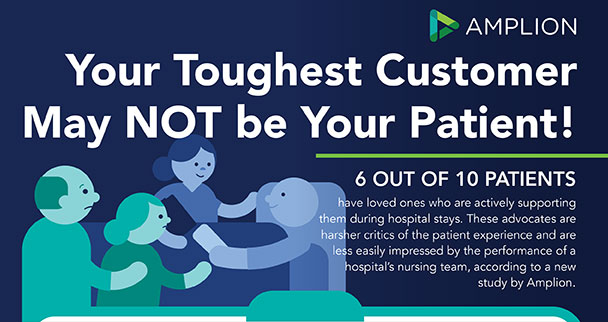
The Amplion Clinical Communications study found that a majority of patients (60%) across the United States have loved ones (family, friends or professional patient advocates) actively supporting them during hospital stays.  In nearly every category surveyed in the study, the patient caregiver graded the nursing staff lower in meeting patient’s needs than patients did. 

In addition, fewer caregivers (46%) than patients (63%) said they were highly likely to recommend the hospital based on their perception.

“This is sobering news to health systems and the nurses who are on the front lines of the patient experience,” said Brenda Aubin, RN, BSN, Clinical Integration Manager for Amplion Clinical Communications in a statement.   “A nurse’s job isn’t easy today, but this study affirms what many suspected, that the patient isn’t the only important arbiter of superior nursing care.  In today’s healthcare system, nursing teams need to focus on patient caregivers almost as much as the patients themselves in order for both patients and caregivers to recognize a high quality patient experience.   Hospitals will need a strong and passionate nursing staff, as well as current technology designed to help deliver on that expectation.”

The study included a quantitative survey of 1,000 patients and caregivers at hospitals across the country and qualitative interviews that more deeply explored the quantitative findings. 

The research effort was intended to document issues around communications with hospital staff, particularly nursing staff responsiveness to patient calls, requests and perceptions of nursing care.  The study has since been developed into an eBook, “Your Toughest Customers,” that provides focus group anecdotes about the participants’ care experiences, insights about this revelation from several industry experts and the study’s hard-and fast statistics.

Given this new perspective, the investigation makes five recommendations that hospitals and nurses should adopt if they want credit for the quality care they provide and the resulting patient satisfaction grades.

5 Recommendations for Hospitals & Nurses to Improve Patient Experience

1. Turn caregivers into allies.  Educate the staff to the importance of including caregivers in caring for patients both in the hospital and at home.  As partners, these individuals can be significant supporters to nurses’ efforts to provide quality patient care.

2. Prepare the clinical staff to work with caregivers.  Build an empathic clinical staff that can effectively deliver care to the patient while also providing attention to the caregiver.  More and more, the patient caregiver is becoming a key judge of care quality.

3. Create a culture of shared accountability.  A superior nursing team will help each other respond to patient needs, not ignore a patient’s call because “he’s not my patient.”

4. Understand how caregivers impact hospital image and reimbursement.  Every impression matters.  Poor performance by a member of the nursing team can degrade the entire team’s performance.  Hospitals should recruit, train and retain staff that understand the service side of the care experience.

5. Provide consistent quality patient care.  Hard wire consistency into patient care.  Ensure quality patient engagement is replicated throughout the care team, measuring for effectiveness and tracking for improvement.

  • LinkedIn
  • Twitter
  • Facebook
  • Email
  • Print

Tap Native

Get in-depth healthcare technology analysis and commentary delivered straight to your email weekly

Reader Interactions

Primary Sidebar

Subscribe to HIT Consultant

Latest insightful articles delivered straight to your inbox weekly.

Submit a Tip or Pitch

2026 Predictions & Trends

Healthcare 2026 Forecast: Executives on AI Survival, Financial Reckoning, and the End of Point Solutions

2026 Healthcare Executive Predictions: Why the AI “Pilot Era” Is Officially Over

Most-Read

NYC Health + Hospitals to Acquire Maimonides in $2.2B Safety Net Overhaul

NYC Health + Hospitals to Acquire Maimonides in $2.2B Safety Net Overhaul

KLAS Report: Why Hospitals Are Choosing Efficiency Over 'Agentic' AI Hype in 2025

KLAS Report: Why Hospitals Are Choosing Efficiency Over ‘Agentic’ AI Hype in 2025

Advanced Primary Care 2026: Top 6 Investments for Health Systems According to Harvard Medical School

Advanced Primary Care 2026: Top 6 Investments for Health Systems According to Harvard Medical School

AI Nutrition Labels: The Key to Provider Adoption and Patient Trust?

AI Nutrition Labels: The Key to Provider Adoption and Patient Trust?

Kristen Hartsell, VP of Clinical Services, RedSail Technologies

The Pharmacy Closures Crisis: How Independent Pharmacies Are Fixing Pharmacy Deserts

HHS Launches 'OneHHS' AI Strategy to Integrate AI Across CDC, CMS, and FDA for Efficiency and Public Trust

HHS Launches ‘OneHHS’ AI Strategy to Integrate AI Across CDC, CMS, and FDA for Efficiency and Public Trust

From Overwhelmed to Optimized: How AI Agents Address Staffing Challenges and Burnout in Healthcare

From Overwhelmed to Optimized: How AI Agents Address Staffing Challenges and Burnout in Healthcare

The VBC Paradox: Why Hospitals Are Doubling Down on Value-Based Care While Revenue at Risk Lags

The VBC Paradox: Why Hospitals Are Doubling Down on Value-Based Care While Revenue at Risk Lags

Tebra Secures $250M to Challenge Legacy EHRs with AI-Powered Automation

Tebra Secures $250M to Challenge Legacy EHRs with AI-Powered Automation

AstraZeneca Selects Salesforce Agentforce Life Sciences to Deploy AI-Powered Global Customer Engagement

AstraZeneca Selects Salesforce Agentforce Life Sciences to Deploy AI-Powered Global Customer Engagement

Secondary Sidebar

Footer

Company

  • About Us
  • Advertise with Us
  • Reprints and Permissions
  • Op-Ed Submission Guidelines
  • Contact
  • Subscribe

Editorial Coverage

  • Opinion
  • Health IT
    • Care Coordination
    • EMR/EHR
    • Interoperability
    • Population Health Management
    • Revenue Cycle Management
  • Digital Health
    • Artificial Intelligence
    • Blockchain Tech
    • Precision Medicine
    • Telehealth
    • Wearables
  • Startups
  • Value-Based Care
    • Accountable Care
    • Medicare Advantage

Connect

Subscribe to HIT Consultant Media

Latest insightful articles delivered straight to your inbox weekly

Copyright © 2026. HIT Consultant Media. All Rights Reserved. Privacy Policy |