
• Skip to main content
  • Skip to secondary menu
  • Skip to primary sidebar
  • Skip to secondary sidebar
  • Skip to footer

  • Opinion
  • Health IT
    • Behavioral Health
    • Care Coordination
    • EMR/EHR
    • Interoperability
    • Patient Engagement
    • Population Health Management
    • Revenue Cycle Management
    • Social Determinants of Health
  • Digital Health
    • AI
    • Blockchain
    • Precision Medicine
    • Telehealth
    • Wearables
  • Life Sciences
  • Investments
  • M&A
  • Value-based Care
    • Accountable Care (ACOs)
    • Medicare Advantage

Report: 66% of Providers to Focus on Improving RCM in 2016

by Fred Pennic 01/25/2016 Leave a Comment

  • LinkedIn
  • Twitter
  • Facebook
  • Email
  • Print
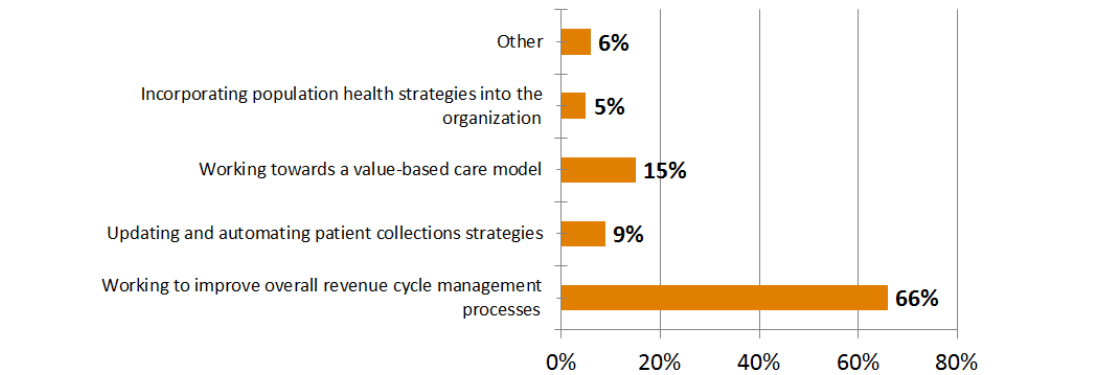
Providers to Focus on Improving RCM in 2016
Source: Navicure Healthcare Organizations Post ICD-10 Implementation Survey

With the ICD-10 transition in our rearview, 66% of providers plan to focus on improving their overall revenue cycle management processes in 2016, according to the post-ICD-10 implementation survey from Navicure. Fifteen percent indicated they would be working towards a value-based care model while another nine percent are updating and automating patient collections strategies. Navicure and Porter Research deployed the survey in December 2015 as the final wave of a research study designed to trend attitudes and behavior regarding the ICD-10 transition.

The survey found healthcare organizations have seen minimal or no staff productivity impact in the first few months following the ICD-10 implementation. Respondents reported that only 13 percent of administrative staff and 15 percent of clinical staff saw a significant productivity impact following the transition.

Additional findings were focused on themes of readiness, challenges and successes, including:

Readiness for the ICD-10 deadline. Nearly all of respondents (99%) said they were prepared for the transition date. This is consistent with the August 2015 survey where the majority (85%) were confident they would be ready. While 42 percent of participants did not participate in end-to-end testing as part of preparation efforts, 82 percent of the organizations that participated rated it as being somewhat or extremely helpful to their successful outcome.

Impact on revenue and denial rates. The majority of participants (60%) did not see any impact on monthly revenue following October 1, 2015, and 34 percent have seen revenue decrease by up to 20 percent. Denial rates remained the same for 45 percent of respondents, with nominal increases between 1 and 10 percent for 44 percent of the participants. Eleven percent of participants reported increases between 11 and 40 percent. This compared favorably to prior survey results where 61 percent of respondents expected denial rates to increase by 11 to 40 percent.

Impact on Productivity. Only 13 percent of administrative staff and 15 percent of clinical staff saw significant productivity impact following the ICD-10 transition. An additional 46 percent of administrative staff and 42 percent of clinical staff didn’t see much of a productivity impact and still haven’t. The remaining 43 percent of clinical staff and 41 percent of administrative staff experienced a minor impact or didn’t know.

Survey Background/Methodology

In December 2015, Navicure commissioned Porter Research to conduct a national survey of healthcare organizations to gauge ICD-10’s impact on their organization. This was a follow up to four ICD-10 preparation surveys conducted in 2013 and 2015. The survey focused on ICD-10 readiness and impact following the October 1, 2015, transition. Some questions were identical to previous surveys while others were unique to this survey. Responses to all questions were self-reported.

The majority of the 360 survey participants were practice administrators or billing managers (59%), followed by practice executives (17%) and billers and coders (16%). Survey respondents represented a broad range of specialties and sizes, with the majority (60%) coming from organizations with one to 10 providers.

  • LinkedIn
  • Twitter
  • Facebook
  • Email
  • Print

Tagged With: revenue cycle, revenue cycle management systems

Tap Native

Get in-depth healthcare technology analysis and commentary delivered straight to your email weekly

Reader Interactions

Primary Sidebar

Subscribe to HIT Consultant

Latest insightful articles delivered straight to your inbox weekly.

Submit a Tip or Pitch

2026 Predictions & Trends

Healthcare 2026 Forecast: Executives on AI Survival, Financial Reckoning, and the End of Point Solutions

2026 Healthcare Executive Predictions: Why the AI “Pilot Era” Is Officially Over

Most-Read

NYC Health + Hospitals to Acquire Maimonides in $2.2B Safety Net Overhaul

NYC Health + Hospitals to Acquire Maimonides in $2.2B Safety Net Overhaul

KLAS Report: Why Hospitals Are Choosing Efficiency Over 'Agentic' AI Hype in 2025

KLAS Report: Why Hospitals Are Choosing Efficiency Over ‘Agentic’ AI Hype in 2025

Advanced Primary Care 2026: Top 6 Investments for Health Systems According to Harvard Medical School

Advanced Primary Care 2026: Top 6 Investments for Health Systems According to Harvard Medical School

AI Nutrition Labels: The Key to Provider Adoption and Patient Trust?

AI Nutrition Labels: The Key to Provider Adoption and Patient Trust?

Kristen Hartsell, VP of Clinical Services, RedSail Technologies

The Pharmacy Closures Crisis: How Independent Pharmacies Are Fixing Pharmacy Deserts

HHS Launches 'OneHHS' AI Strategy to Integrate AI Across CDC, CMS, and FDA for Efficiency and Public Trust

HHS Launches ‘OneHHS’ AI Strategy to Integrate AI Across CDC, CMS, and FDA for Efficiency and Public Trust

From Overwhelmed to Optimized: How AI Agents Address Staffing Challenges and Burnout in Healthcare

From Overwhelmed to Optimized: How AI Agents Address Staffing Challenges and Burnout in Healthcare

The VBC Paradox: Why Hospitals Are Doubling Down on Value-Based Care While Revenue at Risk Lags

The VBC Paradox: Why Hospitals Are Doubling Down on Value-Based Care While Revenue at Risk Lags

Tebra Secures $250M to Challenge Legacy EHRs with AI-Powered Automation

Tebra Secures $250M to Challenge Legacy EHRs with AI-Powered Automation

AstraZeneca Selects Salesforce Agentforce Life Sciences to Deploy AI-Powered Global Customer Engagement

AstraZeneca Selects Salesforce Agentforce Life Sciences to Deploy AI-Powered Global Customer Engagement

Secondary Sidebar

Footer

Company

  • About Us
  • Advertise with Us
  • Reprints and Permissions
  • Op-Ed Submission Guidelines
  • Contact
  • Subscribe

Editorial Coverage

  • Opinion
  • Health IT
    • Care Coordination
    • EMR/EHR
    • Interoperability
    • Population Health Management
    • Revenue Cycle Management
  • Digital Health
    • Artificial Intelligence
    • Blockchain Tech
    • Precision Medicine
    • Telehealth
    • Wearables
  • Startups
  • Value-Based Care
    • Accountable Care
    • Medicare Advantage

Connect

Subscribe to HIT Consultant Media

Latest insightful articles delivered straight to your inbox weekly

Copyright © 2025. HIT Consultant Media. All Rights Reserved. Privacy Policy |