
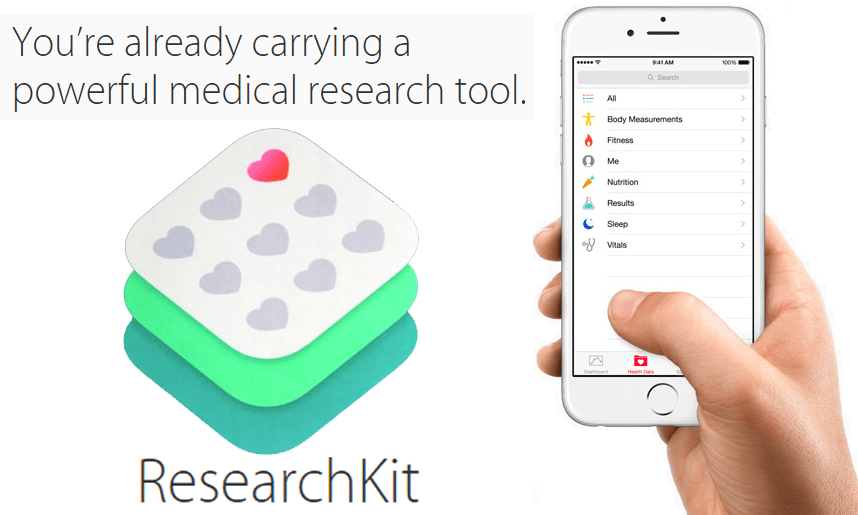
Most medical studies are lucky to have a few hundred people interested in participating. But imagine being able to tap into an enormous pool of Apple users: Out of the millions who use Apple phones and watches, if even a few thousand showed interest in a medical study, that could make a significant difference in outcomes and how quickly a particular study yields results.
That’s one of the most promising points of the Apple ResearchKit. The ResearchKit is an open-source tool designed to allow healthcare researchers to develop their own apps to facilitate research studies. Many researchers have already jumped at the opportunities afforded by the tool: a team at Johns Hopkins University created EpiWatch, an app that can potentially alert users to imminent epileptic seizures. Oregon Health and Science University is working on a melanoma app that can screen users for skin cancer. Duke University is getting into the game with the Autism & Beyond app, which films children as they watch videos on their phone with the hope of one day finding patterns in their reactions that might help alert parents to the possibility of autism or related problems.
But before a researcher dives into Apple ResearchKit, it is important to recognize where it might be truly helpful. According to Julliette Ehlert, technical architect at Cambridge-based digital health consulting firm Medullan, there are three key things that every healthcare researcher should know before using ResearchKit.
1. Its Greatest Strength is Recruiting
Researchers can reach out to massive numbers of people in the span of just a few weeks on a very easy-to-use platform. “Apple ResearchKit comes with a pre-built audience by already being an Apple product,” Ehlert said. “Many consumers are avid Apple supporters, so having ResearchKit integrated within the Apple ecosystem opens up opportunities to recruit participants quickly. Traditionally, these studies would take months or years to recruit potential participants.”
One of the biggest hurdles researchers face when conducing a medical study is getting consent; this job is made much easier with an app. “With their consent, data can be automatically collected as people go about their day,” Ehlert said. “So it’s easier to participate, and results are more objective and precise. With a user’s consent, ResearchKit can seamlessly tap into the pool of useful data generated by HealthKit — like daily step counts, calorie use, and heart rates — making it accessible to medical researchers.”
Users can tailor their own consent, which might make them more likely to use the app as it was intended. They can choose what level of data they want to apply, and they can change those permissions with a few simple taps. That extra level of control makes users feel more connected, and thus makes them more likely to stick with the app once they start the process.
2. Working with the Data can be Tricky
But what happens to all that data?
“While ResearchKit allows researchers to collect all this data easily for research, it doesn’t store, secure, de-identify or analyze that data in a HIPAA-compliant manner,” Ehlert warned. “Researchers will find themselves needing to separate the useful data from the noise if they want to efficiently gather useful insights.”
The freedom to collect so much data comes with the downside of ‘cleaning’ that data in order to remove ways to identify patients, as well as figuring out how to send and store that data securely. In addition to working through complex amounts of data, researchers are still held to the standard of ensuring that they are not harming the individuals with the study – a standard that can be tough to meet when the data is being collected through a hands-off app.
3. It Doesn’t Go Far Enough for Patient Engagement
In order to get the most out of any app, patients must stay engaged. They must be willing to use the app on a regular basis, of their own accord, and enter all the information as prompted. However patient engagement has historically been a key problem for any sort of patient-driven study.
There is also the problem of a smaller demographic profile than most medical apps will need. Ehlert pointed out that Apple users tend to fit a specific demographic profile: wealthier and white. This makes it tough for those who want to do research on a high volume of specific populations, such as those with low income, or those who are Hispanic or African American.
Researchers also have to be very careful not to fall into the trap of writing apps only for the iPhone. As CNN Money pointed out, studies could be dramatically skewed if they focus only on the segment of the population who is wealthy enough to afford the latest iPhone or iWatch.
4 Best Practices for ResearchKit
Apple ResearchKit offers an exciting new way for researchers to create faster, more comprehensive medical studies. But Ehlert cautions that researchers should do a little preparation before diving in. Here’s what might help:
1. Take your time. Though it can be exciting to get an app up and running, longevity requires building that app appropriately and getting the security in place. Make sure there are no bugs. “Treat it as something you want to make money off of. Treat it with that level of respect and gravitas.”
2. Test, test, test. Testing is never done. One of the most important parts is to look at the user experience: Does it make sense? “Gather feedback for incorporating it back into the app,” Ehlert said. “Make sure you are doing it right before publishing to the market.”
3. Understand it. “You’re collecting the data and getting feedback. Understand how the app itself is being used. Determine the roadblocks. Where are you getting behaviors you are not expecting?” Understanding how the app is being used can help you adjust the current one, make tweaks when you create a new one, and increase engagement and enhance user experience.
4. Utilize Gamification or Rewards. Want to get users truly engaged? Give them something to get excited about. Offer timely and relevant notifications and reminders, and tap into the person’s typical behavior. “For example, we notice you are sitting down, maybe you stand up and exercise,” Ehlert said. Creating an air of friendly competition is also a great way to get attention. “They have no sense of where they stand amongst others. Be patient and see that comparison in the study and provide that feedback data.”
Apple ResearchKit has Room to Grow
ResearchKit is only in its first stages; imagine where it will go when it has some time to grow. “ResearchKit is a living thing,” Ehlert said. “It is growing more robust as time goes on. Its evolving. People are contributing today. So what’s there today, such as certain limitations, may not be there in the future as it further evolves.”
