
• Skip to main content
  • Skip to secondary menu
  • Skip to primary sidebar
  • Skip to secondary sidebar
  • Skip to footer

  • Opinion
  • Health IT
    • Behavioral Health
    • Care Coordination
    • EMR/EHR
    • Interoperability
    • Patient Engagement
    • Population Health Management
    • Revenue Cycle Management
    • Social Determinants of Health
  • Digital Health
    • AI
    • Blockchain
    • Precision Medicine
    • Telehealth
    • Wearables
  • Life Sciences
  • Investments
  • M&A
  • Value-based Care
    • Accountable Care (ACOs)
    • Medicare Advantage

Stanford Engineers Test Tricorder-Like Detector for Tumors

by Fred Pennic 11/11/2015 Leave a Comment

  • LinkedIn
  • Twitter
  • Facebook
  • Email
  • Print

Stanford Engineers Test Tricorder-Like Detector

Science fiction such as Star Trek popularized the tricorder, a handheld detector that can gather readings from the environment or even diagnose disease. Today, Stanford engineers is currently testing a tricorder device that might be able to spot fast-growing tumors detailed in Applied Physics Letters and presented at the International Ultrasonics Symposium in Taipei, Taiwan. The new touchless ultrasound technology could possibly provide a new way to detect early stage cancers in the future. 

How It Works

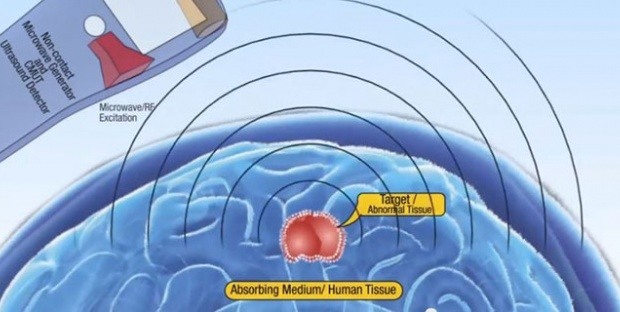
The work, led by Assistant Professor Amin Arbabian and Research Professor Pierre Khuri-Yakub, combines mild microwaves with sensitive ultrasound to create a safe and portable way detect hidden objects. All materials expand and contract when stimulated with electromagnetic energy, such as light or microwaves. 

As a result of this contraction, ultrasound waves are produced that travels to the surface and can be detected remotely.Medical research has shown that tumors grow additional blood vessels to nourish their cancerous growth. Blood vessels absorb heat differently than surrounding tissue allowing tumors to potentially show up as ultrasound hotspots. 

“We think we could develop instrumentation sufficiently sensitive to disclose the presence of tumors, and perhaps other health anomalies, much earlier than current detection systems, non-intrusively and with a handheld portable device,” Arbabian told Stanford News.

Stanford researchers also believe that their microwave and ultrasound detection system will be have greater mobility and less expensive than other medical imaging devices such as MRI or CT, and safer than X-rays.

  • LinkedIn
  • Twitter
  • Facebook
  • Email
  • Print

Tap Native

Get in-depth healthcare technology analysis and commentary delivered straight to your email weekly

Reader Interactions

Primary Sidebar

Subscribe to HIT Consultant

Latest insightful articles delivered straight to your inbox weekly.

Submit a Tip or Pitch

Featured Insights

Aligning IT & Clinical Teams: How to Reduce Friction and Improve Communication

Most-Read

KLAS 2026 EHR Market Share Report: Epic Gains as Oracle Health Faces Third Year of Losses

KLAS 2026 EHR Market Share Report: Epic Gains as Oracle Health Faces Third Year of Losses

Aidoc Secures $150M to Accelerate Enterprise-Scale Clinical AI Across 2,000 Hospitals

OpenAI Launches ChatGPT for Clinicians: Free AI Documentation and Research Tool for Verified Physicians

OpenAI Launches ChatGPT for Clinicians: Free AI Documentation and Research Tool for Verified Physicians

IKS Health Acquires TruBridge for Rural EHR and RCM Solutions Expansion

IKS Health Acquires TruBridge for Rural EHR and RCM Solutions Expansion

UT Austin is Building the Nation's First 'AI-Native' Hospital, Backed by $750M

Why UT Austin is Building an ‘AI-Native’ Hospital from Scratch

The Medtech Pitch Deck Casino: Why Hype Still Wins, and How Scrutiny Could Improve Everyone’s Odds

The Casino Model: Why Medtech VCs Are Betting Billions on Unproven AI

Oracle Lays Off 539 Kansas City Employees as Focus Shifts to AI Data Centers

Oracle Lays Off 539 Kansas City Employees as Focus Shifts to AI Data Centers

SAMHSA and ONC Invest $20M in Behavioral Health IT Initiative

HHS Reverses 2024 Tech Reorganization: Why HHS Just Stripped AI and Cyber Operations Out of the ONC

How Small Medical Practices Can Build HIPAA-Aligned DevSecOps Without Enterprise Budgets

How Small Medical Practices Can Build HIPAA-Aligned DevSecOps Without Enterprise Budgets

Insilico Medicine and Eli Lilly Form $2.75B AI Drug Discovery Collaboration

Insilico Medicine and Eli Lilly Form $2.75B AI Drug Discovery Collaboration

Secondary Sidebar

Footer

Company

  • About Us
  • 2026 Editorial Calendar
  • Advertise with Us
  • Reprints and Permissions
  • Op-Ed Submission Guidelines
  • Contact
  • Subscribe

Editorial Coverage

  • Opinion
  • Health IT
    • Care Coordination
    • EMR/EHR
    • Interoperability
    • Population Health Management
    • Revenue Cycle Management
  • Digital Health
    • Artificial Intelligence
    • Blockchain Tech
    • Precision Medicine
    • Telehealth
    • Wearables
  • Startups
  • Value-Based Care
    • Accountable Care
    • Medicare Advantage

Connect

Subscribe to HIT Consultant Media

Latest insightful articles delivered straight to your inbox weekly

Copyright © 2026. HIT Consultant Media. All Rights Reserved. Privacy Policy |