
• Skip to main content
  • Skip to secondary menu
  • Skip to primary sidebar
  • Skip to secondary sidebar
  • Skip to footer

  • Opinion
  • Health IT
    • Behavioral Health
    • Care Coordination
    • EMR/EHR
    • Interoperability
    • Patient Engagement
    • Population Health Management
    • Revenue Cycle Management
    • Social Determinants of Health
  • Digital Health
    • AI
    • Blockchain
    • Precision Medicine
    • Telehealth
    • Wearables
  • Life Sciences
  • Investments
  • M&A
  • Value-based Care
    • Accountable Care (ACOs)
    • Medicare Advantage

GHX Unveils 2 Healthcare Supply Chain Savings Calculators

by Fred Pennic 08/11/2015 Leave a Comment

  • LinkedIn
  • Twitter
  • Facebook
  • Email
  • Print

GHX Launches New Healthcare Supply Chain Savings Calculators

Providers and suppliers continue to look at the supply chain as the cornerstone for transforming their operations. One of their ongoing challenges in this area, however, is having the ability to fully understand the long- and short-terms risks and cost savings associated with those investments. 

Healthcare supply leader, GHX has launched two new healthcare supply chain savings tickers that track actual and potential savings available to healthcare providers and suppliers. The new tickers are based on the recently announced GHX value calculation methodology, which includes more than 70 individual calculations and industry averages, evaluated by Forrester Consulting and conforming to its rigorous Total Economic ImpactTM (TEI) methodology. The two GHX healthcare savings tickers are available on the company’s website.

The new savings tickers are one of the first outcomes of the Forrester Consulting TEI™ Compliance Review. GHX commissioned the compliance review to help ensure that its ROI calculations meet the standards of Forrester’s rigorous cost and benefit analysis framework. The new calculation tickers provide a daily update on the savings being achieved by GHX solutions throughout the industry and the additional savings that can be achieved with greater supply chain automation.

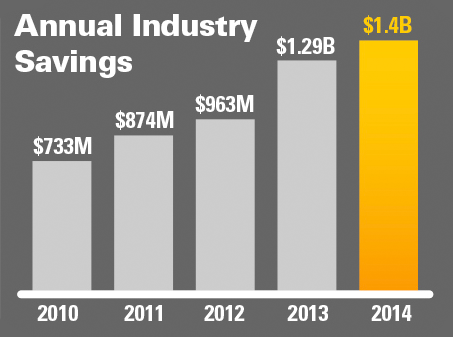
“GHX customers are currently delivering well over $1 billion in savings annually to healthcare,” said Bruce Johnson, President and CEO, GHX. “We started tracking the savings our customers were delivering to their organizations and the industry back in 2010. Since then, we’ve tracked more than $6 billion in savings that can be put toward quality patient care instead of waste in business processes. But what our new tickers expose is how big the unrealized savings opportunity is – $2.8 billion per year. While the challenges facing healthcare are significant, there remains a tremendous opportunity to deliver even greater efficiency that can result in significant measureable savings.”

GHX Healthcare Supply Chain Calculator Overview

This unrealized savings number is also based on the GHX value calculation methodology evaluated by Forrester Consulting. GHX conservatively calculated the potential savings with two “what if” assumptions: What if GHX customers (1) were using the full suite of GHX integrated solutions, and (2) were employing those solutions at average – not even best-in-class – rates of utilization based on how existing GHX customers with those solutions are currently using them.

Supply chain efficiency measured by the new GHX ticker comes from:

– Transaction automation: savings accumulate as a greater percentage of supply chain transactions are conducted electronically thru EDI (Electronic Data Interchange) as opposed to manual, paper-based processes.

– Trading partner network: the higher the number of electronic trading partners, the greater the savings.

– Accurate transactional data: discrepancies and exceptions that arise from inaccurate pricing, catalog and contract data have a detrimental ripple effect across the supply chain. Minimizing and eliminating exceptions can drive substantial savings and yield visibility to key data for better decision making in a value-based environment.

– On-contract spend: confirming that negotiated contact pricing is actually reflected and propagated throughout transaction workflow is essential to driving supply chain value.

  • LinkedIn
  • Twitter
  • Facebook
  • Email
  • Print

Tagged With: Healthcare Supply Chain, Hospital Supply Chain

Tap Native

Get in-depth healthcare technology analysis and commentary delivered straight to your email weekly

Reader Interactions

Primary Sidebar

Subscribe to HIT Consultant

Latest insightful articles delivered straight to your inbox weekly.

Submit a Tip or Pitch

2026 Predictions & Trends

Healthcare 2026 Forecast: Executives on AI Survival, Financial Reckoning, and the End of Point Solutions

2026 Healthcare Executive Predictions: Why the AI “Pilot Era” Is Officially Over

Most-Read

NYC Health + Hospitals to Acquire Maimonides in $2.2B Safety Net Overhaul

NYC Health + Hospitals to Acquire Maimonides in $2.2B Safety Net Overhaul

KLAS Report: Why Hospitals Are Choosing Efficiency Over 'Agentic' AI Hype in 2025

KLAS Report: Why Hospitals Are Choosing Efficiency Over ‘Agentic’ AI Hype in 2025

Advanced Primary Care 2026: Top 6 Investments for Health Systems According to Harvard Medical School

Advanced Primary Care 2026: Top 6 Investments for Health Systems According to Harvard Medical School

AI Nutrition Labels: The Key to Provider Adoption and Patient Trust?

AI Nutrition Labels: The Key to Provider Adoption and Patient Trust?

Kristen Hartsell, VP of Clinical Services, RedSail Technologies

The Pharmacy Closures Crisis: How Independent Pharmacies Are Fixing Pharmacy Deserts

HHS Launches 'OneHHS' AI Strategy to Integrate AI Across CDC, CMS, and FDA for Efficiency and Public Trust

HHS Launches ‘OneHHS’ AI Strategy to Integrate AI Across CDC, CMS, and FDA for Efficiency and Public Trust

From Overwhelmed to Optimized: How AI Agents Address Staffing Challenges and Burnout in Healthcare

From Overwhelmed to Optimized: How AI Agents Address Staffing Challenges and Burnout in Healthcare

The VBC Paradox: Why Hospitals Are Doubling Down on Value-Based Care While Revenue at Risk Lags

The VBC Paradox: Why Hospitals Are Doubling Down on Value-Based Care While Revenue at Risk Lags

Tebra Secures $250M to Challenge Legacy EHRs with AI-Powered Automation

Tebra Secures $250M to Challenge Legacy EHRs with AI-Powered Automation

AstraZeneca Selects Salesforce Agentforce Life Sciences to Deploy AI-Powered Global Customer Engagement

AstraZeneca Selects Salesforce Agentforce Life Sciences to Deploy AI-Powered Global Customer Engagement

Secondary Sidebar

Footer

Company

  • About Us
  • Advertise with Us
  • Reprints and Permissions
  • Op-Ed Submission Guidelines
  • Contact
  • Subscribe

Editorial Coverage

  • Opinion
  • Health IT
    • Care Coordination
    • EMR/EHR
    • Interoperability
    • Population Health Management
    • Revenue Cycle Management
  • Digital Health
    • Artificial Intelligence
    • Blockchain Tech
    • Precision Medicine
    • Telehealth
    • Wearables
  • Startups
  • Value-Based Care
    • Accountable Care
    • Medicare Advantage

Connect

Subscribe to HIT Consultant Media

Latest insightful articles delivered straight to your inbox weekly

Copyright © 2026. HIT Consultant Media. All Rights Reserved. Privacy Policy |