
• Skip to main content
  • Skip to secondary menu
  • Skip to primary sidebar
  • Skip to secondary sidebar
  • Skip to footer

  • Opinion
  • Health IT
    • Behavioral Health
    • Care Coordination
    • EMR/EHR
    • Interoperability
    • Patient Engagement
    • Population Health Management
    • Revenue Cycle Management
    • Social Determinants of Health
  • Digital Health
    • AI
    • Blockchain
    • Precision Medicine
    • Telehealth
    • Wearables
  • Life Sciences
  • Investments
  • M&A
  • Value-based Care
    • Accountable Care (ACOs)
    • Medicare Advantage

Patient Centered Medical Homes Are The Foundation of Successful ACOs

by Fred Pennic 01/17/2014 Leave a Comment

  • LinkedIn
  • Twitter
  • Facebook
  • Email
  • Print

The Patient Centered Medical Home model studies continue to show positive improvements in impacting cost, quality and population health, according to PCPCC’s (Patient-Centered Primary Care Collaborative) annual report.  The annual report, The Patient-Centered Medical Home’s Impact on Cost & Quality: An Annual Update of the Evidence, 2012-2013 highlights recently published clinical, quality, and financial outcomes of patient centered medical home (PCMH) initiatives from across the United States.

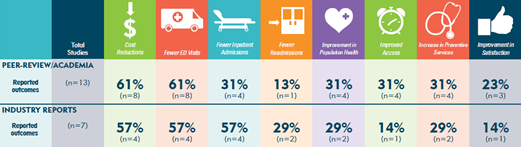
Report findings show that the PCMH model is having a significant impact on reducing costs of care, unnecessary emergency department (ED) and hospital visits, as well as increasing the provision of preventive services and improving population health. 60 percent of the PCMH evaluations reported decreases in cost of care or use of unnecessary / avoidable services, while approximately 30% reported improvements in population health. A gap still exists in reporting impact on clinician satisfaction.
Patient Centered Medical Homes Are The Core of Successful ACOs

PCMH = Foundation of High Performing ACOs

The PCMH model continues to play a role in strengthening the larger health care system, specifically Accountable Care Organizations and the emerging medical neighborhood model. The report acknowledges PCMHs must be part of a larger delivery system reform and integration efforts to successfully improve population health, cost effectiveness and better patient experience.

Currently, high performing ACOs have embraced PCMHs as a key component and as a result are well-positioned to lead and drive change across ACOs. Additionally, significant payment reforms are incorporating the PCMH model and its key attributes.

Background

Supported by the Milbank Memorial Fund, the report analyzed quantitative outcomes across 20 medical home evaluations from August 2012-2013, including thirteen peer-review and seven industry-generated evaluations

Although the evidence is early from an academic perspective, and the report does not represent a formal peer-reviewed meta-analysis of the literature, the expanding body of research provided here suggests that when fully transformed primary care practices have embraced the PCMH model of care, we find a number of consistent, positive outcomes.

To view/download the executive summary and annual report, visit http://www.pcpcc.org/resource/medical-homes-impact-cost-quality

  • LinkedIn
  • Twitter
  • Facebook
  • Email
  • Print

Tap Native

Get in-depth healthcare technology analysis and commentary delivered straight to your email weekly

Reader Interactions

Primary Sidebar

Subscribe to HIT Consultant

Latest insightful articles delivered straight to your inbox weekly.

Submit a Tip or Pitch

Featured Insights

Aligning IT & Clinical Teams: How to Reduce Friction and Improve Communication

Most-Read

M&A: Tempus AI to Acquire Personalis for $1.5B to Expand Precision Oncology and MRD Monitoring

M&A: Tempus AI to Acquire Personalis for $1.5B to Expand Precision Oncology and MRD Monitoring

Why Brain Health Is Entering Its Infrastructure Era

Brain Health’s Infrastructure Era: Proving Clinical Outcomes with Integrated Neuromotor Tracking

Why Catholic Health Inked a $500M Care Alliance with GE HealthCare to Automate Outpatient Triage

Catholic Health Inks $500M Care Alliance with GE HealthCare to Automate Outpatient Triage

KLAS Global HIT Trends 2026 Report: Artificial Intelligence Becomes the Top Investment Priority

KLAS Global HIT Trends 2026 Report: Artificial Intelligence Becomes the Top Investment Priority

Optum Partners with Anthropic to Deploy Claude Across Healthcare Claims and Revenue Workflows

Optum Partners with Anthropic to Deploy Claude Across Healthcare Claims and Revenue Workflows

Rock Health H1 2026 Digital Health Funding Recap: Startups Hit $7.4B in Venture Rebound

Rock Health H1 2026 Digital Health Funding Recap: Startups Hit $7.4B in Venture Rebound

M&A: ResMed to Sell MatrixCare Business to Frazier Healthcare Partners for $450M

M&A: ResMed to Sell MatrixCare Business to Frazier Healthcare Partners for $450M

The Real Risk in Healthcare AI Isn’t the Model. It’s the Data. 

Clinical Data Fidelity: The Real Blindspot in Healthcare AI Strategy

KLAS 2026 EHR Market Share Report: Epic Gains as Oracle Health Faces Third Year of Losses

KLAS 2026 EHR Market Share Report: Epic Gains as Oracle Health Faces Third Year of Losses

Qualtrics Acquires Press Ganey Forsta for $6.75B to Create the Most Comprehensive AI Experience Platform

M&A: Qualtrics Completes $6.75B Acquisition of Press Ganey Forsta

Secondary Sidebar

Footer

Company

  • About Us
  • 2026 Editorial Calendar
  • Advertise with Us
  • Reprints and Permissions
  • Op-Ed Submission Guidelines
  • Contact
  • Subscribe

Editorial Coverage

  • Opinion
  • Health IT
    • Care Coordination
    • EMR/EHR
    • Interoperability
    • Population Health Management
    • Revenue Cycle Management
  • Digital Health
    • Artificial Intelligence
    • Blockchain Tech
    • Precision Medicine
    • Telehealth
    • Wearables
  • Startups
  • Value-Based Care
    • Accountable Care
    • Medicare Advantage

Connect

Subscribe to HIT Consultant Media

Latest insightful articles delivered straight to your inbox weekly

Copyright © 2026. HIT Consultant Media. All Rights Reserved. Privacy Policy |