
• Skip to main content
  • Skip to secondary menu
  • Skip to primary sidebar
  • Skip to secondary sidebar
  • Skip to footer

  • Opinion
  • Health IT
    • Behavioral Health
    • Care Coordination
    • EMR/EHR
    • Interoperability
    • Patient Engagement
    • Population Health Management
    • Revenue Cycle Management
    • Social Determinants of Health
  • Digital Health
    • AI
    • Blockchain
    • Precision Medicine
    • Telehealth
    • Wearables
  • Life Sciences
  • Investments
  • M&A
  • Value-based Care
    • Accountable Care (ACOs)
    • Medicare Advantage

Study: Patients Using EMRs Feel They Receive Higher Quality of Care

by Jasmine Pennic 08/05/2013 9 Comments

  • LinkedIn
  • Twitter
  • Facebook
  • Email
  • Print

Patients using EMRs feel they receive better quality of care and feel a stronger loyalty to their doctors, according to the recent EMR Patient Impact Study. The findings show that EMR users also believe they engage in clearer and more responsive communications with their physicians, and can gain access to information easier than non EMR users.

The findings come from a national consumer study by independent research firms Aeffect and 88 Brand Partners that examines the behaviors and perceptions of electronic medical record (EMR) users. Overall, an estimated 24 percent of Americans are currently using EMRs to check test results, order prescription refills, and make appointments while another 52 percent have expressed interest in using EMRs, but do not have access to them at this time for a variety of reasons.

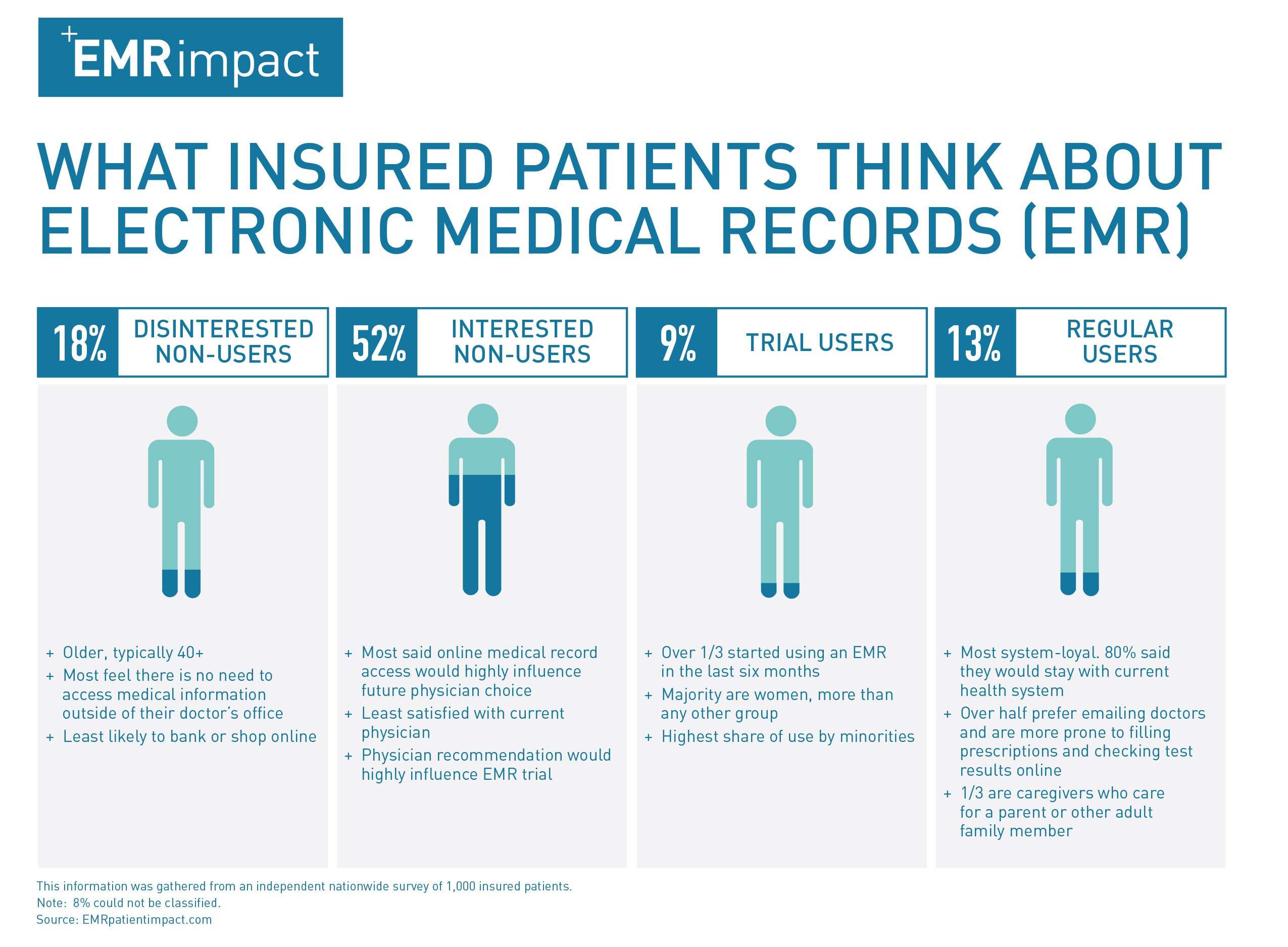
With patient access to EMRs still being relatively new to the marketplace, the study identified four segments of EMRs users shown below, ranging from the disinterested, non user to the regular user.

4 Stages of EMR Adoption
Study: Patients Using EMRs Feel They Receive Higher Quality of Care

  • Stage 1 – Disinterested Non-Users (18%) believe EMRs are no more accurate than paper files; say they don’t need their medical information outside of their doctors’ offices.
  • Stage 2 – Interested Non-Users (52%) tend to be less satisfied with their physician than any other type of user; most influenced by physicians encouragement of using EMRs.
  • Stage 3 – Trial Users (9%) have the highest share of women and non-white consumers than any other group; one-third have just recently started using EMRs within the last six months.
  • Stage 4 – Regular Users (13%) prefer emailing their doctor instead of calling or meeting in-person; one in three are caregivers to an adult family member; 67 percent say online access would be very influential in their choice of a new doctor.

Other key findings include:

  • One in three caregivers (33%) have used an EMR, either on the web or via a mobile device, compared to 21 percent of non-caregivers
  • Consumers who prefer their doctor to use an electronic chart cited numerous reasons including: access to medical records (40%); accuracy/better record keeping (18%); and coordination of care and information sharing (e.g. in case of emergency) (17%).
  • EMR utilization is higher among consumers who are younger, live in the Western part of the United States, have higher levels of education, and provide care to an adult family member. An estimated 34 percent of residents of Western states report having tried an EMR.
  • Consumers do not believe that paper charts are more secure than EMRs (28% agree). However, nearly 40 percent (39%) believe that electronic medical records are more accurate than paper charts.

Background/Methodology

Aeffect and 88 Brand Partners conducted a nationwide online survey of 1000 consumers who represent potential users of health information technology. The survey consisted of 40 questions on topics related to use of electronic medical records (EMRs). To qualify for participation, respondents were required to have some type of health insurance, have seen a physician within the past three years, and have a regular doctor. Employment screens were in place to exclude individuals who work in IT/web development, marketing or advertising, or healthcare.

For a full copy of the report, visit www.EMRPatientImpact.com

Featured image credit: Yann Ropars via cc

  • LinkedIn
  • Twitter
  • Facebook
  • Email
  • Print

Tap Native

Get in-depth healthcare technology analysis and commentary delivered straight to your email weekly

Reader Interactions

Primary Sidebar

Subscribe to HIT Consultant

Latest insightful articles delivered straight to your inbox weekly.

Submit a Tip or Pitch

2026 Predictions & Trends

Healthcare 2026 Forecast: Executives on AI Survival, Financial Reckoning, and the End of Point Solutions

2026 Healthcare Executive Predictions: Why the AI “Pilot Era” Is Officially Over

Most-Read

HHS Launches 'OneHHS' AI Strategy to Integrate AI Across CDC, CMS, and FDA for Efficiency and Public Trust

HHS Launches ‘OneHHS’ AI Strategy to Integrate AI Across CDC, CMS, and FDA for Efficiency and Public Trust

Kristen Hartsell, VP of Clinical Services, RedSail Technologies

The Pharmacy Closures Crisis: How Independent Pharmacies Are Fixing Pharmacy Deserts

From Overwhelmed to Optimized: How AI Agents Address Staffing Challenges and Burnout in Healthcare

From Overwhelmed to Optimized: How AI Agents Address Staffing Challenges and Burnout in Healthcare

The VBC Paradox: Why Hospitals Are Doubling Down on Value-Based Care While Revenue at Risk Lags

The VBC Paradox: Why Hospitals Are Doubling Down on Value-Based Care While Revenue at Risk Lags

Tebra Secures $250M to Challenge Legacy EHRs with AI-Powered Automation

Tebra Secures $250M to Challenge Legacy EHRs with AI-Powered Automation

AstraZeneca Selects Salesforce Agentforce Life Sciences to Deploy AI-Powered Global Customer Engagement

AstraZeneca Selects Salesforce Agentforce Life Sciences to Deploy AI-Powered Global Customer Engagement

Aidoc Partners with NVIDIA MONAI to Scale Open-Source Clinical AI

Aidoc Partners with NVIDIA MONAI to Scale Open-Source Clinical AI

RapidAI Secures FDA Clearance for Five New Deep Clinical AI Modules, Expanding Enterprise Imaging Platform

RapidAI and AWS Deepen Partnership to Scale Clinical AI in Healthcare

Greece and Sword Health to Build AI-Powered Healthcare Front Door

Greece and Sword Health to Build AI-Powered Healthcare Front Door

GE HealthCare Acquires Intelerad for $2.3B to Create Cloud-First, AI-Enabled Imaging Ecosystem

GE HealthCare Acquires Intelerad for $2.3B to Create Cloud-First, AI-Enabled Imaging Ecosystem

Secondary Sidebar

Footer

Company

  • About Us
  • Advertise with Us
  • Reprints and Permissions
  • Op-Ed Submission Guidelines
  • Contact
  • Subscribe

Editorial Coverage

  • Opinion
  • Health IT
    • Care Coordination
    • EMR/EHR
    • Interoperability
    • Population Health Management
    • Revenue Cycle Management
  • Digital Health
    • Artificial Intelligence
    • Blockchain Tech
    • Precision Medicine
    • Telehealth
    • Wearables
  • Startups
  • Value-Based Care
    • Accountable Care
    • Medicare Advantage

Connect

Subscribe to HIT Consultant Media

Latest insightful articles delivered straight to your inbox weekly

Copyright © 2025. HIT Consultant Media. All Rights Reserved. Privacy Policy |