

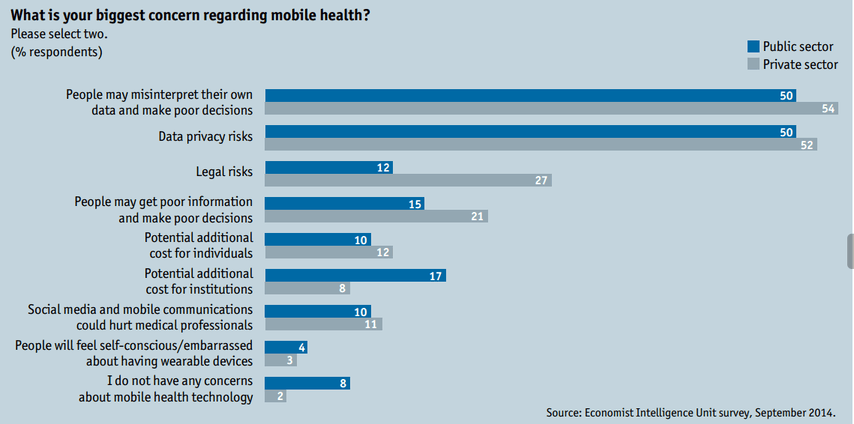
51 percent of healthcare executives find data privacy is the biggest barrier to mHealth adoption, according to a survey of 144 executives and managers in the healthcare industry in 23 countries published by The Economist Intelligence Unit (EIU).
Privacy Concerns
The report, Power to the patient: How mobile technology is transforming healthcare , sponsored by SAP, reveals the path to mHealth adoption will not be smooth. 49 percent of EIU survey respondents think consumer wariness about privacy violations could be a stumbling block for adoption, while 53 percent of executives fear that consumers may misinterpret their data and make poor decisions.
The worries are real and justified, but solutions can be found. In Ampath’s project in Kenya, “it took us five years to get to the point where we feel comfortable and we are continuously improving the security features within our applications”, says Dr. Were, chief medical information officer at Ampath in Kenya. Key steps include encrypting all data and being able to remotely wipe smartphones clean if lost or stolen.
In addition, companies worry that regulators will struggle to keep up with the fast pace of technological innovation, leading to long delays before new devices are approved. In the developing world, people tend to use pre-paid phones and switch numbers frequently, making it harder to reach them reliably by text or email.
Finding Viable Business Models
Another key barrier for mHealth adoption is finding viable business models for the new devices, services and connections. The report states the business case is strongest when the agency or organization that pays for mobile health is able to reap potential savings. This problem is most acute in U.S. fee-for-service healthcare model, where mobile health may take money out of the pockets of hospitals, doctors, lab-testing companies and pharmaceutical firms. In fact, 19% of EIU survey respondents in the U.S. saw no viable revenue stream at all. Healthcare executives identified the following possible business models:
– selling health services (cited by 41% of respondents)
– selling subscriptions to premium content and advice (38%)
– selling the data collected although potentially controversial
For example, the pharmaceutical firm AstraZeneca is helping to fund Ampath’s HIV control efforts in Kenya, for instance, in exchange for data that it can use in drug development.
Key Findings
Other key findings include:
– 64% of healthcare leaders and executives say mobile health could dramatically improve outcomes by giving people greater access to medical information
– 79% of healthcare executives say that mobile technologies are providing education and information.
– In five years, 50% predict that mobile health will enable patients to proactively participate in their own care, and lower costs.
– The main role of mobile health technologies, according to 79% of the respondents in the EIU survey, is to provide education and information.
– Many respondents fear that “consumers and/or patients are not used to the idea of tech-based health services” (54%), and that “the technologies are too complicated,” especially for the ill or elderly (44%).
– Five years from now, only 11% of respondents in the EIU survey see education as the primary role for mobile technology. Rather, they see the top three benefits as “enabling patients to participate proactively in their care” (50%), “reducing the cost of healthcare delivery” (50%) and “improving personal awareness through self-monitoring” (29%).
– 50% of the EIU survey respondents, predict that mobile health can slash spending on healthcare in the US and other developed countries.
-44% of respondents find institutional conservatism a big problem
In the future of mobile health, success will go to pioneers with the most innovative ideas, devices, services and business models.
Survey Background/Methodology
The report is based on a survey of 144 executives and managers in the healthcare industry in 23 countries. The survey tapped the opinions of those in biotechnology companies (8%), healthcare provision (41%), healthcare technology companies (10%), medical device and diagnostics provision (8%), healthcare payment (5%) and pharmaceuticals (15%). Just over a third (36%) of respondents came from public sector institutions, such as Medicare or Medicaid in the US or the NHS in the UK, while two-thirds are from the private sector (64%). Respondents were based in North America (48%), Europe (30%), Latin America (34%), and Africa (32%).
